Toronto to Raleigh
Raleigh → TorontoFTL freight transportation service between Toronto and Raleigh. Reliable logistics solutions for your business.
Route Description
Everything you need to know about the corridor Toronto - Raleigh
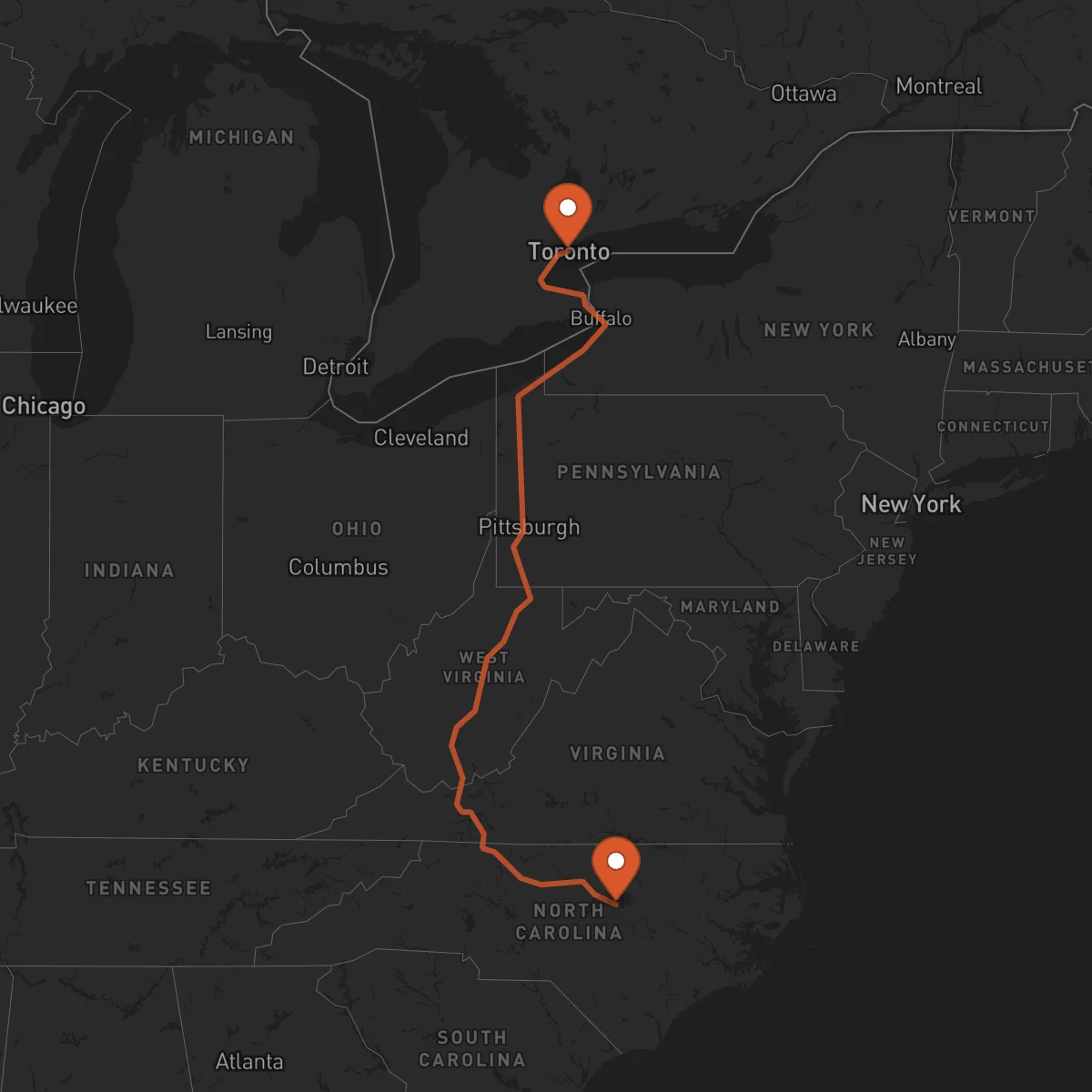
The Toronto-Raleigh corridor represents a vital trade route connecting Canada's largest economic hub with North Carolina's Research Triangle. This 878 km cross-border route facilitates the movement of high-value goods between two major North American markets, serving as a crucial link in the supply chains of numerous industries. The corridor connects Ontario's manufacturing powerhouse with North Carolina's growing technology and research sectors, creating significant opportunities for freight transportation.
The route primarily utilizes Interstate 85 and Ontario's Highway 401, offering reliable and efficient transportation infrastructure. Major border crossings at Niagara Falls and Detroit provide multiple entry points into the United States, with the Peace Bridge and Ambassador Bridge being particularly significant for commercial traffic. Control Terrestre's extensive network of certified carriers ensures seamless cross-border operations, handling all customs documentation and compliance requirements for our clients.
Key industries utilizing this corridor include automotive manufacturing, aerospace components, pharmaceuticals, and high-tech electronics. Toronto's diverse manufacturing base exports finished goods and components to Raleigh's growing industrial sector, while Raleigh supplies specialized equipment and technology products back to Canadian markets. The route also supports the movement of agricultural products, with Ontario's farming regions connecting to North Carolina's food processing facilities.
Services for this Route
Available services for the corridor Toronto - Raleigh
 Origin
Toronto stands as Canada's premier logistics hub, offering unparalleled connectivity through its strategic location on Lake Ontario. The city's extensive transportation infrastructure includes Pearson International Airport, one of North America's busiest cargo airports, and the Port of Toronto for maritime shipping. Toronto's robust highway network, centered around the 400-series highways, provides direct access to major US border crossings and national distribution centers.
 Destination
Raleigh
Raleigh serves as a strategic logistics center in North Carolina's Research Triangle, benefiting from its proximity to major ports in Norfolk and Wilmington. The city's location provides excellent access to the southeastern United States market, with multiple interstate highways converging in the region. Raleigh's growing infrastructure includes the Raleigh-Durham International Airport and expanding warehousing facilities to support the area's booming technology and research sectors.










