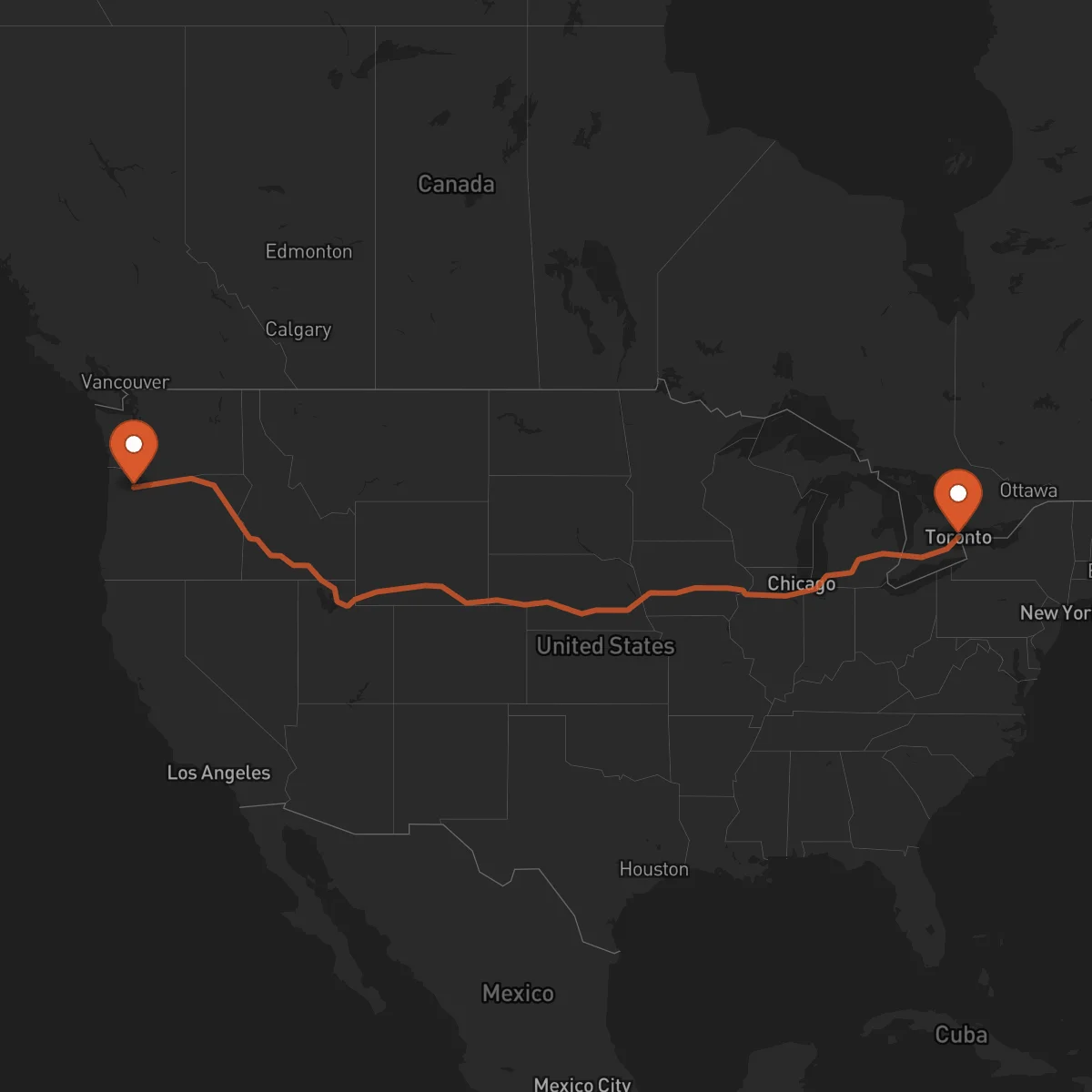
Toronto to Portland
Portland → TorontoFTL freight transportation service between Toronto and Portland. Reliable logistics solutions for your business.
Route Description
Everything you need to know about the corridor Toronto - Portland
The Toronto-Portland corridor represents a vital cross-border freight transportation route connecting the economic heart of Ontario with the Pacific Northwest's major port city. This 3,393 km journey traverses diverse terrain and crosses multiple state and provincial borders, making it a complex yet essential link in North American supply chains. The route connects Canada's largest metropolitan area with one of the United States' most strategic Pacific ports, facilitating trade between the Great Lakes industrial region and the growing West Coast markets.
This corridor serves as a critical artery for industries requiring efficient movement of goods between Canada and the Pacific Northwest. Manufacturing companies in Toronto rely on this route to access Portland's port facilities for international shipping, while technology and agricultural businesses in Oregon depend on it for receiving specialized equipment and components from Canadian suppliers. The route particularly benefits companies in the automotive, aerospace, and advanced manufacturing sectors that require reliable cross-border transportation solutions.
Major transportation infrastructure along this corridor includes the Queen Elizabeth Way and Highway 401 through Ontario, connecting to Interstate 90 and Interstate 94 across the Great Lakes region, before transitioning to Interstate 5 through Washington and Oregon. The corridor crosses at key border points including the Blue Water Bridge near Sarnia-Port Huron or the Detroit-Windsor crossing, depending on optimal routing. Control Terrestre's expertise in cross-border operations ensures seamless customs clearance and compliance with all regulatory requirements, minimizing delays and maintaining the integrity of time-sensitive shipments throughout this extensive journey.
Services for this Route
Available services for the corridor Toronto - Portland
 Origin
Toronto stands as Canada's premier logistics hub, strategically positioned in the heart of the Golden Horseshoe region. The city's location on Lake Ontario provides immediate access to water transportation, while its extensive network of highways, including the 400-series, connects to all major North American markets. Toronto's Lester B. Pearson International Airport serves as Canada's busiest air cargo facility, complementing the city's multimodal transportation capabilities. The region's robust infrastructure supports the movement of goods throughout Canada and across the border into the United States, making it an ideal origin point for cross-border freight operations.
The Greater Toronto Area hosts a diverse industrial base, with particularly strong concentrations in automotive manufacturing, aerospace, advanced technology, and financial services. The region is home to numerous Fortune 500 company headquarters and serves as a major distribution center for both domestic and international markets. Toronto's skilled workforce and proximity to major universities and research institutions create an environment conducive to innovation and high-value manufacturing, generating consistent demand for reliable freight transportation services to key U.S. markets.
 Destination
Portland
Portland's strategic location on the Columbia River provides unparalleled access to Pacific Rim markets, making it one of the most important logistics hubs on the West Coast. The Port of Portland operates multiple marine terminals capable of handling diverse cargo types, while Portland International Airport serves as a major air cargo gateway. The city's position at the intersection of Interstate 5 and Interstate 84 creates excellent ground transportation connections to both coastal and inland markets, extending reach throughout the Pacific Northwest and beyond.
The Portland metropolitan area has developed strong industrial clusters in technology, renewable energy, and sustainable manufacturing. The region is particularly noted for its footwear and apparel industry, with major global brands maintaining significant operations in the area. Portland's commitment to green technology and sustainable practices has attracted companies in the clean energy, recycling, and environmental services sectors. This diverse economic base creates consistent demand for cross-border freight services, particularly for specialized equipment, components, and finished goods requiring reliable transportation from major Canadian manufacturing centers.










