Toronto to Louisville
Louisville → TorontoFTL freight transportation service between Toronto and Louisville. Reliable logistics solutions for your business.
Route Description
Everything you need to know about the corridor Toronto - Louisville
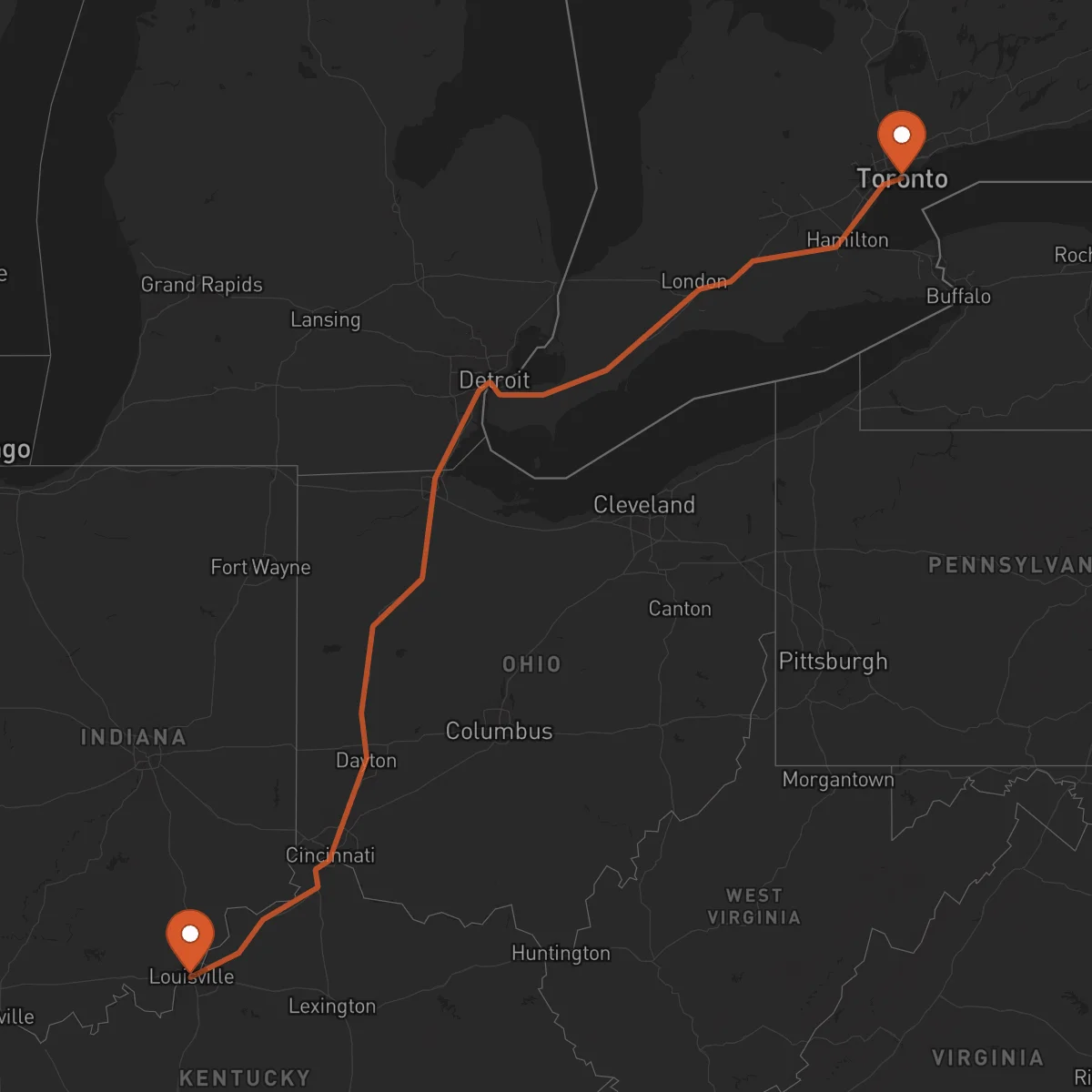
The Toronto-Louisville corridor represents a vital logistics link between Canada's largest economic hub and a key logistics center in the United States. This 805-kilometer cross-border route connects Ontario's manufacturing powerhouse with Kentucky's strategic location in the heart of the U.S., facilitating the movement of goods between two major North American markets. The corridor traverses the Great Lakes region, passing through major industrial centers and agricultural areas, making it essential for diverse cargo types.
The economic significance of this route is underscored by the strong industrial presence in both cities. Toronto serves as Canada's financial and manufacturing capital, while Louisville has established itself as a major logistics hub, home to UPS Worldport and numerous distribution centers. The corridor supports industries including automotive manufacturing, consumer goods, pharmaceuticals, and agricultural products, with significant cross-border trade between Canadian suppliers and U.S. distribution networks.
Transportation infrastructure along this corridor is robust, with the primary route utilizing Interstate 75 (I-75) in the United States and connecting highways in Ontario. The most common border crossing is the Ambassador Bridge in Windsor-Detroit, though alternative crossings like the Blue Water Bridge in Sarnia-Port Huron are also utilized depending on traffic and cargo requirements. Control Terrestre's expertise in cross-border operations ensures seamless customs clearance and compliance with both Canadian and U.S. regulations, providing reliable FTL transportation services that maintain the integrity of supply chains between these two important economic centers.
Services for this Route
Available services for the corridor Toronto - Louisville
 Origin
Toronto stands as Canada's premier logistics hub, strategically positioned on the northwestern shore of Lake Ontario. The city's extensive transportation infrastructure includes Pearson International Airport, one of North America's busiest cargo airports, and a comprehensive network of highways including the 400-series roads that connect to major U.S. border crossings. Toronto's location provides access to over 60% of the U.S. market within a day's drive, making it an ideal origin point for cross-border freight operations.
The Greater Toronto Area (GTA) is home to diverse manufacturing sectors, including automotive, aerospace, electronics, and food processing. The region's strong economic base generates substantial freight volume, with numerous warehouses, distribution centers, and industrial parks supporting just-in-time delivery requirements. Toronto's proximity to major Canadian suppliers and manufacturers, combined with its access to international ports and airports, creates a dynamic freight environment that demands reliable transportation solutions.
 Destination
Louisville
Louisville has earned its reputation as the "Gateway to the South" and a premier logistics hub in the United States. The city's strategic location provides access to over 60% of the U.S. population within a day's drive, making it an ideal destination for distribution and fulfillment operations. Louisville International Airport's UPS Worldport facility is the largest fully automated package handling facility in the world, processing over 2 million packages daily and creating substantial freight movement in the region.
The city's logistics infrastructure includes the Louisville Port Authority's inland port, extensive rail connections through CSX and Norfolk Southern, and a network of interstate highways including I-65, I-64, and I-71. Louisville's economy is anchored by logistics, healthcare, and manufacturing sectors, with major employers including Ford, GE Appliances, and numerous third-party logistics providers. The city's central location and business-friendly environment have attracted significant warehouse and distribution center development, creating consistent demand for full truckload transportation services.










