Toronto to Jackson
Jackson → TorontoFTL freight transportation service between Toronto and Jackson. Reliable logistics solutions for your business.
Route Description
Everything you need to know about the corridor Toronto - Jackson
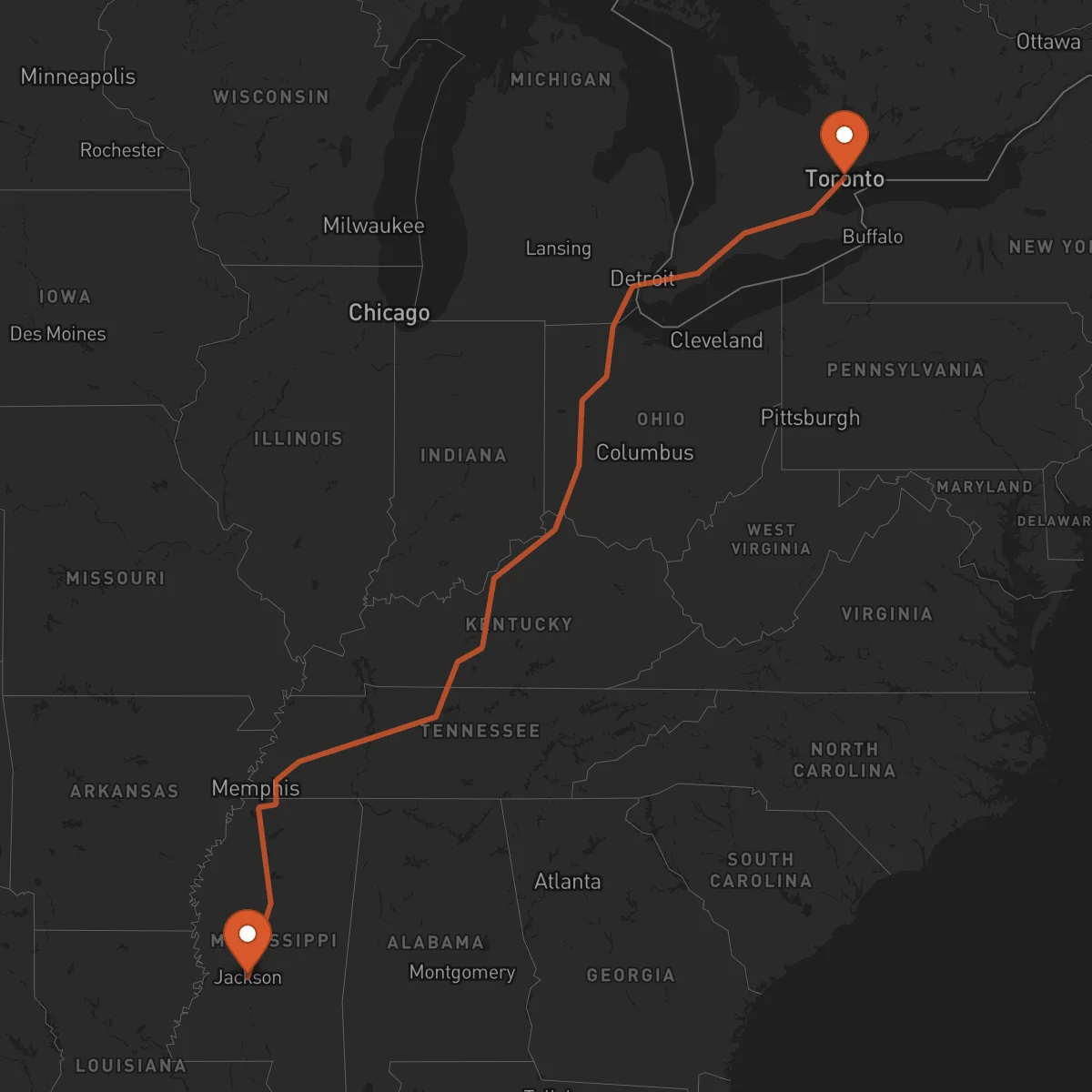
The Toronto to Jackson corridor represents a vital cross-border freight transportation route connecting Canada's economic powerhouse with the growing logistics hub of Mississippi. This 1,575 km route traverses major economic regions, facilitating the movement of goods between the Great Lakes industrial corridor and the southeastern United States. The route passes through key states including Michigan, Indiana, Kentucky, Tennessee, and Alabama before reaching Mississippi, connecting multiple industrial and distribution centers along the way.
The corridor serves critical industries including automotive manufacturing, agricultural products, industrial equipment, and consumer goods. Toronto, as Canada's financial and manufacturing capital, generates substantial freight volumes that require efficient transportation to southern markets. Jackson, strategically located in Mississippi, has developed into a significant distribution center with excellent connectivity to other southeastern states. The route primarily utilizes Interstate 75 South and Interstate 65 South, providing reliable highway infrastructure for freight movement.
Control Terrestre facilitates seamless operations on this cross-border corridor through our network of certified transportation providers. We navigate complex customs requirements between Canada and the United States, ensuring compliance with all regulatory requirements. Our expertise in cross-border logistics includes handling documentation, customs clearance, and coordination with border authorities at key crossing points. We provide dedicated FTL services that optimize transit times and ensure cargo security throughout the journey from Toronto to Jackson.
Services for this Route
Available services for the corridor Toronto - Jackson
 Origin
Toronto stands as Canada's premier logistics and economic center, strategically positioned on the northwestern shore of Lake Ontario. The city serves as a major gateway for international trade, with extensive transportation infrastructure including Pearson International Airport, the Port of Toronto, and comprehensive highway networks connecting to the U.S. border. Toronto's logistics advantages include proximity to major U.S. markets, with New York City and Chicago both within one-day driving distance.
The Greater Toronto Area hosts diverse industries including automotive manufacturing, aerospace, technology, financial services, and food processing. The region's industrial base generates substantial freight volumes requiring reliable transportation to U.S. markets. Toronto's location within the Quebec City-Windsor Corridor, Canada's most populous and industrialized region, provides access to a large consumer base and manufacturing centers. The city's transportation infrastructure includes multiple border crossings to the United States, with the Ambassador Bridge and Detroit-Windsor Tunnel providing direct highway connections to major U.S. interstates.
 Destination
Jackson
Jackson, Mississippi serves as a strategic logistics hub in the southeastern United States, offering excellent connectivity to major markets across the region. The city's location provides access to the Gulf Coast ports, Atlanta's logistics networks, and the broader southeastern consumer market. Jackson's transportation infrastructure includes Interstate 55, Interstate 20, and multiple rail connections, creating a multimodal transportation environment that facilitates efficient freight movement.
The Jackson metropolitan area supports key industries including automotive manufacturing, food processing, healthcare, and distribution. The region has attracted significant investment in logistics and distribution centers, leveraging its central southeastern location and transportation accessibility. Jackson's proximity to major southern ports and its position within the emerging southeastern logistics corridor make it an increasingly important destination for freight originating from Canadian markets. The city's growing industrial base and distribution network create consistent demand for reliable cross-border transportation services connecting with Canadian suppliers and manufacturers.










