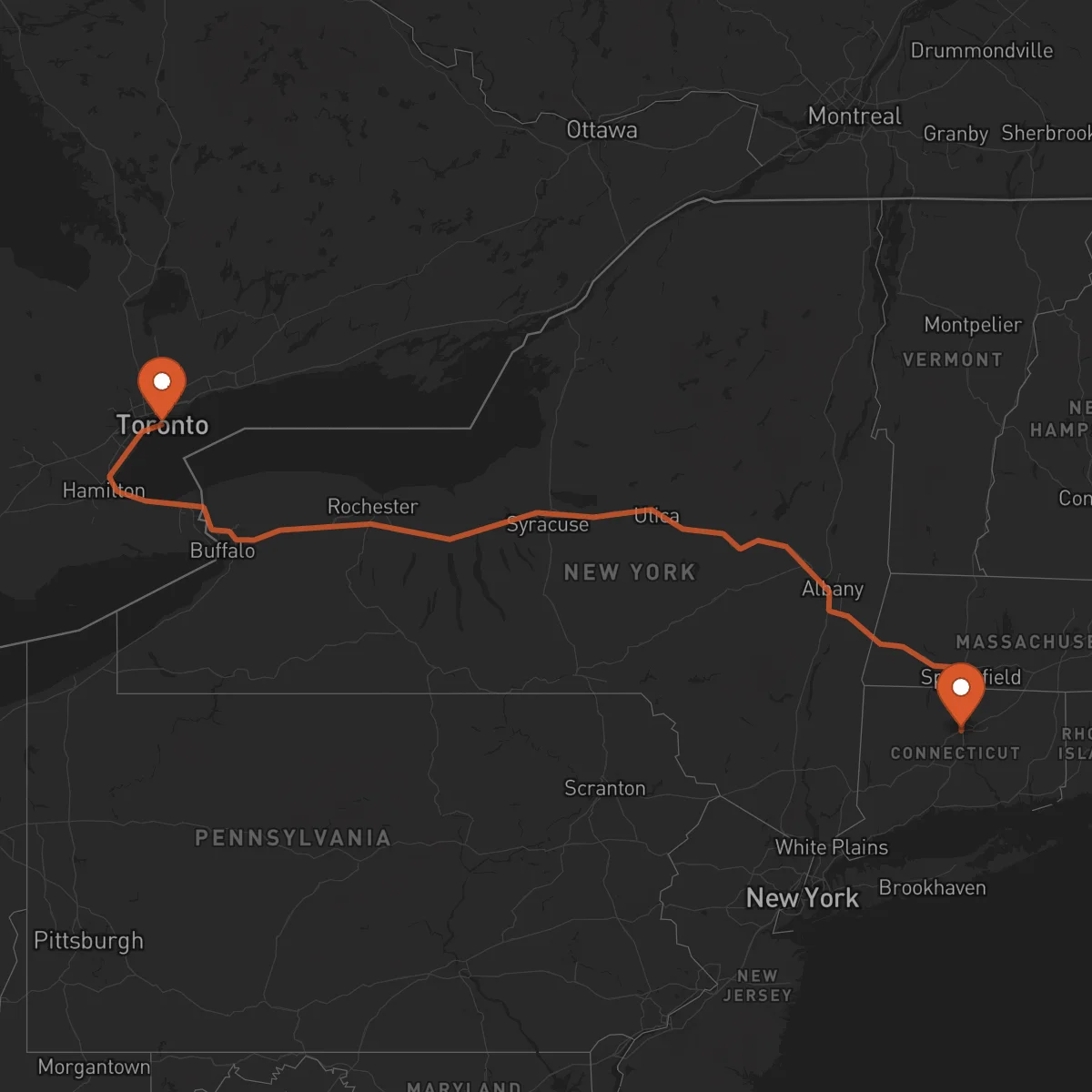
Toronto to Hartford
Hartford → TorontoFTL freight transportation service between Toronto and Hartford. Reliable logistics solutions for your business.
Route Description
Everything you need to know about the corridor Toronto - Hartford
The Toronto-Hartford corridor represents a vital trade link between Canada and the United States, connecting Ontario's largest city with Connecticut's capital through a 587 km route that crosses the Great Lakes region. This cross-border corridor facilitates the movement of goods between two major economic zones, traversing diverse terrain from urban centers to rural landscapes.
The region's economic significance stems from Toronto's status as a financial and industrial hub, paired with Hartford's position as a center for insurance and advanced manufacturing. Major highways including Highway 401 in Canada and I-90/I-91 in the United States form the backbone of this transportation route, ensuring reliable connectivity for freight movement.
Key industries utilizing this corridor include automotive parts manufacturing, aerospace components, pharmaceuticals, and high-tech electronics. The corridor particularly serves the automotive supply chain, with numerous tier suppliers operating in both regions. Manufacturing facilities in Toronto produce components that feed into assembly operations throughout the northeastern United States.
Control Terrestre facilitates seamless operations along this corridor through our extensive network of certified carriers and strategic partnerships. Our expertise in cross-border logistics ensures smooth customs clearance and compliance with both Canadian and U.S. regulations. We provide dedicated FTL services that maintain cargo integrity throughout the journey, with real-time tracking and proactive communication to keep your supply chain moving efficiently.
Services for this Route
Available services for the corridor Toronto - Hartford
 Origin
Toronto serves as a strategic logistics hub for North American trade, leveraging its position on Lake Ontario and proximity to major U.S. markets. The city's extensive transportation infrastructure includes Pearson International Airport, one of Canada's busiest cargo facilities, and a comprehensive network of highways connecting to both U.S. borders and western Canadian provinces.
The region's economic base spans multiple sectors including financial services, technology, automotive manufacturing, and advanced engineering. Toronto's manufacturing sector produces a wide range of goods from automotive components to aerospace parts, creating substantial freight volumes that require reliable transportation solutions. The city's port facilities on Lake Ontario provide additional options for intermodal transport, enhancing supply chain flexibility.
 Destination
Hartford
Hartford's strategic location in central Connecticut positions it as a key logistics node in the northeastern United States. The city benefits from proximity to major metropolitan areas including New York City and Boston, while maintaining direct highway connections via I-91 and I-84. Bradley International Airport, located nearby in Windsor Locks, provides air cargo capabilities that complement ground transportation options.
The Hartford area's economic landscape centers on insurance and financial services, earning it the nickname "Insurance Capital of the World." Beyond insurance, the region hosts significant manufacturing operations, particularly in aerospace and defense sectors. Pratt & Whitney's presence in East Hartford creates substantial freight movement for specialized components and materials. The area's concentration of corporate headquarters and distribution centers generates consistent demand for reliable freight transportation services.










