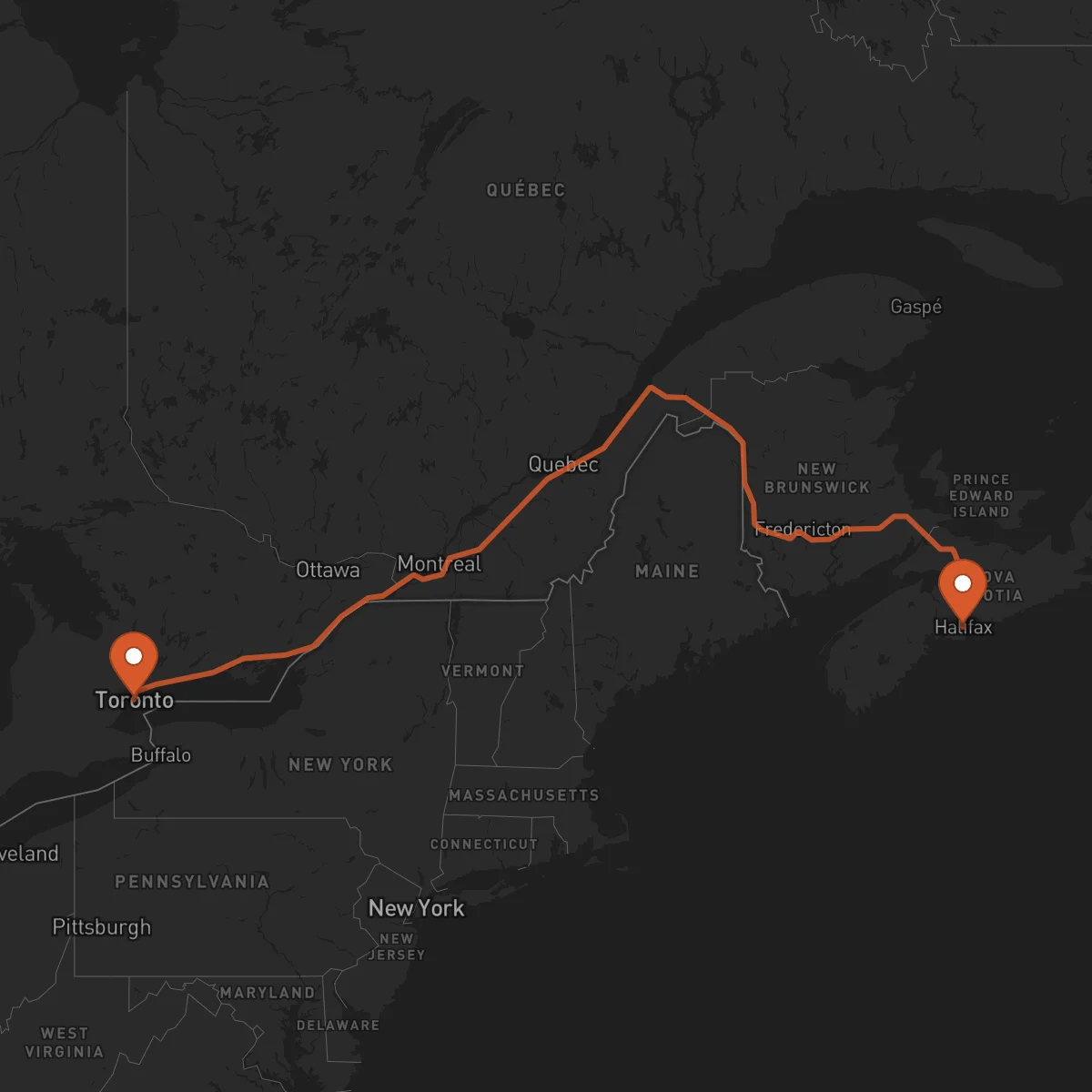
Toronto to Halifax
Halifax → TorontoFTL freight transportation service between Toronto and Halifax. Reliable logistics solutions for your business.
Route Description
Everything you need to know about the corridor Toronto - Halifax
The Toronto to Halifax corridor represents one of Canada's most vital east-west transportation routes, connecting Ontario's economic powerhouse with Nova Scotia's Atlantic gateway. This 1263 km route traverses the heart of Canada's industrial and agricultural regions, providing essential freight connectivity between central Canada and the Atlantic provinces. The corridor serves as a critical link in Canada's supply chain, facilitating the movement of goods from the manufacturing centers of Ontario to the port facilities and markets of Atlantic Canada.
The route follows the Trans-Canada Highway (Highway 401 through Ontario, then Highway 20 and Highway 2 through Quebec and New Brunswick, before connecting to Nova Scotia's Highway 104), offering reliable transportation infrastructure with multiple service options. This strategic pathway enables businesses to optimize their logistics operations, reduce transit times, and maintain consistent supply chains across the vast Canadian landscape. The corridor's importance continues to grow as trade volumes increase and supply chain efficiency becomes increasingly crucial for competitive advantage.
Control Terrestre specializes in full truckload (FTL) transportation services along this corridor, providing dedicated equipment and experienced drivers who understand the unique challenges of cross-province freight movement. Our network of certified carriers ensures reliable, timely delivery of your cargo from Toronto's distribution centers to Halifax's port facilities and industrial zones. With our commitment to safety, efficiency, and customer service, we help businesses maintain seamless supply chain operations across this essential Canadian trade route.
Services for this Route
Available services for the corridor Toronto - Halifax
 Origin
Toronto stands as Canada's largest city and financial capital, serving as a major logistics hub in North America. Located in the heart of Ontario's Golden Horseshoe, Toronto offers unparalleled access to a vast consumer market and industrial base. The city's strategic position provides immediate connectivity to major highways including the 401, 400, and QEW, creating multiple routing options for freight movement. Toronto's extensive intermodal facilities, including major rail yards and proximity to international airports, make it an ideal origin point for nationwide freight distribution.
The Greater Toronto Area (GTA) hosts diverse industries including automotive manufacturing, technology, pharmaceuticals, food processing, and consumer goods production. This industrial diversity creates consistent freight demand and ensures year-round cargo availability. Toronto's robust warehousing and distribution infrastructure, combined with its proximity to the U.S. border, makes it a strategic launching point for both domestic and cross-border freight operations.
 Destination
Halifax
Halifax serves as Atlantic Canada's primary economic and logistics center, strategically positioned as the region's gateway to global markets. The city's deep-water port is one of North America's busiest, handling significant volumes of container, bulk, and break-bulk cargo. Halifax's location provides direct access to European and Mediterranean shipping routes, making it crucial for international trade and supply chain operations. The city's transportation infrastructure includes modern highways, rail connections, and air cargo facilities, creating a comprehensive logistics network.
The Halifax region supports diverse industries including seafood processing, forestry products, aerospace manufacturing, and defense contracting. The port's container terminal and extensive warehousing facilities accommodate various cargo types, from refrigerated goods to oversized equipment. Halifax's role as a provincial capital also drives consistent freight demand for government and institutional supplies, while its growing technology sector creates additional logistics opportunities.










