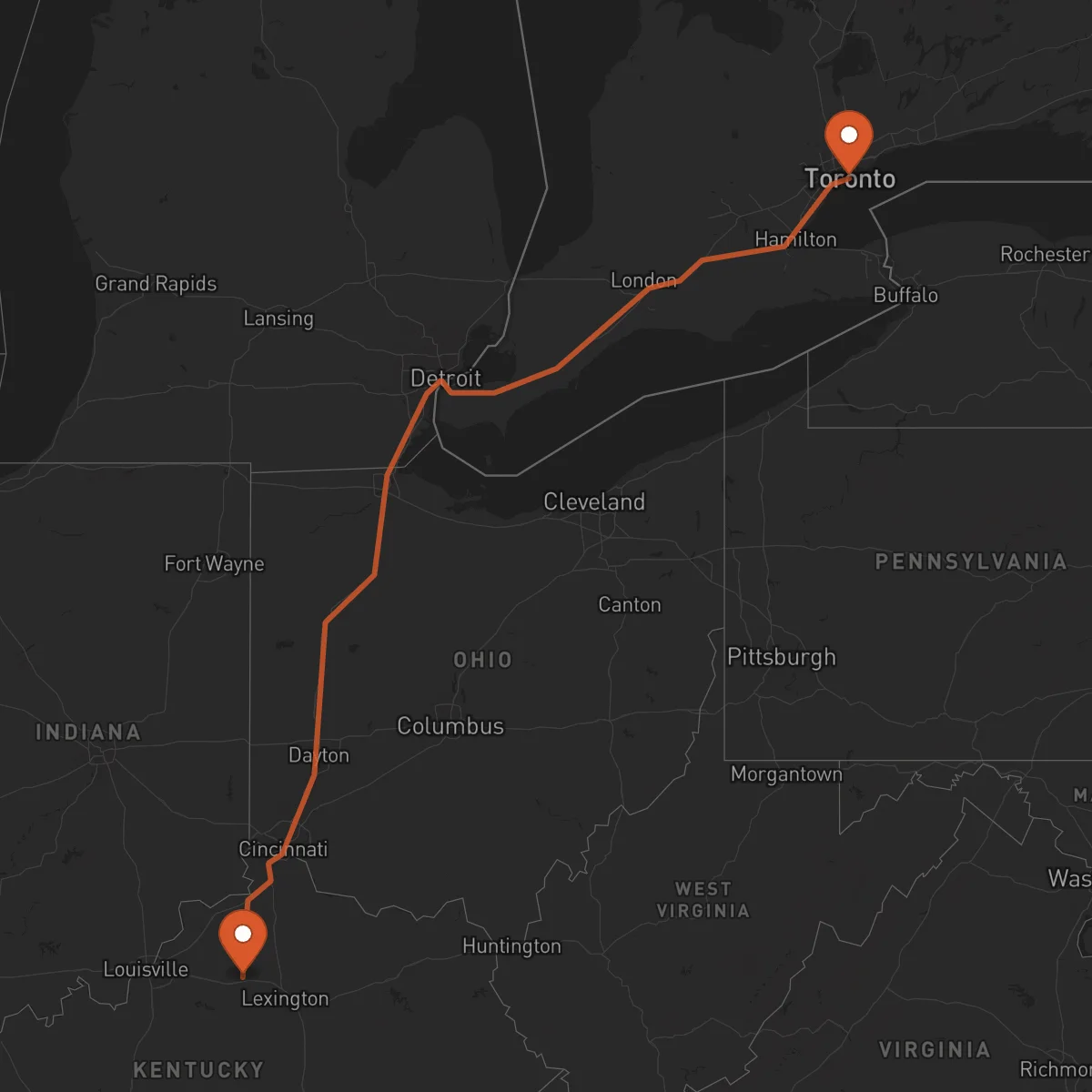
Toronto to Frankfort
Frankfort → TorontoFTL freight transportation service between Toronto and Frankfort. Reliable logistics solutions for your business.
Route Description
Everything you need to know about the corridor Toronto - Frankfort
The Toronto to Frankfort corridor represents a vital cross-border freight transportation route connecting the economic powerhouse of Ontario with the manufacturing hub of Kentucky. This strategic corridor spans approximately 762 kilometers and facilitates the movement of goods between Canada and the United States, supporting the integrated North American supply chain. The route traverses diverse terrain and crosses international borders, requiring expertise in customs clearance and cross-border logistics operations.
The corridor serves as a critical link between Toronto's extensive manufacturing and technology sectors and Frankfort's growing automotive and industrial base. Major highways including the 401 in Canada and I-75 in the United States form the backbone of this transportation route, providing efficient freight movement with minimal congestion. The corridor connects key economic regions, enabling just-in-time delivery for manufacturers and supporting the automotive supply chain that dominates both regions.
Control Terrestre specializes in managing the complexities of this cross-border corridor, offering dedicated FTL services that ensure cargo moves seamlessly between Toronto and Frankfort. Our expertise includes handling customs documentation, coordinating border crossings, and providing real-time tracking throughout the journey. We understand the specific requirements for cross-border freight, including C-TPAT compliance and the necessary certifications our providers maintain to expedite border processing. Our team manages every aspect of the shipment, from pickup in Toronto's industrial areas to final delivery in Frankfort's manufacturing districts.
Services for this Route
Available services for the corridor Toronto - Frankfort
 Origin
Toronto serves as a major logistics hub in Canada, strategically positioned along the shores of Lake Ontario with access to multiple transportation modes. The city's extensive infrastructure includes the Toronto Pearson International Airport, major rail terminals, and the 400-series highways that connect to all major Canadian markets. Toronto's location provides efficient access to both domestic Canadian destinations and cross-border routes to the United States, making it an ideal origin point for freight distribution.
The Greater Toronto Area is home to diverse industries including automotive manufacturing, aerospace, technology, and food processing. The region's strong economic base generates substantial freight volumes, particularly in automotive parts, electronics, and consumer goods. Toronto's industrial parks and warehousing facilities are strategically distributed throughout the region, providing numerous options for efficient freight consolidation and distribution. The city's proximity to the US border and major population centers makes it a critical node in North American supply chains.
 Destination
Frankfort
Frankfort, Kentucky serves as an important logistics and distribution center in the southeastern United States, strategically located along major transportation corridors. The city's proximity to major highways including I-64 and I-75 provides excellent connectivity to regional markets and national freight networks. Frankfort's location in the heart of Kentucky offers efficient access to both northern and southern US markets, making it an ideal destination for cross-border freight from Canada.
The Frankfort region is characterized by strong manufacturing and logistics sectors, with particular emphasis on automotive production, food processing, and distribution centers. The area benefits from Kentucky's business-friendly environment and skilled workforce, attracting major companies that require reliable freight transportation. Frankfort's industrial parks and warehousing facilities are equipped to handle diverse cargo types, from automotive components to consumer goods. The city's logistics infrastructure supports just-in-time manufacturing operations and provides efficient last-mile delivery capabilities for regional distribution.










