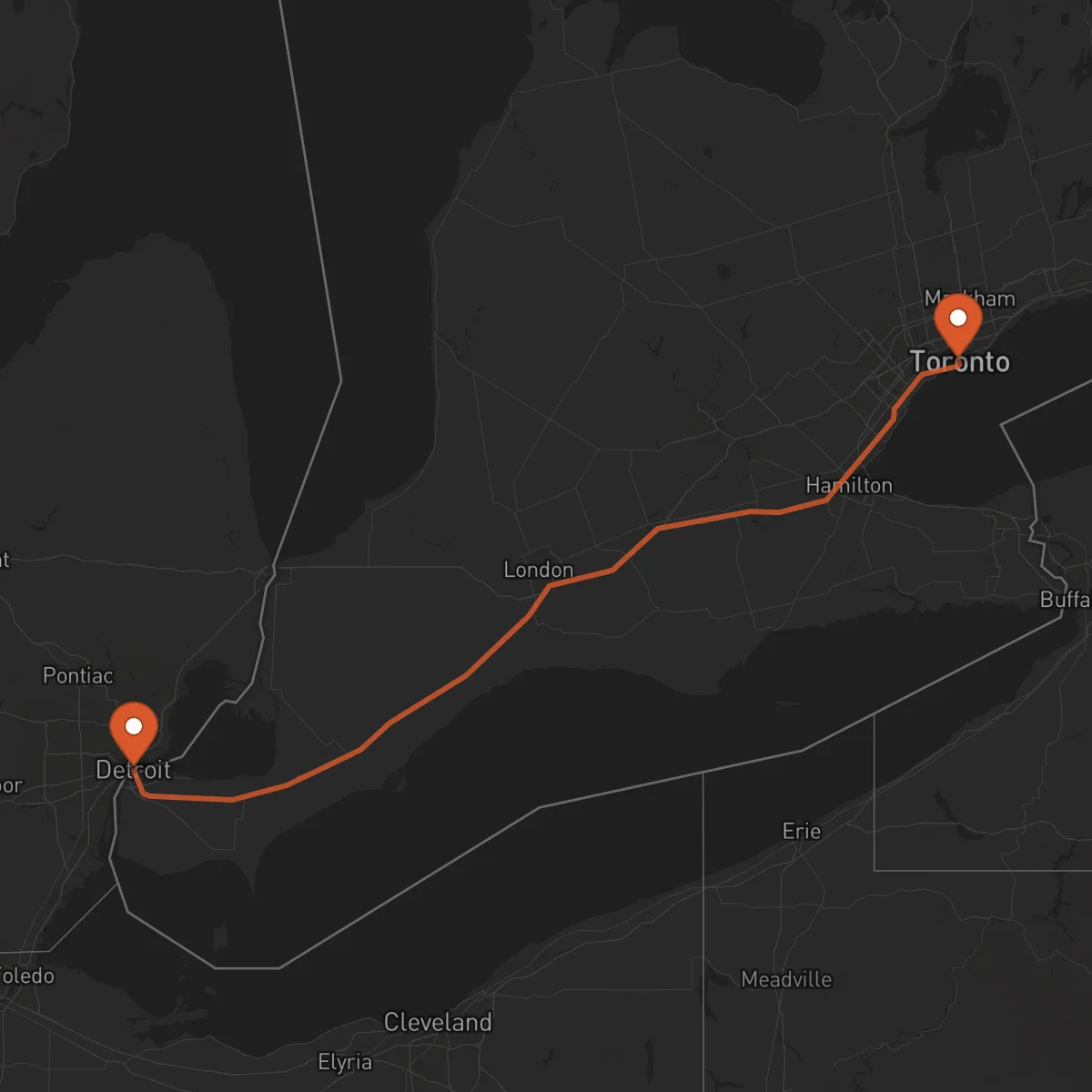
Toronto to Detroit
Detroit → TorontoFTL freight transportation service between Toronto and Detroit. Reliable logistics solutions for your business.
Route Description
Everything you need to know about the corridor Toronto - Detroit
The Toronto-Detroit corridor represents a vital economic link between Canada and the United States, connecting two major industrial centers separated by just 332 kilometers. This cross-border route facilitates the seamless movement of goods between Ontario's capital and Michigan's largest city, serving as a critical artery for North American trade. The corridor's strategic importance is amplified by its position connecting the Great Lakes manufacturing region with Canada's financial and technological hub.
The region's economic landscape is dominated by automotive manufacturing, with both Toronto and Detroit serving as major hubs for vehicle production and parts distribution. Beyond automotive, the corridor supports diverse industries including aerospace, advanced manufacturing, pharmaceuticals, and technology. Major corporations maintain cross-border operations, creating consistent freight demand along this route. The proximity of these industrial centers enables just-in-time manufacturing processes that require reliable, time-sensitive transportation solutions.
Transportation infrastructure along the Toronto-Detroit corridor includes major highways such as Highway 401 in Ontario and I-75 in Michigan, providing direct cross-border connections. The Windsor-Detroit crossing serves as the primary border entry point, handling significant commercial traffic daily. Control Terrestre's expertise in cross-border logistics ensures smooth customs clearance and compliance with all regulatory requirements. Our network of certified carriers and deep understanding of border procedures allows us to minimize delays and provide efficient FTL transportation solutions for companies operating along this critical trade corridor.
Services for this Route
Available services for the corridor Toronto - Detroit
 Origin
Toronto stands as Canada's largest city and a major logistics hub, strategically positioned in the heart of Ontario's manufacturing and technology corridor. The city's extensive transportation infrastructure includes Pearson International Airport, one of North America's busiest cargo facilities, and a comprehensive network of highways connecting to major Canadian and U.S. markets. Toronto's Port Lands area provides additional multimodal capabilities, while the city's extensive rail connections support efficient freight movement. The Greater Toronto Area (GTA) serves as a distribution center for millions of consumers and businesses, making it a critical origin point for freight destined throughout North America.
 Destination
Detroit
Detroit represents a cornerstone of American manufacturing and logistics, historically known as the automotive capital of the world. The city's strategic location in the Great Lakes region provides direct access to major U.S. markets and international trade routes via the St. Lawrence Seaway. Detroit's transportation infrastructure includes the Detroit Metropolitan Airport, extensive highway networks, and rail connections that facilitate efficient cargo movement. The city's proximity to the Canadian border creates unique opportunities for cross-border trade, while its industrial heritage continues to drive demand for reliable freight transportation services. Detroit's ongoing economic diversification has expanded its logistics needs beyond automotive to include technology, healthcare, and advanced manufacturing sectors.










