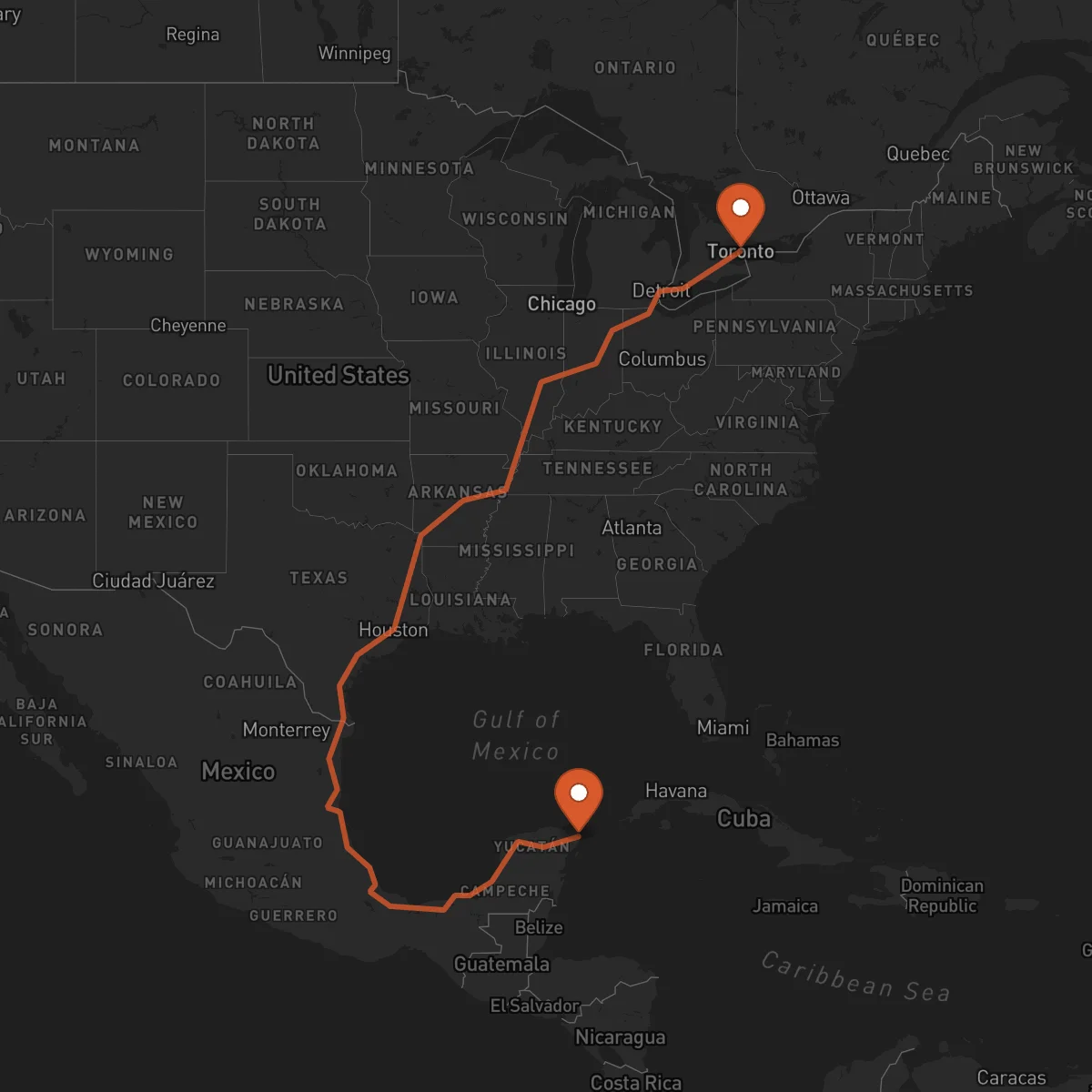
Toronto to Cancún
Cancún → TorontoFTL freight transportation service between Toronto and Cancún. Reliable logistics solutions for your business.
Route Description
Everything you need to know about the corridor Toronto - Cancún
The Toronto to Cancún corridor represents one of North America's most significant cross-border logistics routes, connecting Canada's economic powerhouse with Mexico's premier tourist destination. This 2,595 km route traverses diverse landscapes and crosses multiple jurisdictions, making it a critical artery for trade between the United States, Canada, and Mexico. The corridor facilitates the movement of goods between three major North American economies, supporting industries from automotive to consumer goods and agricultural products.
The economic importance of this corridor cannot be overstated. Toronto serves as Canada's financial and manufacturing hub, while Cancún anchors Mexico's Caribbean tourism industry. Between these endpoints lie major industrial centers in the United States, including Detroit, Chicago, and Atlanta. This creates a unique logistics triangle where goods flow in multiple directions, supporting just-in-time manufacturing, retail distribution, and the hospitality sector's complex supply chain needs.
Transportation infrastructure along this corridor includes major highways such as I-75, I-65, and I-10, connecting with Mexico's Federal Highway 180D. The route requires careful coordination at border crossings, particularly at Detroit-Windsor and Laredo-Nuevo Laredo, where customs procedures and documentation must be meticulously managed. Control Terrestre's expertise in cross-border operations ensures seamless transit through these critical points, with our C-TPAT-certified partners providing expedited clearance and reduced inspection times.
Our dedicated FTL services along this corridor are designed to meet the specific needs of industries requiring temperature-controlled transport, time-sensitive deliveries, and specialized handling. Whether moving automotive parts from Ontario's manufacturing plants to assembly facilities in Mexico, or transporting perishable goods to support Cancún's hospitality industry, Control Terrestre provides reliable, end-to-end transportation solutions that keep your supply chain moving efficiently across international borders.
Services for this Route
Available services for the corridor Toronto - Cancún
 Origin
Toronto, Ontario stands as Canada's most populous city and a major logistics hub for North American trade. Located on the northwestern shore of Lake Ontario, Toronto benefits from exceptional connectivity through Pearson International Airport, one of Canada's busiest cargo facilities, and extensive rail networks operated by CN and CP Rail. The city's strategic position provides direct access to major highways including the 401, 400, and QEW, facilitating efficient ground transportation to both Canadian and U.S. markets. Toronto's diverse economy spans financial services, advanced manufacturing, automotive production, and technology sectors, creating substantial freight movement requirements. The Greater Toronto Area hosts numerous warehousing and distribution centers, making it an ideal origin point for full truckload shipments requiring reliable, time-definite delivery across North America.
 Destination
Cancún
Cancún, Quintana Roo represents Mexico's Caribbean gateway and a critical logistics hub for the Yucatán Peninsula. Located on Mexico's northeastern coast, Cancún benefits from proximity to Cancún International Airport, one of Latin America's busiest cargo airports, and access to major highways connecting the region to the rest of Mexico. The destination's strategic importance stems from its role as the epicenter of Mexico's tourism industry, requiring constant supply of goods ranging from food and beverages to construction materials and consumer products. The region's growing manufacturing sector, particularly in the nearby Riviera Maya, has created additional demand for reliable freight transportation. Cancún's port facilities and road infrastructure support the efficient distribution of goods throughout the Yucatán Peninsula and beyond, making it an essential endpoint for cross-border logistics operations.










