Toronto to Atlanta
Atlanta → TorontoFTL freight transportation service between Toronto and Atlanta. Reliable logistics solutions for your business.
Route Description
Everything you need to know about the corridor Toronto - Atlanta
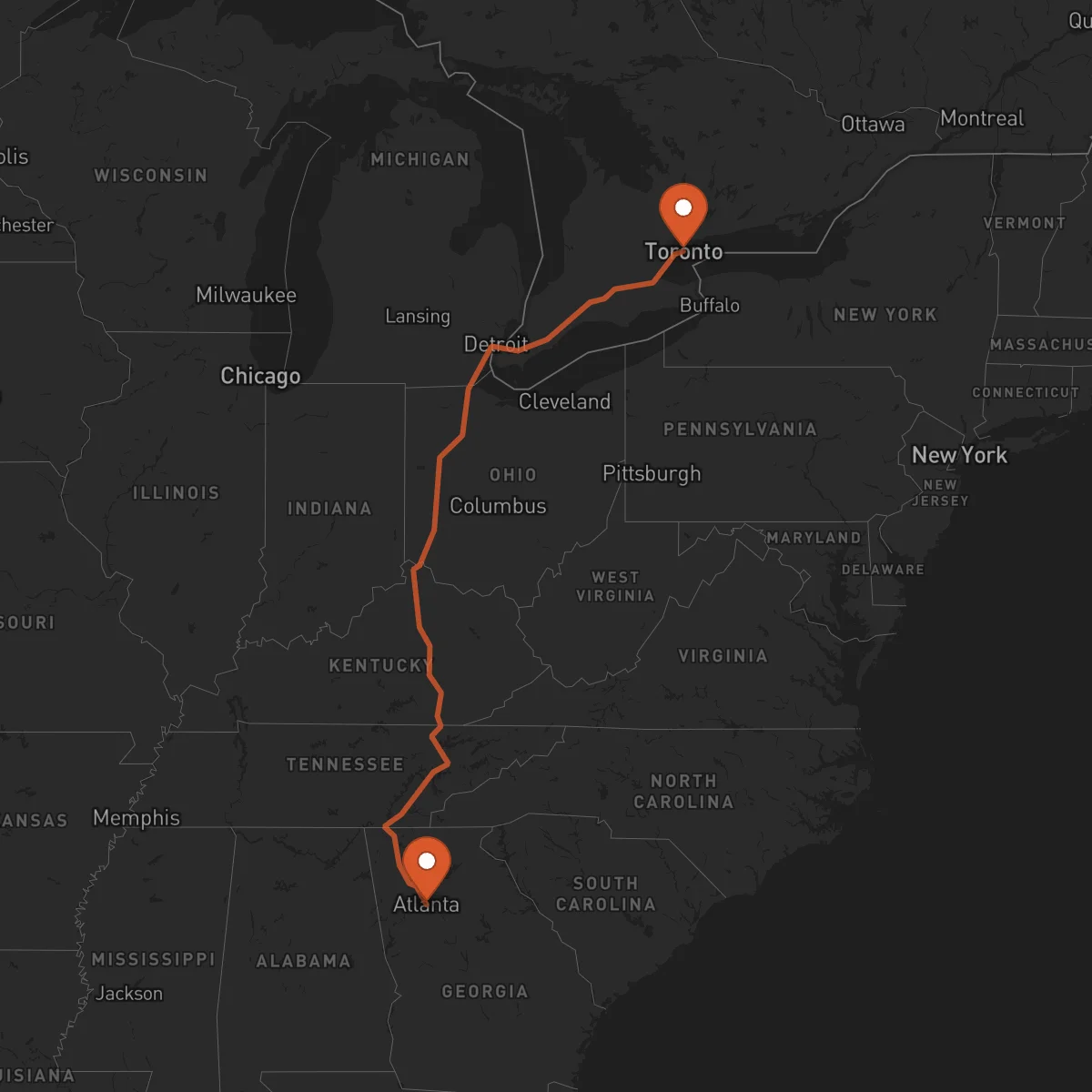
The Toronto-Atlanta corridor represents a vital trade link between Canada's largest economic hub and one of the Southeast United States' most dynamic commercial centers. This cross-border route spans approximately 1,183 kilometers, connecting Ontario's manufacturing powerhouse with Georgia's logistics and distribution epicenter. The corridor facilitates the movement of goods between two major North American markets, supporting integrated supply chains that serve both Canadian and American consumers.
The economic significance of this route is underscored by the complementary industrial strengths of both regions. Toronto serves as Canada's financial and technological capital, while Atlanta has emerged as a major distribution center for retail, automotive, and consumer goods. Key industries utilizing this corridor include automotive parts, electronics, pharmaceuticals, and food products. The route traverses major transportation infrastructure including Interstate 75 and Highway 401, with efficient border crossings at key points between Ontario and Michigan.
Control Terrestre specializes in optimizing cross-border operations along this corridor, offering dedicated FTL services that ensure timely and secure freight movement. Our expertise in customs clearance and compliance with C-TPAT and FAST certifications streamlines border crossings, reducing delays and enhancing supply chain efficiency. We provide door-to-door service, handling all aspects of the journey from pickup in Toronto to final delivery in Atlanta, with real-time tracking and dedicated customer support throughout the transit process.
Services for this Route
Available services for the corridor Toronto - Atlanta
 Origin
Toronto stands as Canada's premier logistics hub, strategically positioned on the northwestern shore of Lake Ontario. The city's extensive transportation network includes Pearson International Airport, one of North America's busiest cargo airports, and a comprehensive rail system connecting to major Canadian and U.S. markets. Toronto's Port of Toronto facilitates maritime freight movement, while its highway infrastructure provides direct access to the U.S. border via Highway 401, North America's busiest highway.
The Greater Toronto Area (GTA) is home to diverse economic sectors including advanced manufacturing, financial services, information technology, and pharmaceuticals. The region's industrial base produces a wide range of goods requiring efficient transportation to U.S. markets. Toronto's proximity to major automotive manufacturing centers in Southern Ontario makes it a critical node for automotive parts distribution throughout North America.
 Destination
Atlanta
Atlanta serves as a strategic logistics hub in the southeastern United States, renowned for its world-class transportation infrastructure and business-friendly environment. The city boasts the world's busiest airport by passenger traffic (Hartsfield-Jackson Atlanta International Airport) and a major cargo hub, complemented by extensive rail networks operated by Norfolk Southern and CSX. Atlanta's highway system includes direct access to I-75, I-85, and I-20, creating a multimodal transportation network that facilitates efficient freight movement throughout the region.
The Atlanta metropolitan area has developed into a major distribution center, particularly for retail, e-commerce, and consumer goods. The region's economic strengths include logistics and supply chain management, film and media production, information technology, and advanced manufacturing. Atlanta's central location in the Southeast makes it an ideal distribution point for serving markets throughout the eastern United States and beyond.










