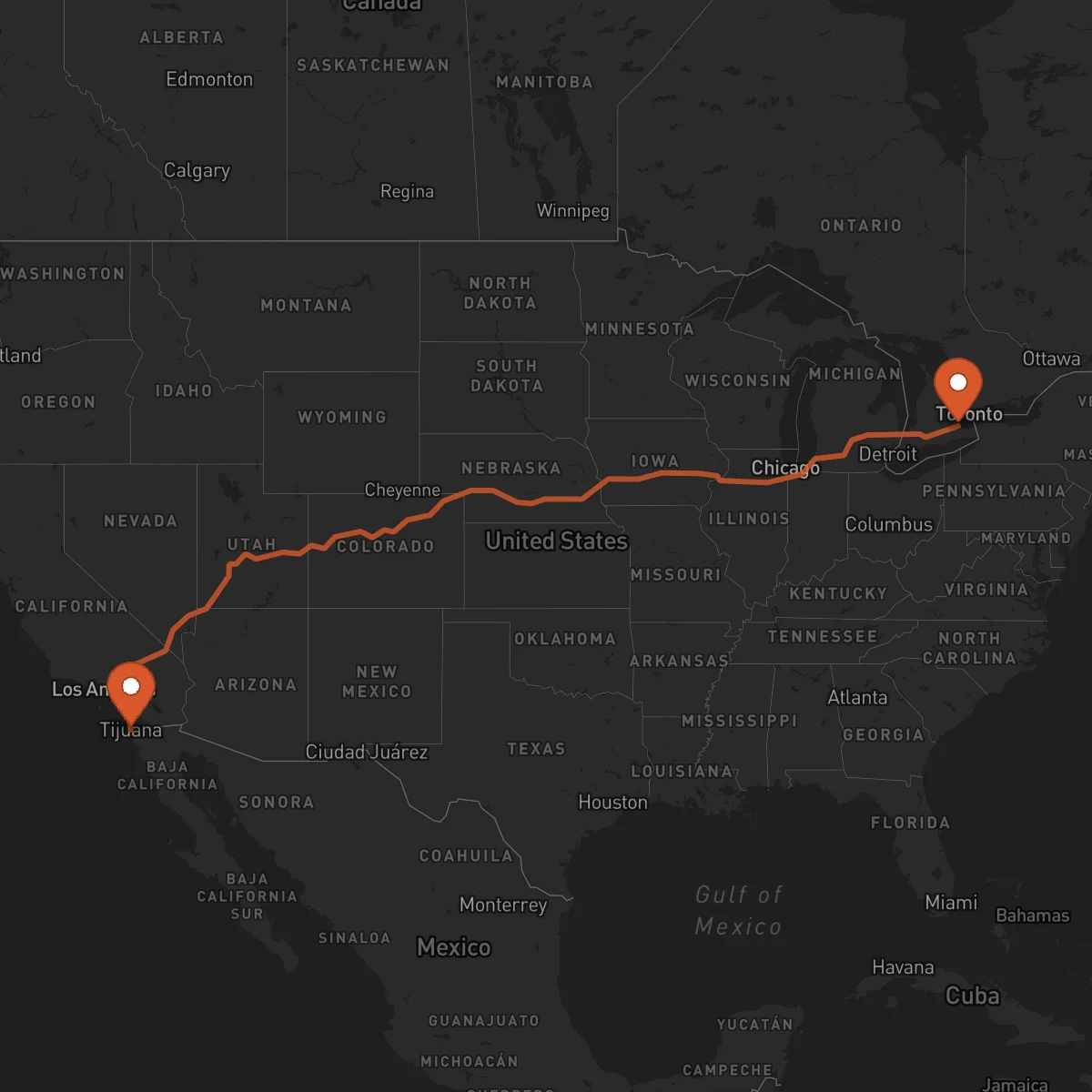
Tijuana to Hamilton
Hamilton → TijuanaFTL freight transportation service between Tijuana and Hamilton. Reliable logistics solutions for your business.
Route Description
Everything you need to know about the corridor Tijuana - Hamilton
The Tijuana-Hamilton corridor represents a vital cross-border logistics connection linking Mexico's dynamic border region with Canada's industrial heartland. This 3,437 km route traverses the North American continent, connecting the Pacific coast with the Great Lakes industrial corridor. The corridor serves as a crucial artery for trade between Mexico, the United States, and Canada, facilitating the movement of goods across three major economic zones.
The route primarily utilizes major interstate highways including I-5, I-15, I-80, and I-90, crossing through key commercial hubs such as San Diego, Salt Lake City, Chicago, and Detroit before reaching Hamilton. The primary border crossing at San Ysidro/Tijuana connects seamlessly with the Ambassador Bridge or Detroit-Windsor Tunnel for entry into Canada. This corridor is particularly significant for industries requiring temperature-controlled transportation, given Hamilton's role as a major food processing and manufacturing center.
Control Terrestre specializes in managing cross-border operations along this corridor, providing dedicated full truckload (FTL) services with experienced drivers familiar with customs procedures and documentation requirements. Our C-TPAT-certified carriers ensure expedited processing at border crossings, while our real-time tracking systems provide visibility throughout the journey. We understand the complexities of cross-border regulations and coordinate all necessary permits, especially for specialized or oversized cargo moving between these jurisdictions.
Services for this Route
Available services for the corridor Tijuana - Hamilton
 Origin
Tijuana
Tijuana stands as a strategic logistics hub on Mexico's northern border, directly adjacent to San Diego, California. This positioning makes it an ideal gateway for international trade, with immediate access to both Mexican and U.S. transportation networks. The city hosts one of North America's busiest border crossings, handling millions of commercial truck movements annually. Tijuana's infrastructure includes multiple industrial parks, rail connections to Mexico's national network, and proximity to the Port of Ensenada for maritime freight.
The region's economy thrives on manufacturing, particularly in aerospace, medical devices, electronics, and automotive components. The presence of numerous maquiladoras (manufacturing plants) creates consistent demand for cross-border freight services. Tijuana also serves as a critical point for agricultural exports from Baja California, including fresh produce that requires refrigerated transportation to northern markets.
 Destination
Hamilton, located on the western tip of Lake Ontario, serves as a strategic logistics center in Canada's industrial corridor. The city's position at the intersection of major highways (QEW, 403, and 407) provides excellent connectivity to Toronto, Montreal, and the U.S. border. Hamilton's port facilities on Lake Ontario facilitate both domestic and international shipping, while its rail connections link to Canada's transcontinental network.
The city's economy centers on manufacturing, particularly steel production, which has earned it the nickname "Steel Town." Hamilton also hosts significant food processing facilities, advanced manufacturing operations, and a growing technology sector. The presence of McMaster University drives research and development activities, creating demand for specialized logistics services. The region's agricultural hinterland supplies numerous food processing plants, generating consistent refrigerated freight movements.










