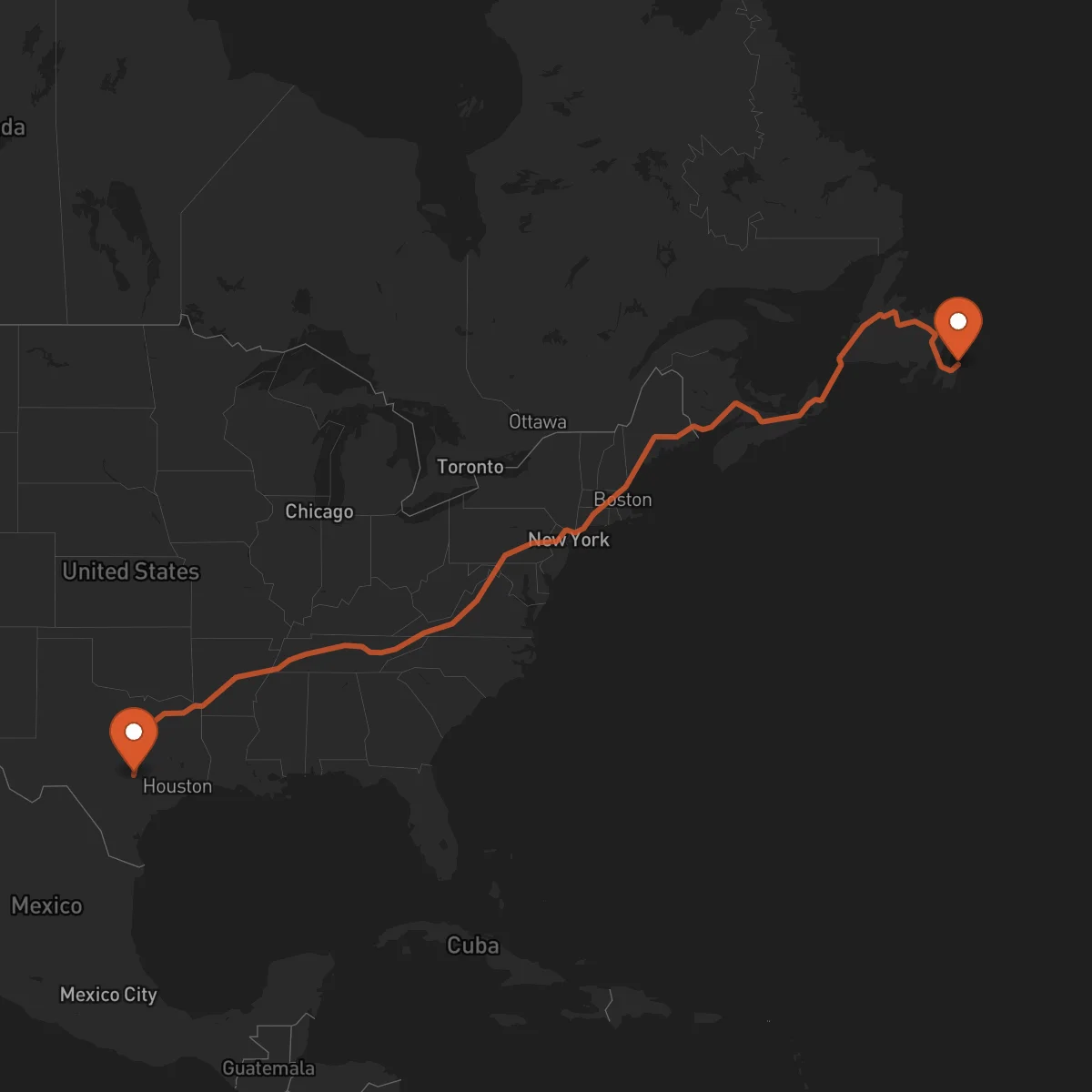
St. John's to Austin
Austin → St. John'sFTL freight transportation service between St. John's and Austin. Reliable logistics solutions for your business.
Route Description
Everything you need to know about the corridor St. John's - Austin
The cross-border corridor connecting San Juan de Terranova (St. John's) to Austin represents a vital logistics link between Canada and the United States, spanning approximately 4266 km. This route traverses diverse landscapes and economic regions, facilitating the movement of goods between the Atlantic provinces and the heart of Texas. The corridor passes through major urban centers including Montreal, Toronto, Detroit, and Dallas, connecting two distinct economic regions with complementary industrial strengths.
This route serves as a crucial artery for industries such as technology, automotive, energy, and manufacturing. The journey from St. John's to Austin crosses multiple time zones and climate zones, requiring specialized logistics expertise to ensure timely and secure delivery. Control Terrestre's network of certified carriers ensures seamless cross-border operations, managing customs documentation and regulatory compliance across all jurisdictions.
Key transportation infrastructure along this corridor includes the Trans-Canada Highway (Highway 1) from St. John's, connecting to major US interstates such as I-75, I-65, I-55, and I-35. The corridor utilizes strategic border crossings including the Ambassador Bridge in Detroit and the Laredo International Bridge, depending on the specific routing. Control Terrestre's experience with cross-border operations ensures efficient customs clearance and minimizes delays at these critical points.
Services for this Route
Available services for the corridor St. John's - Austin
 Origin
St. John's
San Juan de Terranova (St. John's), located on the eastern tip of the Avalon Peninsula in Newfoundland and Labrador, serves as a strategic maritime gateway for Atlantic Canada. As the oldest city in North America, it combines historical significance with modern logistics capabilities. The Port of St. John's provides deep-water facilities capable of handling various cargo types, while the St. John's International Airport offers air freight connections to major North American hubs.
The region's economy is anchored by the offshore oil and gas industry, fisheries, and emerging technology sectors. The Memorial University of Newfoundland contributes to a skilled workforce and research capabilities, particularly in ocean technology and marine sciences. The city's infrastructure includes modern warehousing facilities, cold storage capabilities, and specialized handling equipment for diverse cargo types, making it an ideal origin point for complex supply chain operations.
 Destination
Austin
Austin, Texas, has emerged as a major technology and business hub in the American South, earning its reputation as the "Silicon Hills." The city's strategic location in central Texas provides excellent connectivity to major markets across the southern United States. Austin-Bergstrom International Airport offers robust cargo services, while the city's extensive highway network includes direct connections to I-35, facilitating efficient ground transportation.
The Austin metropolitan area hosts a diverse economic ecosystem dominated by technology companies, including major offices of Apple, Google, and Tesla. The region also benefits from a strong healthcare sector, educational institutions like the University of Texas, and a growing manufacturing base. Austin's logistics infrastructure includes modern distribution centers, specialized facilities for high-tech equipment, and a business-friendly environment that supports efficient supply chain operations.










