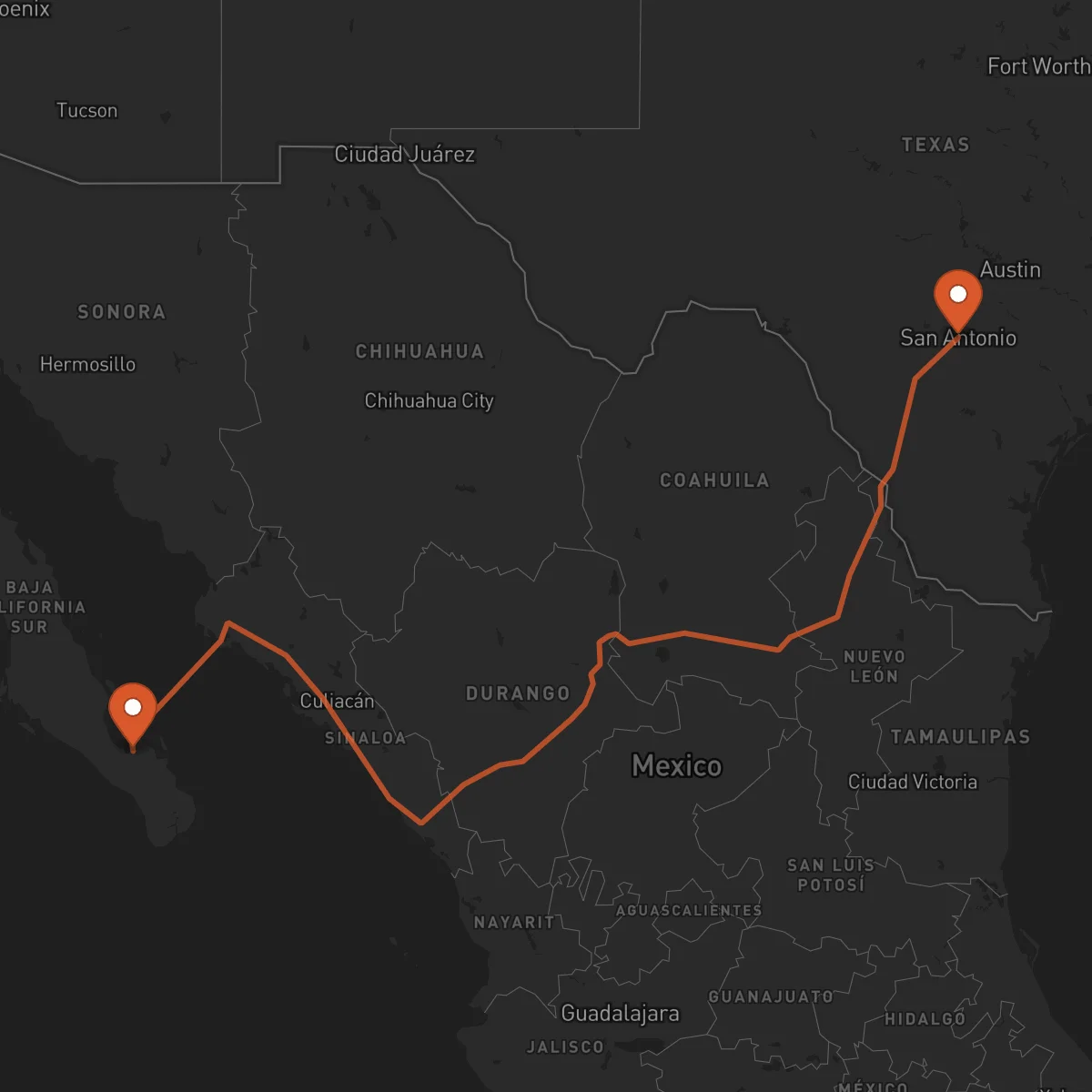
San Antonio to La Paz
La Paz → San AntonioFTL freight transportation service between San Antonio and La Paz. Reliable logistics solutions for your business.
Route Description
Everything you need to know about the corridor San Antonio - La Paz
The logistics corridor connecting San Antonio, Texas, to La Paz, Baja California Sur, represents a vital cross-border route that links the industrial heartland of the United States with Mexico's growing Pacific coast region. This 1,311 km corridor serves as a critical artery for freight transportation, enabling the seamless movement of goods between two dynamic economic zones. The route traverses diverse landscapes and crosses international borders, requiring expert coordination and specialized knowledge of cross-border logistics operations.
The economic significance of this corridor is substantial, supporting trade between major manufacturing centers and emerging markets in northwestern Mexico. San Antonio serves as a key logistics hub in Texas, while La Paz represents an important gateway to Baja California Sur's developing industrial and tourism sectors. The corridor facilitates the transportation of various cargo types, from automotive parts and electronics to agricultural products and consumer goods, supporting the supply chains of numerous industries.
Transportation along this route primarily utilizes Mexico's Federal Highway 1 and key U.S. interstate connections, providing reliable access between the two points. The corridor requires careful navigation of border crossing procedures, with particular attention to customs documentation and compliance requirements. Control Terrestre's expertise in cross-border operations ensures smooth transitions through these critical checkpoints, minimizing delays and maintaining cargo security throughout the journey.
Our comprehensive understanding of this corridor's unique challenges allows us to provide efficient FTL transportation services that meet the specific needs of businesses operating between San Antonio and La Paz. From coordinating border crossings to managing specialized cargo requirements, we ensure reliable freight movement that keeps your supply chain operating smoothly across international boundaries.
Services for this Route
Available services for the corridor San Antonio - La Paz
 Origin
San Antonio
San Antonio stands as a strategic logistics hub in south-central Texas, offering exceptional connectivity through its extensive transportation infrastructure. The city's location provides access to major interstate highways, including I-10, I-35, and I-37, creating a robust network for freight distribution throughout the region. San Antonio's position as a gateway to both Mexican and U.S. markets makes it an ideal origin point for cross-border freight operations, with proximity to major industrial centers and manufacturing facilities.
The city's economy is diverse and robust, with strong presence in aerospace, biosciences, information technology, and advanced manufacturing sectors. San Antonio hosts numerous distribution centers and warehouses, supported by the San Antonio International Airport and the Port San Antonio logistics complex. The region's skilled workforce and business-friendly environment have attracted significant investment from both domestic and international companies, creating substantial freight transportation demand that flows through this strategic location.
 Destination
La Paz
La Paz serves as the capital and commercial center of Baja California Sur, positioned strategically on the Sea of Cortez with growing importance in Mexico's Pacific trade network. The city's location provides access to maritime shipping routes and serves as a gateway to the broader Baja California peninsula. La Paz's developing infrastructure includes modern port facilities and improving highway connections that link the city to the continental highway system through Mexico.
The local economy is characterized by a mix of tourism, fishing, mining, and emerging manufacturing sectors. La Paz is experiencing growth in renewable energy projects and sustainable tourism development, creating new opportunities for freight transportation services. The city's role as a regional commercial center supports distribution activities throughout southern Baja California, with increasing industrial activity driving demand for reliable logistics solutions that connect the region to major U.S. markets.










