Richmond to Lansing
Lansing → RichmondFTL freight transportation service between Richmond and Lansing. Reliable logistics solutions for your business.
Route Description
Everything you need to know about the corridor Richmond - Lansing
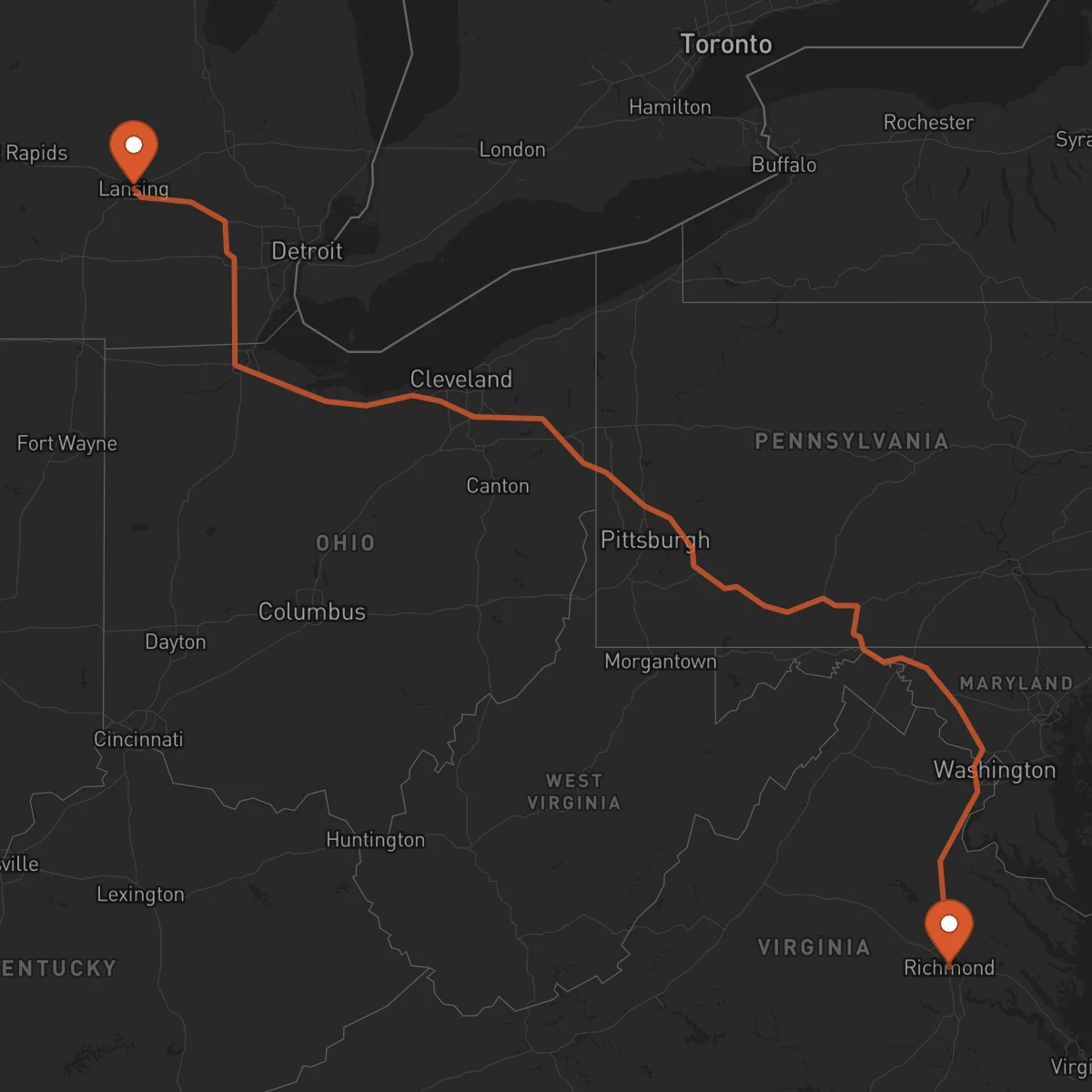
The Richmond to Lansing corridor connects two key industrial hubs in the eastern United States, spanning approximately 836 kilometers through the heart of the Midwest. This domestic route serves as a vital link between Virginia's coastal industrial centers and Michigan's automotive manufacturing powerhouse. The corridor traverses through major economic regions including Washington D.C., Baltimore, Pittsburgh, and Cleveland, providing access to numerous logistics hubs and industrial centers along the way.
The Richmond-Lansing corridor supports critical supply chain operations for the automotive, manufacturing, and technology sectors. Richmond serves as a major distribution center with access to multiple ports and rail connections, while Lansing anchors Michigan's automotive manufacturing ecosystem. This route facilitates the movement of automotive parts, raw materials, finished vehicles, and industrial equipment between these strategic locations. The corridor's proximity to major population centers and industrial zones makes it essential for just-in-time manufacturing and distribution operations.
Control Terrestre specializes in full truckload (FTL) freight transportation along this corridor, offering dedicated services with our certified transportation partners. Our fleet includes 48' and 53' dry vans and refrigerated units, ensuring your cargo moves efficiently regardless of its requirements. We provide door-to-door service with real-time tracking and our team of logistics experts coordinates every shipment to optimize transit times and ensure reliable delivery between Richmond and Lansing.
Services for this Route
Available services for the corridor Richmond - Lansing
 Origin
Richmond
Richmond, Virginia serves as a strategic logistics hub on the East Coast, positioned at the intersection of major transportation networks. The city's location provides immediate access to the Port of Virginia, one of the largest container ports on the East Coast, as well as extensive rail connections through CSX and Norfolk Southern. Richmond's central East Coast location makes it an ideal distribution point for companies serving the Mid-Atlantic and Northeast regions. The city's robust infrastructure includes multiple interstate highways (I-95, I-64, I-295) that facilitate efficient ground transportation to all directions.
The Richmond metropolitan area is home to diverse industries including advanced manufacturing, biotechnology, food processing, and government services. Major employers include Philip Morris USA, Capital One, and the University of Richmond Medical Center. The region's logistics sector is particularly strong, with numerous warehousing and distribution centers serving both national and international markets. Richmond's proximity to Washington D.C. and its educated workforce make it an attractive location for technology and professional services companies that require sophisticated logistics support.
 Destination
Lansing
Lansing, Michigan stands as a central logistics hub in the Great Lakes region, strategically positioned to serve the automotive manufacturing heartland of America. The city's location provides direct access to major transportation arteries including I-96, I-496, and US-127, connecting it to Detroit, Chicago, and the broader Midwest industrial network. Lansing's proximity to major automotive manufacturing centers in Michigan makes it a critical node for automotive supply chains and parts distribution.
The Lansing area is anchored by its automotive heritage, with General Motors operating major facilities in the region and numerous automotive suppliers maintaining operations. The city has diversified its industrial base to include healthcare, education, and technology sectors, with Michigan State University driving research and innovation. Lansing's transportation infrastructure includes Capital Region International Airport and the Lansing Board of Water & Light's rail operations, providing multimodal freight options. The city's central location within Michigan and its access to the Great Lakes waterway system make it an ideal distribution point for companies serving the Midwest and beyond.










