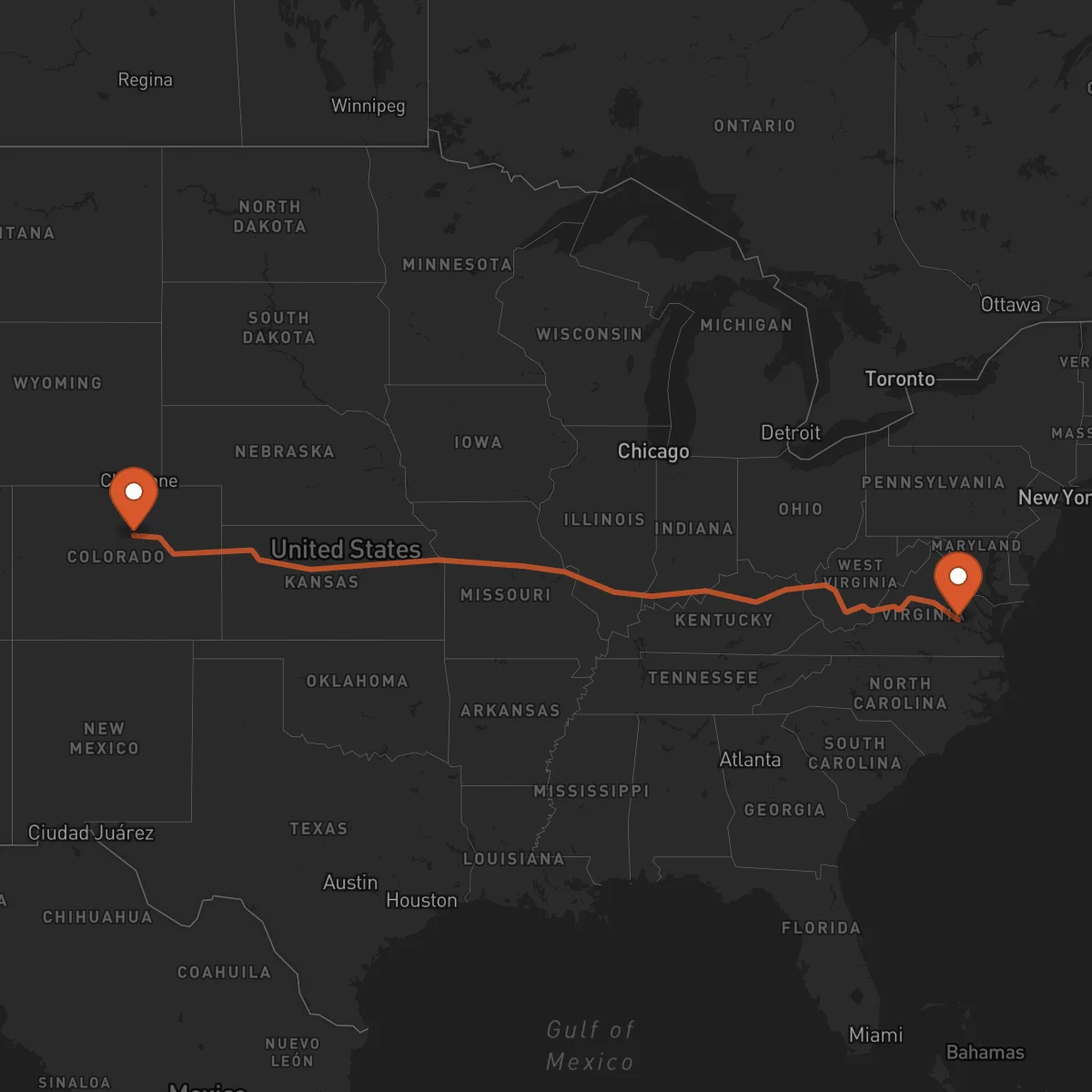
Richmond to Denver
Denver → RichmondFTL freight transportation service between Richmond and Denver. Reliable logistics solutions for your business.
Route Description
Everything you need to know about the corridor Richmond - Denver
The freight transportation corridor between Richmond, Virginia, and Denver, Colorado, represents a vital connection between the East Coast and the Rocky Mountain region of the United States. This 2,396-kilometer route traverses diverse landscapes and crosses multiple states, facilitating the movement of goods between two economically significant regions. The corridor serves as a critical link for companies operating across the eastern and central United States, connecting Virginia's port access and manufacturing base with Colorado's growing industrial and technological sectors.
The economic importance of this corridor is substantial, supporting industries ranging from manufacturing and automotive to technology and agriculture. Richmond, with its proximity to major East Coast ports and established industrial base, serves as a key origin point for manufactured goods, raw materials, and consumer products. Denver, positioned as a major distribution hub for the Mountain West region, receives these goods for distribution throughout Colorado, Wyoming, Utah, and beyond. The route facilitates just-in-time inventory management and supply chain optimization for companies operating in both regions.
This corridor primarily utilizes major interstate highways including I-64, I-70, and I-76, providing reliable and efficient transportation infrastructure. Control Terrestre leverages this established network to offer full truckload (FTL) services that ensure dedicated capacity and direct delivery between Richmond and Denver. Our specialized carriers, certified with C-TPAT, FAST, and other industry standards, provide secure and compliant transportation solutions that meet the specific needs of businesses moving freight across this extensive route.
Services for this Route
Available services for the corridor Richmond - Denver
 Origin
Richmond
Richmond, Virginia, serves as a strategic logistics hub on the East Coast, offering excellent connectivity to major ports, rail networks, and interstate highways. Located just 160 kilometers from the Port of Virginia, one of the largest container ports on the East Coast, Richmond provides immediate access to international trade routes. The city's central location within Virginia and proximity to Washington D.C. make it an ideal origin point for freight distribution throughout the Mid-Atlantic and Northeast regions. Richmond's infrastructure includes multiple interstate connections (I-95, I-64, I-295) that facilitate efficient outbound freight movement to western destinations like Denver.
The Richmond metropolitan area hosts diverse industries including advanced manufacturing, food processing, healthcare, and technology. Major employers in the region drive consistent freight volumes, particularly in automotive parts, pharmaceuticals, and consumer goods. The area's manufacturing sector produces a wide range of products destined for national distribution, while its agricultural connections provide food and beverage shipments. Richmond's economic diversity ensures steady demand for full truckload services along the corridor to Denver, with shipments typically including manufactured goods, industrial equipment, and consumer products requiring dedicated transportation capacity.
 Destination
Denver
Denver, Colorado, stands as a strategic logistics center in the Mountain West region, offering unique advantages for freight distribution across the western United States. Situated at the intersection of major interstate highways (I-70, I-25, I-76), Denver provides critical access to Colorado, Wyoming, Utah, and surrounding states. The city's location at the base of the Rocky Mountains makes it a natural gateway for goods moving between the eastern and western regions of the country. Denver International Airport, one of the largest cargo airports in the nation, complements the city's ground transportation infrastructure, creating a multimodal logistics environment.
The Denver metropolitan area has experienced significant economic growth, particularly in aerospace, technology, energy, and outdoor recreation industries. The region's manufacturing sector produces specialized equipment and electronics, while its energy industry generates consistent freight volumes for both inbound raw materials and outbound finished products. Denver's role as a distribution hub for the Mountain West means it receives diverse freight types, from industrial machinery and construction materials to consumer packaged goods and retail inventory. The city's growing population and economic expansion continue to drive demand for reliable full truckload services from origin points like Richmond, supporting supply chain operations across multiple industries.










