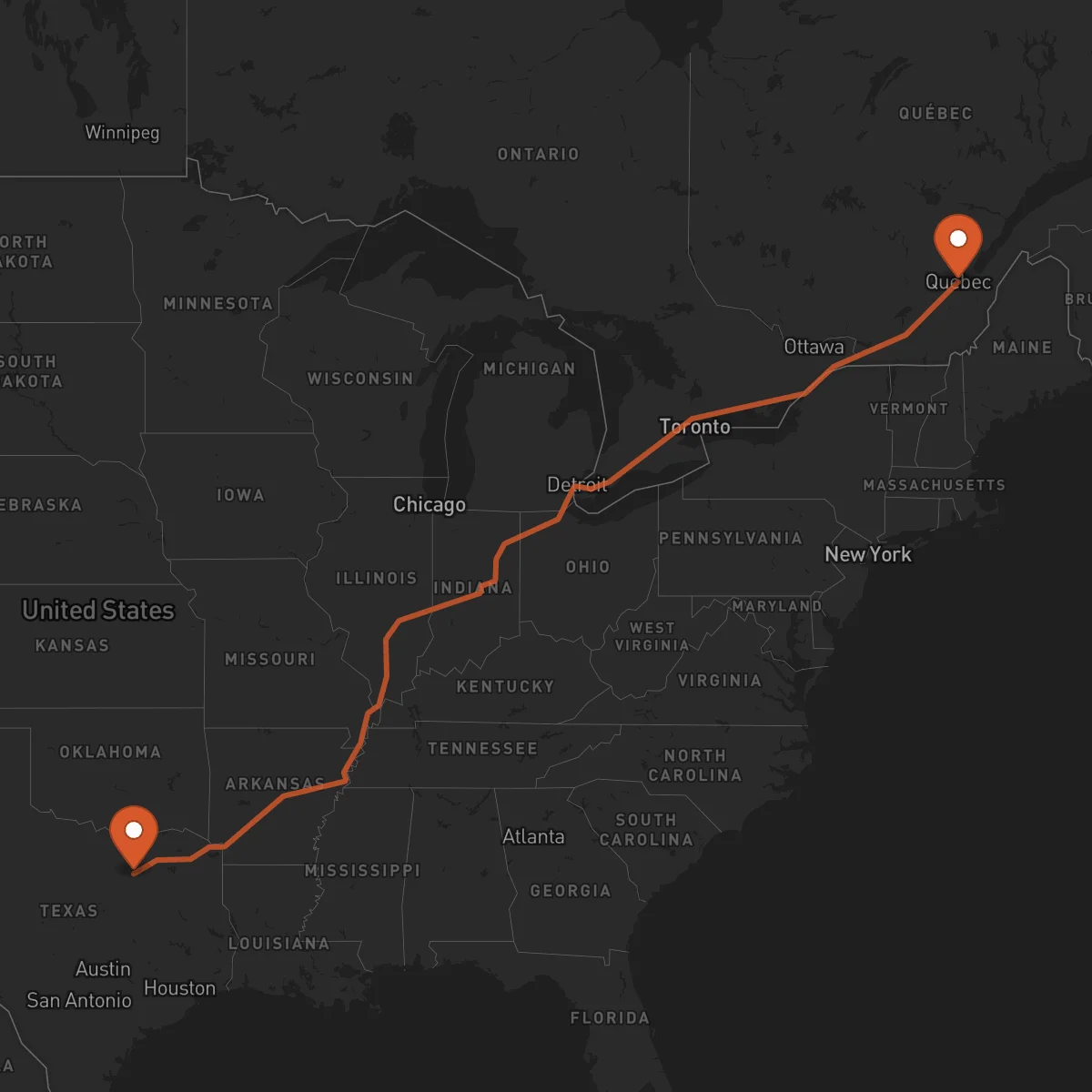
Quebec City to Dallas
Dallas → Quebec CityFTL freight transportation service between Quebec City and Dallas. Reliable logistics solutions for your business.
Route Description
Everything you need to know about the corridor Quebec City - Dallas
The Quebec City to Dallas corridor represents a vital cross-border logistics route connecting the industrial heartland of Canada with one of the most dynamic economic centers in the southern United States. This 2,666-kilometer route traverses diverse landscapes and crosses multiple jurisdictions, making it essential for companies engaged in North American trade. The corridor facilitates the movement of goods between Quebec's manufacturing and technology sectors and Texas's energy, aerospace, and advanced manufacturing industries, creating a critical supply chain link that supports economic growth on both sides of the border.
The transportation infrastructure along this route is robust, with major highways including I-35, I-29, and I-81 providing efficient north-south connectivity. The corridor passes through key border crossings such as the Ambassador Bridge in Detroit or the Blue Water Bridge in Port Huron, depending on the specific routing chosen. These crossings are equipped with modern customs facilities and benefit from programs like FAST (Free and Secure Trade), which expedites the processing of pre-approved, low-risk shipments. Control Terrestre's extensive network of certified carriers ensures seamless cross-border operations, with expertise in navigating customs documentation, compliance requirements, and potential delays at border crossings.
This corridor serves a diverse range of industries, with automotive parts, aerospace components, industrial machinery, and consumer goods being among the most commonly transported commodities. The route is particularly important for time-sensitive shipments that require full truckload (FTL) service, as the dedicated nature of FTL transportation ensures faster transit times and reduced handling compared to less-than-truckload (LTL) options. Control Terrestre's specialized fleet, including dry vans and refrigerated units, can accommodate various cargo types while maintaining the integrity and security of shipments throughout the journey from Quebec City to Dallas.
Services for this Route
Available services for the corridor Quebec City - Dallas
 Origin
Quebec City serves as a strategic logistics hub in eastern Canada, leveraging its position along the St. Lawrence River and proximity to major manufacturing centers in Quebec and Ontario. The city's economy is anchored by aerospace, technology, and advanced manufacturing sectors, with companies like Bombardier and numerous tech startups driving demand for reliable freight transportation. Quebec City benefits from excellent transportation infrastructure, including the Jean Lesage International Airport, Port of Quebec for maritime shipping, and extensive highway networks connecting to Montreal and the U.S. border. The region's industrial base produces high-value goods requiring specialized handling, making it an ideal origin point for full truckload shipments destined for markets throughout North America.
 Destination
Dallas
Dallas stands as a premier logistics destination in the southern United States, serving as a gateway to Texas's vast industrial and commercial markets. The Dallas-Fort Worth metroplex is home to major corporations in telecommunications, banking, energy, and healthcare, creating substantial demand for inbound freight transportation. Dallas's strategic location provides access to the Gulf Coast ports, Mexico via Laredo, and the broader southwestern United States. The city boasts world-class infrastructure, including the Dallas/Fort Worth International Airport, multiple Class I rail terminals, and an extensive highway network with direct connections to I-35, I-30, and I-20. This infrastructure, combined with Dallas's pro-business environment and central location, makes it an ideal destination for full truckload shipments from Canadian origins, supporting just-in-time inventory systems and supply chain efficiency.










