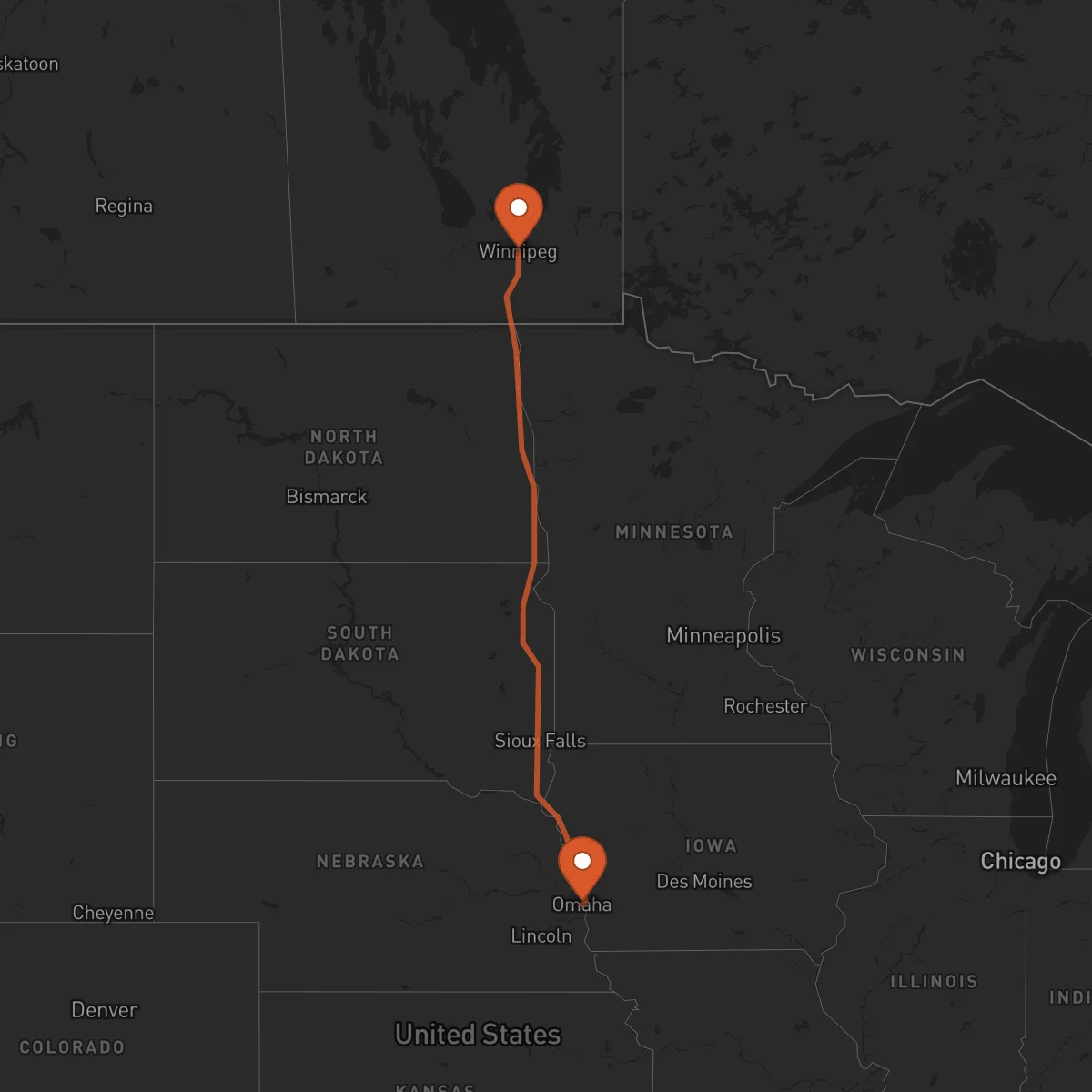
Omaha to Winnipeg
Winnipeg → OmahaFTL freight transportation service between Omaha and Winnipeg. Reliable logistics solutions for your business.
Route Description
Everything you need to know about the corridor Omaha - Winnipeg
The Omaha to Winnipeg corridor represents a vital cross-border logistics route connecting the heart of the American Midwest with Canada's strategic gateway to the West. This 965 km transportation artery links Nebraska's largest city with Manitoba's capital, facilitating the movement of goods between two major North American markets. The corridor traverses diverse landscapes and crosses the international border at Pembina, North Dakota, making it a crucial link for businesses operating across the US-Canada border.
The region's economic significance stems from its strategic location bridging the industrial heartland of the United States with Canada's growing western provinces. Omaha serves as a major distribution hub for the Midwest, while Winnipeg functions as a critical logistics center for goods moving between Canada's western provinces and the United States. This corridor supports the flow of agricultural products, manufactured goods, and industrial equipment between these two important economic regions.
Key industries utilizing this corridor include agriculture and food processing, automotive parts manufacturing, industrial machinery, and retail distribution. The route primarily follows Interstate 29 North through South Dakota before connecting to Interstate 29 and Provincial Trunk Highway 75, providing reliable access for full truckload (FTL) freight movements. Control Terrestre leverages this established infrastructure to provide seamless cross-border transportation services, ensuring efficient customs clearance and reliable delivery times for our clients' cargo moving between these strategic locations.
Services for this Route
Available services for the corridor Omaha - Winnipeg
 Origin
Omaha
Omaha, Nebraska stands as a strategic logistics hub in the American Midwest, offering exceptional connectivity for freight transportation. Located on the banks of the Missouri River, Omaha serves as a gateway to the Great Plains and provides direct access to major interstate highways including I-80 and I-29. The city's central location within the United States makes it an ideal origin point for distribution networks serving both coasts and the northern and southern regions.
The Omaha metropolitan area hosts a diverse industrial base, with key sectors including insurance and financial services, healthcare, education, and manufacturing. The region is particularly strong in food processing, with several major food companies maintaining significant operations in the area. Omaha's transportation infrastructure includes the Eppley Airfield for air cargo, extensive rail connections through Union Pacific Railroad, and a comprehensive network of highways facilitating efficient ground transportation. The city's proximity to major agricultural regions also makes it a crucial point for food and agricultural product distribution.
 Destination
Winnipeg, Manitoba serves as a strategic logistics hub for western Canada, positioned at the confluence of the Red and Assiniboine Rivers. Known as the 'Gateway to the West,' Winnipeg's location makes it a critical distribution center for goods moving throughout Canada's western provinces and into the northern territories. The city's position near the geographic center of North America provides unique advantages for cross-border freight movements.
The Winnipeg economy is diverse, with major industries including aerospace, transportation and logistics, manufacturing, and agriculture. The city is home to significant food processing facilities and serves as a key point for agricultural product distribution from the Canadian Prairies. Winnipeg's transportation infrastructure is comprehensive, featuring the Winnipeg James Armstrong Richardson International Airport, extensive rail connections through Canadian National Railway and Canadian Pacific Railway, and major highways including the Trans-Canada Highway and Provincial Trunk Highway 75, which provides direct access to the US border. The city's strategic location makes it an essential node in North American supply chains, particularly for goods moving between western Canada and the United States.










