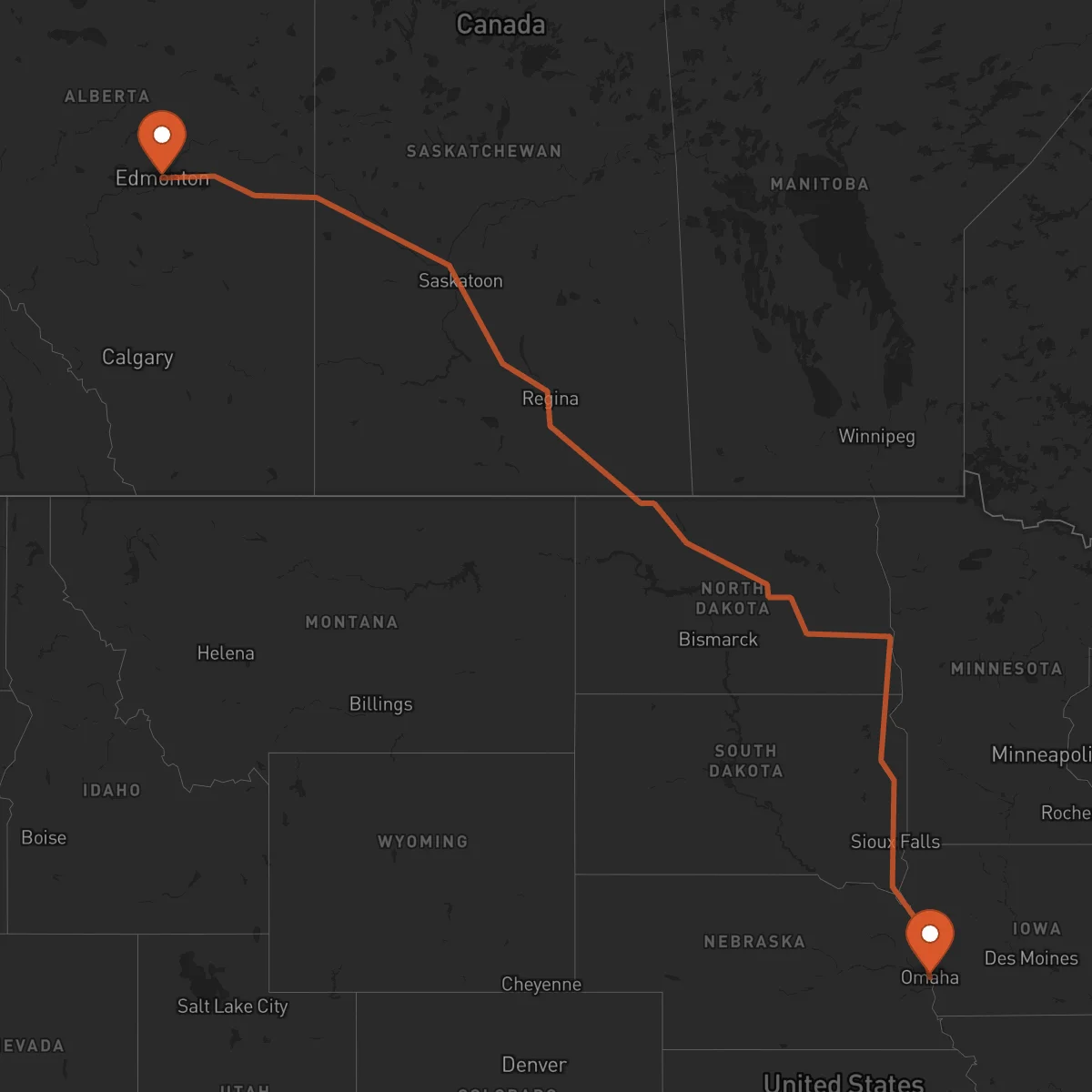
Omaha to Edmonton
Edmonton → OmahaFTL freight transportation service between Omaha and Edmonton. Reliable logistics solutions for your business.
Route Description
Everything you need to know about the corridor Omaha - Edmonton
The logistics corridor between Omaha, Nebraska and Edmonton, Alberta represents a vital cross-border transportation route connecting the central United States with Western Canada. This 1891 km corridor traverses through diverse landscapes and economic regions, facilitating the movement of goods between two major North American markets. The route passes through key states including Nebraska, South Dakota, North Dakota, and Montana before crossing into Alberta, Canada.
The corridor serves as a critical link for industries operating between the American Midwest and Western Canadian markets. Omaha's strategic location as a transportation hub in the central United States, combined with Edmonton's position as Alberta's capital and a major center for Canada's energy sector, creates substantial freight demand along this route. The corridor connects agricultural producers, manufacturing facilities, and energy companies across both nations.
Transportation infrastructure along this corridor includes major highways such as I-29, I-90, and the Yellowhead Highway (Highway 16), providing reliable freight movement capabilities. The primary border crossing at Sweetgrass, Montana/Coutts, Alberta offers efficient customs processing for commercial vehicles. Control Terrestre's expertise in cross-border operations ensures seamless freight movement through customs procedures, regulatory compliance, and coordination with certified carriers who maintain all necessary certifications including C-TPAT and FAST.
Our comprehensive FTL services along this corridor provide dedicated transportation solutions for companies requiring reliable, full truckload capacity. We coordinate with our network of experienced carriers to ensure consistent service quality, proper equipment selection, and timely delivery across the entire route, regardless of seasonal weather conditions that can affect this northern corridor.
Services for this Route
Available services for the corridor Omaha - Edmonton
 Origin
Omaha
Omaha, Nebraska serves as a strategic logistics hub in the American Midwest, positioned at the crossroads of major transportation networks. The city's location along the Missouri River and at the intersection of several interstate highways makes it an ideal origin point for freight distribution. Omaha's economy is diverse, with strong presence in financial services, insurance, telecommunications, and transportation sectors. The region is also a significant agricultural producer, with grain processing and food manufacturing playing important roles in the local economy.
The city boasts excellent transportation infrastructure including the Omaha International Airport, Union Pacific Railroad's headquarters, and extensive highway networks including I-80 and I-29. The Port of Omaha provides barge transportation along the Missouri River, while the metropolitan area's distribution centers and warehousing facilities support efficient freight consolidation and deconsolidation. These infrastructure assets make Omaha an optimal starting point for cross-border freight movements to Canada.
 Destination
Edmonton, Alberta stands as a major logistics center in Western Canada, serving as the capital city of Alberta and a gateway to northern resources. The city's strategic location along the North Saskatchewan River and its proximity to major oil sands developments in northern Alberta have established it as a critical distribution point for energy-related equipment and supplies. Edmonton's economy is heavily influenced by the energy sector, but also includes strong manufacturing, technology, and logistics industries.
The city features comprehensive transportation infrastructure including the Edmonton International Airport, extensive highway networks such as the Yellowhead Highway and QEII Highway, and significant rail connections. Edmonton's location at the northern end of the CANAMEX Corridor provides direct access to U.S. markets, while its role as a staging point for northern Canadian operations creates consistent freight demand. The city's industrial parks and warehousing facilities are equipped to handle diverse cargo types, from general freight to specialized equipment for the energy sector.










