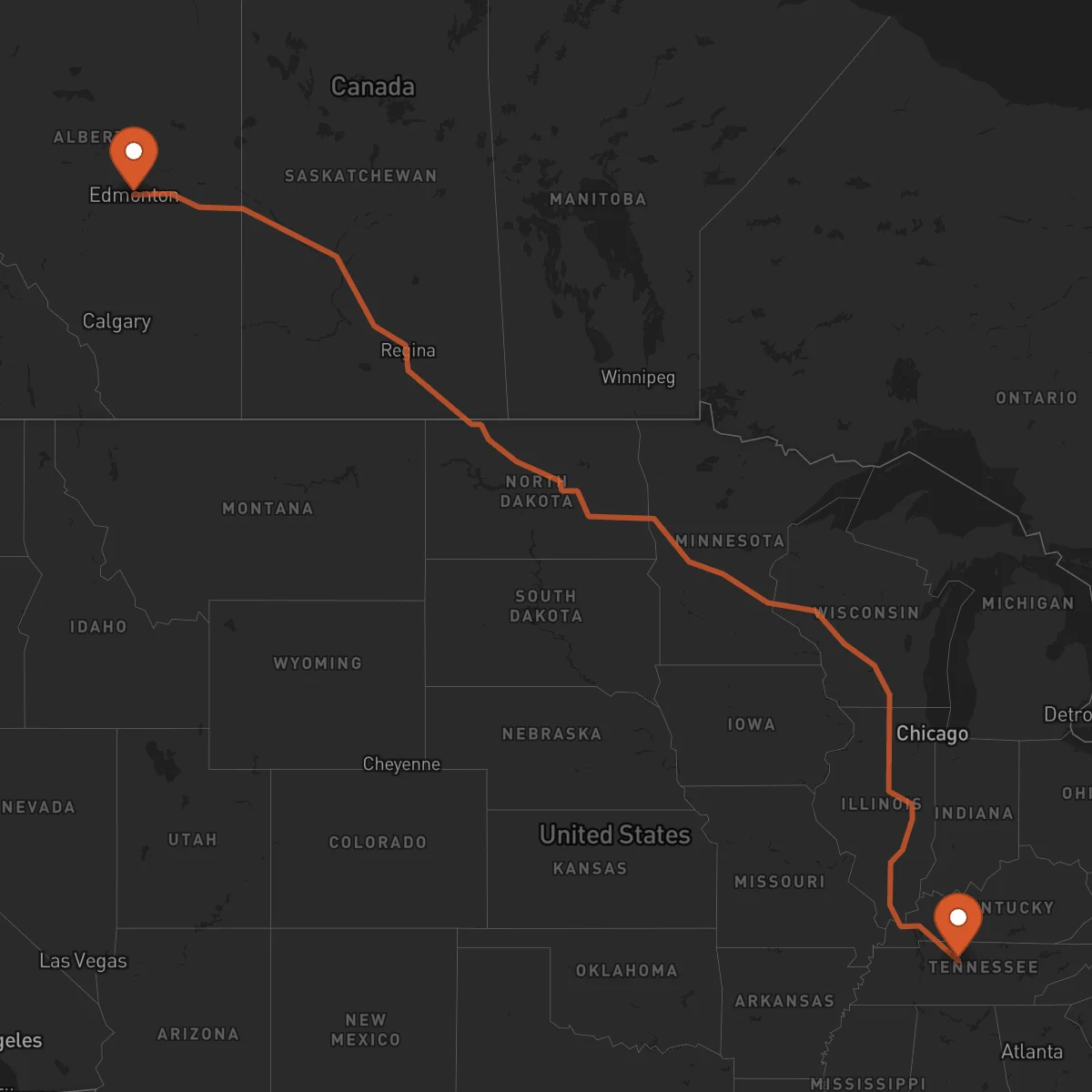
Nashville to Edmonton
Edmonton → NashvilleFTL freight transportation service between Nashville and Edmonton. Reliable logistics solutions for your business.
Route Description
Everything you need to know about the corridor Nashville - Edmonton
The logistics corridor between Nashville, Tennessee and Edmonton, Alberta represents a vital cross-border freight transportation route connecting the central United States with western Canada. This 2,827-kilometer route traverses diverse terrain and crosses international borders, making it essential for companies engaged in North American trade. The corridor facilitates the movement of goods between two major economic regions, supporting supply chain operations that require reliable full truckload (FTL) transportation services.
The economic significance of this corridor stems from the complementary industrial strengths of both regions. Nashville serves as a major distribution hub for the southeastern United States, with strong manufacturing, healthcare, and automotive sectors. Edmonton, as the capital of Alberta, anchors a robust energy sector and serves as a gateway to northern Canada. The route connects these economic powerhouses, enabling efficient movement of industrial equipment, automotive parts, consumer goods, and energy-related materials.
Key transportation infrastructure along this corridor includes major highways such as I-65, I-90, and various Canadian routes connecting through Montana and Alberta. The primary border crossing considerations involve efficient customs clearance processes to minimize delays. Control Terrestre leverages our strategic partnerships and certified transportation providers to ensure seamless cross-border operations, handling all necessary documentation and compliance requirements. Our expertise in navigating customs procedures and our network of reliable carriers ensure your freight moves efficiently from origin to destination, maintaining the integrity of your supply chain throughout this extensive cross-border journey.
Services for this Route
Available services for the corridor Nashville - Edmonton
 Origin
Nashville
Nashville, Tennessee serves as a strategic logistics hub in the southeastern United States, offering excellent connectivity through its central location and robust transportation infrastructure. The city's position provides access to major interstate highways including I-40, I-24, and I-65, facilitating efficient distribution throughout the region. Nashville's international airport and proximity to major rail terminals further enhance its logistical capabilities, making it an ideal origin point for cross-border freight movements.
The region's economy is anchored by diverse industries including automotive manufacturing, healthcare, music and entertainment, and advanced manufacturing. Major corporations have established distribution centers in the Nashville area, taking advantage of its business-friendly environment and skilled workforce. The presence of automotive giants and healthcare companies creates substantial freight transportation demand, particularly for specialized equipment and time-sensitive medical supplies. Nashville's growing population and economic development continue to strengthen its position as a key logistics center for both domestic and international freight movements.
 Destination
Edmonton, Alberta stands as a strategic logistics gateway to western Canada and the northern territories, offering unique advantages for freight transportation. The city's location provides access to major transportation corridors including the Yellowhead Highway (Highway 16) and proximity to the Alaska Highway, creating multiple routing options for freight movements. Edmonton International Airport and the Port Alberta initiative further enhance the region's logistics capabilities, supporting both air and ground freight operations.
The Edmonton economy is heavily influenced by the energy sector, with Alberta's oil sands and natural resource industries driving substantial freight demand. The region also features strong agricultural, manufacturing, and technology sectors, creating diverse shipping requirements. Edmonton's role as Alberta's capital city ensures consistent government and commercial activity, while its position as a distribution center for northern Canada makes it a critical node in cross-border supply chains. The city's infrastructure is designed to handle heavy industrial equipment and specialized freight, supporting the unique needs of energy and resource-based industries.










