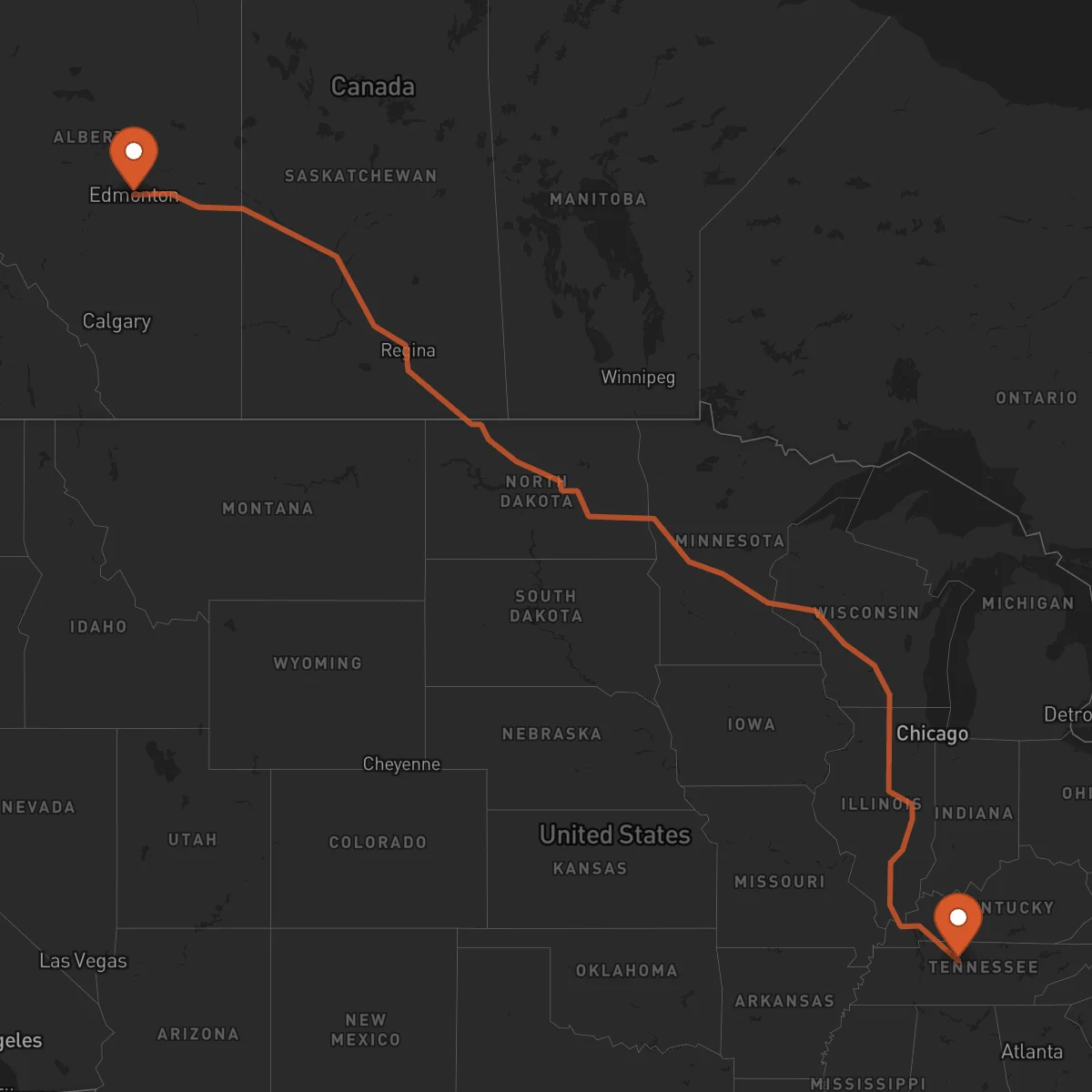
Edmonton to Nashville
Nashville → EdmontonFTL freight transportation service between Edmonton and Nashville. Reliable logistics solutions for your business.
Route Description
Everything you need to know about the corridor Edmonton - Nashville
The Edmonton to Nashville corridor represents a vital cross-border freight transportation route connecting the industrial heart of Alberta with the logistics hub of Tennessee. This 2,827 km route traverses diverse terrain and crosses international borders, requiring specialized expertise in customs clearance and cross-border logistics. The corridor serves as a critical link between Canada's energy and manufacturing sectors and the United States' distribution networks, facilitating the movement of goods that drive both economies.
The economic significance of this corridor cannot be overstated, as it connects two major industrial regions. Edmonton serves as a key center for Canada's oil and gas industry, along with manufacturing and agricultural sectors, while Nashville has emerged as a major distribution and logistics hub for the southeastern United States. The route accommodates high volumes of industrial equipment, automotive parts, agricultural products, and manufactured goods, supporting the supply chains of numerous multinational corporations.
Key transportation infrastructure along this corridor includes major highways such as I-29, I-55, and I-40, providing efficient north-south and east-west connectivity. The route typically involves crossing at major ports of entry, where our C-TPAT certified carriers ensure expedited processing through customs. Control Terrestre's expertise in cross-border operations, combined with our network of experienced carriers, ensures seamless freight movement across this international corridor, handling all necessary documentation, compliance requirements, and coordination with customs authorities to minimize delays and optimize transit times.
Services for this Route
Available services for the corridor Edmonton - Nashville
 Origin
Edmonton, located in Alberta, Canada, serves as a strategic logistics hub for Western Canada. The city's position along the Yellowhead Highway (Highway 16) provides direct access to major transportation routes connecting to Vancouver, Calgary, and the northern territories. Edmonton's economy is heavily influenced by the oil and gas industry, with numerous energy companies headquartered in the region, along with significant manufacturing, construction, and agricultural sectors. The city's industrial areas offer extensive warehousing and distribution facilities, while Edmonton International Airport and major rail connections through CN and CP rail lines provide multimodal transportation options. The city's infrastructure is designed to handle oversized and specialized cargo, making it an ideal origin point for diverse freight shipments.
 Destination
Nashville
Nashville, Tennessee, has established itself as a premier logistics and distribution center in the southeastern United States. The city's strategic location provides access to over 50% of the U.S. population within a day's drive, making it an ideal hub for national distribution networks. Nashville's economy is diverse, with strong presence in healthcare, automotive manufacturing, music and entertainment, and food and beverage industries. The region boasts extensive transportation infrastructure, including the Nashville International Airport, multiple Class I rail lines, and direct access to major interstates such as I-40, I-24, and I-65. The city's industrial parks and modern warehousing facilities are equipped to handle high-volume distribution operations, while its proximity to major consumer markets makes it an attractive destination for freight from across North America.










