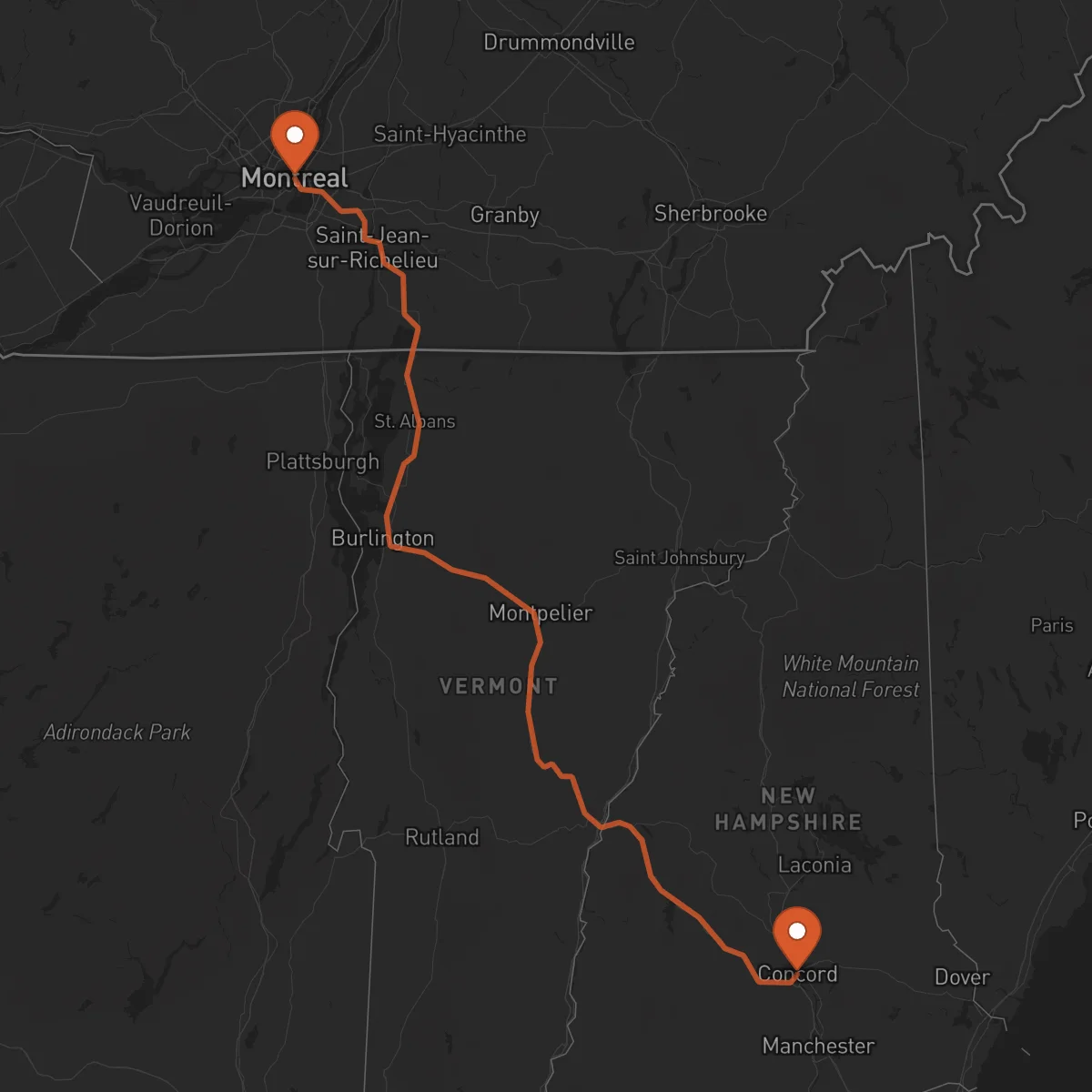
Montreal to Concord
Concord → MontrealFTL freight transportation service between Montreal and Concord. Reliable logistics solutions for your business.
Route Description
Everything you need to know about the corridor Montreal - Concord
The logistics corridor between Montreal, Quebec, and Concord, New Hampshire, represents a vital cross-border connection in North America. This 302-kilometer route links Canada's second-largest metropolitan area with a key city in New England, facilitating the movement of goods between two major economic regions. The corridor traverses the Canadian provinces of Quebec and Ontario before crossing into the United States through New Hampshire, making it an essential pathway for international trade between these neighboring countries.
The region's economic significance is underscored by its diverse industrial base. Montreal serves as a major financial, manufacturing, and technology hub, while Concord functions as a center for healthcare, government services, and advanced manufacturing. The corridor supports the flow of various commodities including automotive parts, industrial equipment, pharmaceuticals, and consumer goods. Manufacturing facilities, distribution centers, and logistics hubs along the route contribute to the corridor's importance in the North American supply chain.
Transportation infrastructure along this corridor is robust, with key highways including Autoroute 10 and Autoroute 35 in Quebec, connecting to Interstate 93 in New Hampshire. The main border crossing at Highgate Springs-St. Armand facilitates the efficient movement of freight between the two countries. Control Terrestre specializes in navigating the complexities of cross-border transportation, ensuring seamless customs clearance and compliance with regulations on both sides of the border. Our expertise in this corridor allows us to provide reliable, timely freight solutions for businesses operating between Montreal and Concord.
Services for this Route
Available services for the corridor Montreal - Concord
 Origin
Montreal, Quebec, stands as a strategic logistics hub in eastern Canada, offering exceptional connectivity for freight transportation. As Canada's second-largest metropolitan area, Montreal boasts a comprehensive transportation network including one of the country's busiest ports, extensive rail connections, and major highways linking to both eastern and western Canada. The city's location on the St. Lawrence River provides access to international shipping routes, while its proximity to the U.S. border makes it an ideal gateway for cross-border freight movements.
The city's diverse economic sectors include aerospace, technology, pharmaceuticals, and advanced manufacturing, all of which generate significant freight volumes. Montreal is home to numerous distribution centers and warehouses, serving both the local Quebec market and providing transshipment points for goods moving throughout North America. The city's transportation infrastructure includes Pierre Elliott Trudeau International Airport for air freight, major rail yards operated by CN and CP, and a network of highways including Autoroutes 10, 15, and 20 that facilitate efficient ground transportation.
 Destination
Concord
Concord, New Hampshire, serves as a strategic logistics point in New England, offering excellent connectivity to major markets in the northeastern United States. Located in the heart of New Hampshire, Concord provides access to the Boston metropolitan area within a two-hour drive and serves as a gateway to the broader New England region. The city's central location makes it an ideal distribution point for companies serving Vermont, Maine, Massachusetts, and other northeastern states.
The city's economy is anchored by healthcare, government services, and advanced manufacturing sectors, with several major employers in these industries. Concord benefits from its proximity to Manchester-Boston Regional Airport for air freight and has good highway connections via Interstate 93, which runs north-south through the city. The surrounding Merrimack County area features several industrial parks and distribution centers that support the region's logistics needs. Concord's location away from major urban congestion while maintaining excellent connectivity to major markets makes it an attractive destination for logistics operations.










