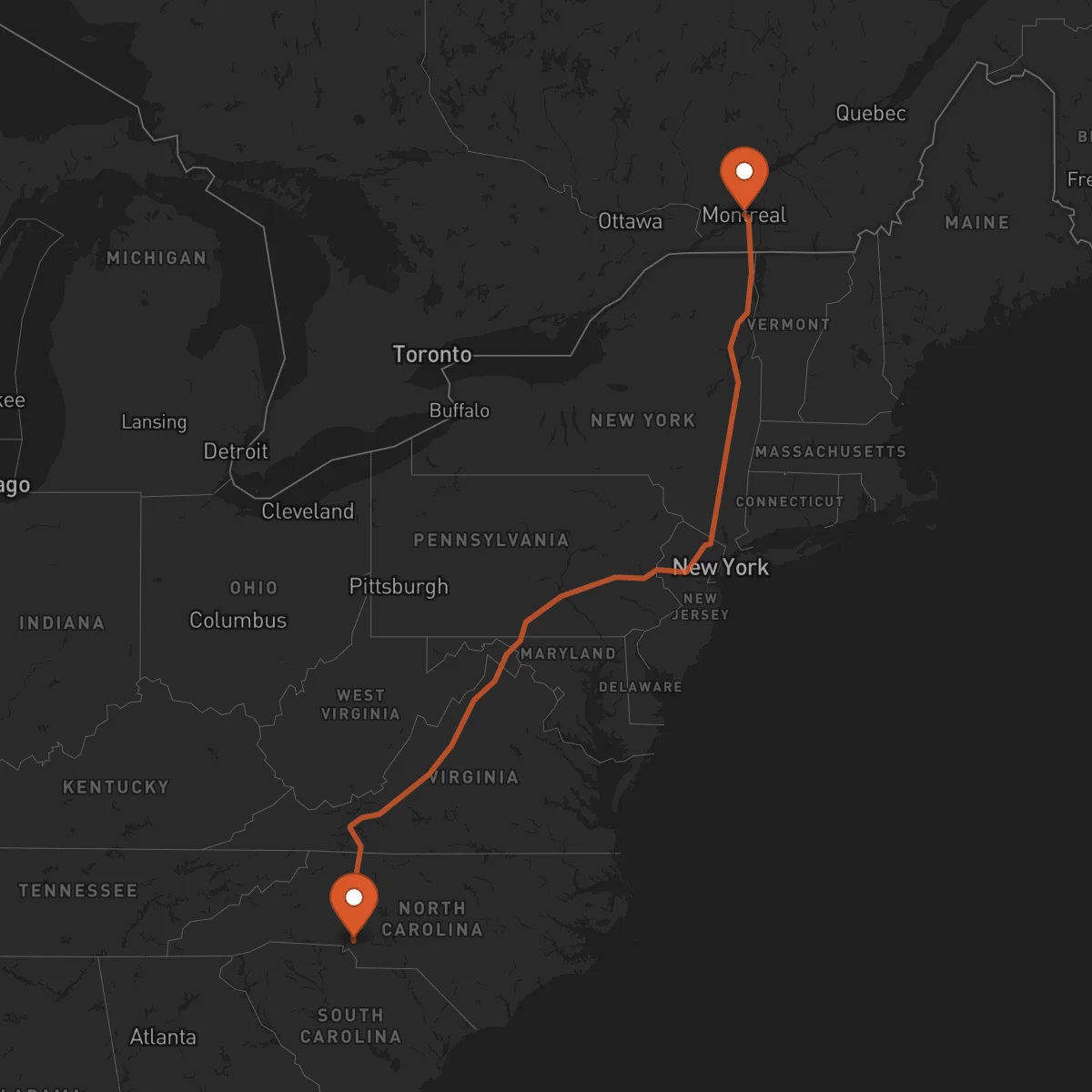
Montreal to Charlotte
Charlotte → MontrealFTL freight transportation service between Montreal and Charlotte. Reliable logistics solutions for your business.
Route Description
Everything you need to know about the corridor Montreal - Charlotte
The Montreal-Charlotte corridor connects two major economic hubs in North America, spanning approximately 1,297 kilometers through Canada and the United States. This cross-border route traverses diverse terrain and passes through key industrial regions, making it a vital artery for freight transportation between Quebec and the southeastern United States.
The corridor primarily utilizes major highways including Autoroute 20 and Autoroute 40 in Quebec, which connect to Interstate 81 and Interstate 77 in the United States. These well-maintained interstate systems ensure reliable transit times and efficient cargo movement. The route crosses at strategic border points, with the Champlain-St. Bernard de Lacolle crossing being a primary entry point for commercial traffic heading south.
This transportation corridor serves numerous industries including automotive manufacturing, aerospace components, pharmaceuticals, and advanced manufacturing. Montreal's position as a major port of entry for goods from Europe and Asia makes it a crucial origin point, while Charlotte's growing logistics hub status and proximity to major automotive and technology centers creates strong demand for reliable freight services. The corridor also facilitates the movement of specialized cargo, including temperature-controlled goods and oversized equipment.
Control Terrestre provides comprehensive cross-border FTL services along this corridor, ensuring seamless customs clearance and regulatory compliance. Our experienced team manages all documentation requirements and coordinates with trusted carriers who understand the specific requirements of this international route. We maintain consistent communication throughout the journey, providing real-time tracking and proactive problem-solving to ensure your cargo reaches its destination efficiently.
Services for this Route
Available services for the corridor Montreal - Charlotte
 Origin
Montreal stands as a strategic logistics powerhouse in eastern Canada, serving as the largest inland port in North America. The city's location on the St. Lawrence River provides crucial maritime connections, while its extensive rail network and proximity to major U.S. markets make it an ideal origin point for cross-border freight. Montreal's advanced transportation infrastructure includes the Port of Montreal, which handles over 26 million tons of cargo annually, and comprehensive highway connections to both eastern and western Canada.
The city hosts diverse economic sectors including aerospace, where major manufacturers like Bombardier operate, pharmaceuticals with companies like Pfizer maintaining significant operations, and technology firms driving innovation. Montreal's strong manufacturing base, particularly in automotive parts and advanced electronics, generates substantial freight volume requiring reliable transportation solutions. The region's commitment to sustainable logistics and green initiatives aligns with modern supply chain requirements.
 Destination
Charlotte
Charlotte has emerged as a strategic logistics center in the southeastern United States, offering excellent connectivity to major markets along the East Coast and throughout the Southeast. The city's location provides access to Interstate 77, connecting north to major northern markets and south to Florida, while Interstate 85 links to Atlanta and beyond. Charlotte Douglas International Airport serves as a major cargo hub, complementing the robust ground transportation network.
The region has experienced significant growth in financial services, with major banking institutions headquartered here, alongside a strong presence in energy, technology, and advanced manufacturing. Charlotte's automotive industry has expanded notably, with suppliers and manufacturers requiring reliable inbound logistics from Canadian production facilities. The city's logistics infrastructure includes multiple warehousing and distribution centers, making it an ideal destination for freight consolidation and distribution operations.










