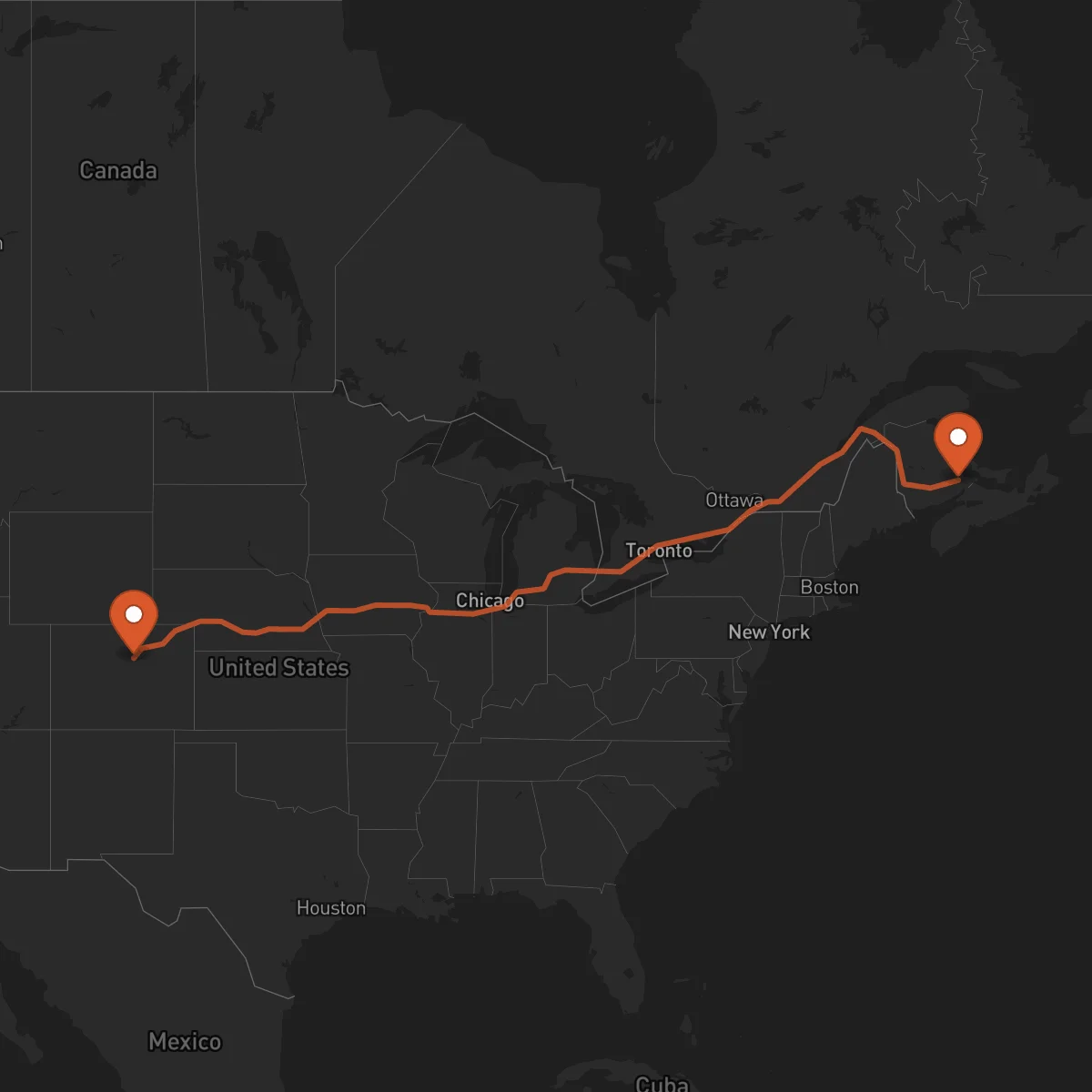
Moncton to Denver
Denver → MonctonFTL freight transportation service between Moncton and Denver. Reliable logistics solutions for your business.
Route Description
Everything you need to know about the corridor Moncton - Denver
The logistics corridor between Moncton, New Brunswick and Denver, Colorado represents a vital cross-border connection linking Atlantic Canada with the heart of the Rocky Mountain region. This 3,313 km route traverses diverse landscapes and connects major economic centers across two countries, facilitating the movement of goods between Canada's eastern provinces and the United States' central-western markets. The corridor serves as a critical artery for North American trade, supporting industries that require reliable full truckload transportation solutions.
The economic significance of this corridor is substantial, connecting Moncton's growing logistics hub with Denver's thriving business ecosystem. Moncton serves as a key distribution center for Atlantic Canada, with its strategic location near major ports and rail terminals. Denver, meanwhile, functions as a major commercial center for the Rocky Mountain region, with strong sectors in aerospace, technology, energy, and manufacturing. This complementary economic relationship drives consistent freight demand along the route.
Key industries utilizing this corridor include automotive parts manufacturing, aerospace components, industrial equipment, and consumer goods distribution. The route primarily follows major highways including the Trans-Canada Highway (Route 2) from Moncton through Quebec and Ontario, transitioning to I-90 and I-25 in the United States. The primary border crossing is typically at the Thousand Islands Bridge near Ontario, offering efficient customs processing for pre-cleared shipments.
Control Terrestre facilitates seamless operations on this corridor through our extensive network of certified transportation providers. Our expertise in cross-border logistics ensures smooth customs clearance, proper documentation handling, and reliable delivery scheduling. We coordinate with trusted carriers who understand the specific requirements of this route, including weather considerations across mountain passes and seasonal variations that can affect transit times. Our dedicated approach to full truckload services means your cargo moves directly from origin to destination without intermediate handling, maintaining supply chain integrity throughout the journey.
Services for this Route
Available services for the corridor Moncton - Denver
 Origin
Moncton
Moncton's strategic location in New Brunswick positions it as a crucial logistics hub for Atlantic Canada. Situated near the Bay of Fundy and within proximity to major ports, Moncton serves as a gateway for goods moving between the Atlantic provinces and the rest of North America. The city's central location within the Maritimes makes it an ideal distribution point for companies serving New Brunswick, Nova Scotia, and Prince Edward Island. Moncton's robust transportation infrastructure includes the Greater Moncton Roméo LeBlanc International Airport, extensive rail connections through CN Rail, and direct highway access via the Trans-Canada Highway, providing multiple options for freight movement.
 Destination
Denver
Denver's strategic location at the foot of the Rocky Mountains makes it a pivotal logistics center for the central-western United States. As the largest city in a 600-mile radius, Denver serves as a natural distribution hub for Colorado, Wyoming, Utah, and surrounding states. The city's elevation and geographic position create unique logistical considerations, but also offer advantages for certain types of freight movement. Denver's transportation infrastructure is exceptionally well-developed, featuring Denver International Airport (one of the busiest cargo airports in the nation), extensive rail yards operated by BNSF and Union Pacific, and major interstate highways including I-70, I-25, and I-76. The city's strong presence in aerospace, technology, energy, and manufacturing sectors generates consistent demand for full truckload freight services connecting to both coasts and international markets.










