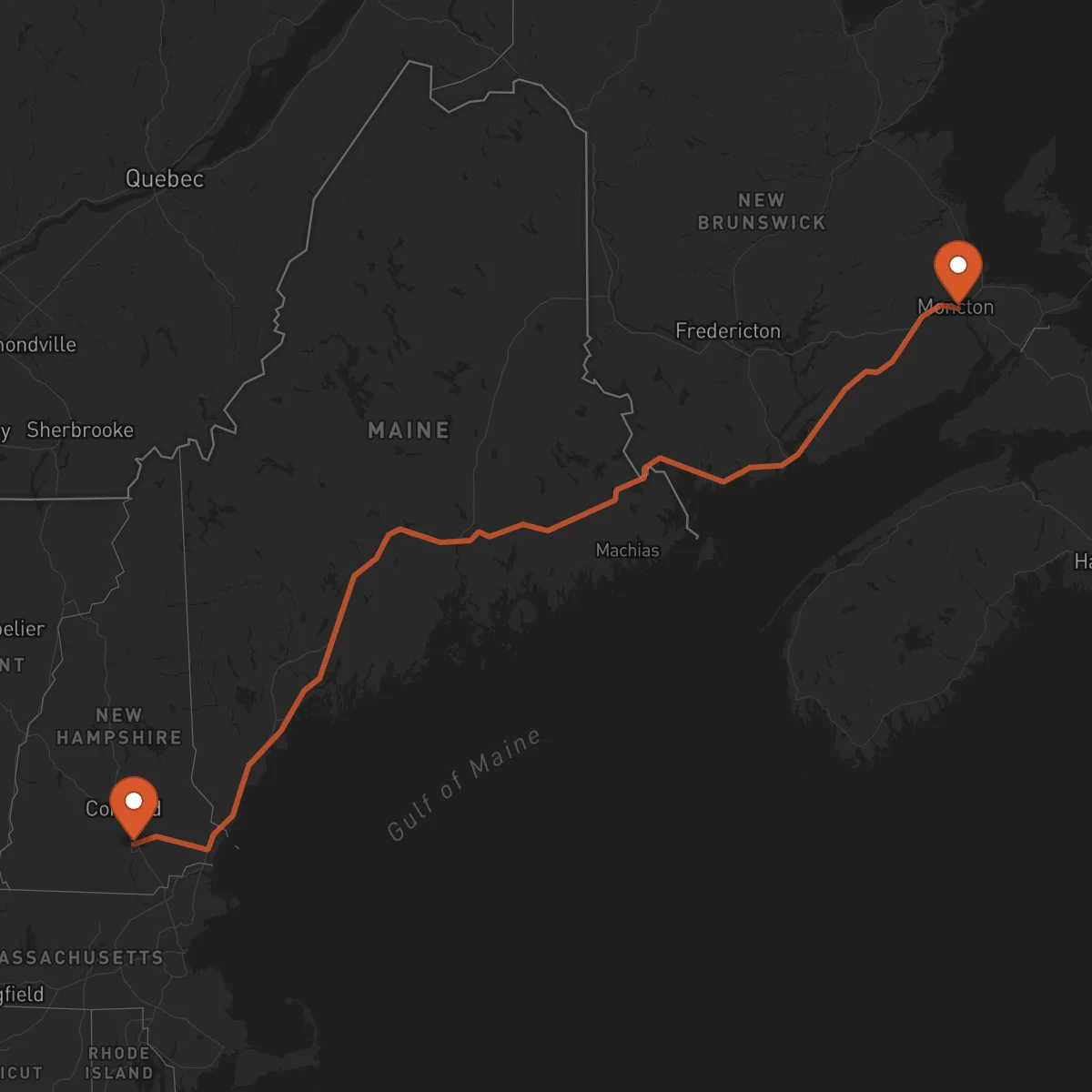
Manchester to Moncton
Moncton → ManchesterFTL freight transportation service between Manchester and Moncton. Reliable logistics solutions for your business.
Route Description
Everything you need to know about the corridor Manchester - Moncton
The Manchester to Moncton corridor represents a vital cross-border freight route connecting New Hampshire with New Brunswick, spanning approximately 631 kilometers through the northeastern United States and Canada. This strategic transportation link facilitates the movement of goods between the industrial centers of New England and the Atlantic Canadian provinces, serving as a crucial artery for regional trade and supply chain operations. The corridor traverses diverse terrain, from the rolling hills of New Hampshire through Maine's forests, before crossing into New Brunswick at key border points.
The economic significance of this route extends beyond its geographic span, connecting manufacturing hubs in southern New Hampshire with distribution centers and ports in Atlantic Canada. Manchester's proximity to major New England markets combined with Moncton's role as a logistics gateway to the Maritimes creates a complementary relationship that drives substantial freight volumes. The corridor particularly benefits from the strong trade relationship between the United States and Canada, with numerous companies relying on efficient cross-border transportation to maintain competitive supply chains.
Primary industries utilizing this corridor include automotive parts, industrial equipment, consumer goods, and agricultural products. The route accommodates significant volumes of time-sensitive freight, particularly for manufacturers operating on just-in-time inventory systems. Major transportation infrastructure includes Interstate 93 and U.S. Route 2 in New Hampshire, transitioning to Canadian highways that connect through Maine before reaching New Brunswick. Key border crossings such as Houlton-Woodstock provide efficient customs processing for commercial shipments.
Control Terrestre's expertise in cross-border operations ensures seamless freight movement along this corridor, handling all customs documentation, regulatory compliance, and border clearance procedures. Our dedicated fleet and experienced drivers understand the specific requirements for transporting goods between the United States and Canada, minimizing delays and ensuring reliable delivery schedules. We provide comprehensive door-to-door service, maintaining constant communication throughout the journey to keep clients informed of their shipment status.
Services for this Route
Available services for the corridor Manchester - Moncton
 Origin
Manchester
Manchester, New Hampshire serves as a strategic logistics hub in the northeastern United States, offering excellent connectivity to major New England markets. Located approximately 90 kilometers north of Boston, Manchester benefits from its position within the Boston-Worcester-Manchester combined statistical area, providing access to over 8 million consumers within a 3-hour drive. The city's industrial heritage has evolved into a modern logistics center, with numerous warehousing and distribution facilities supporting regional supply chains.
The economic landscape of Manchester encompasses advanced manufacturing, technology, healthcare, and professional services sectors. Major employers include manufacturing companies producing electronics, medical devices, and industrial equipment that require reliable transportation to Canadian markets and beyond. The city's transportation infrastructure includes Manchester-Boston Regional Airport for air freight, extensive highway networks including Interstate 93, and rail connections through Pan Am Railways, providing multiple options for freight movement.
 Destination
Moncton
Moncton, New Brunswick represents a strategic logistics gateway to Atlantic Canada, positioned at the geographic center of the Maritime provinces. Known as the "Hub City" for its central location, Moncton provides access to over 1.4 million people within a 4-hour drive and serves as a critical distribution point for goods throughout New Brunswick, Nova Scotia, and Prince Edward Island. The city's bilingual workforce and strong infrastructure make it an ideal logistics center for cross-border operations.
The economic base of Moncton includes transportation, distribution, retail, and manufacturing sectors, with significant growth in call centers and technology services. The city hosts major distribution centers for national retailers and serves as a key point for agricultural products from the Maritimes destined for U.S. markets. Transportation infrastructure includes the Greater Moncton Roméo LeBlanc International Airport, extensive highway networks including the Trans-Canada Highway, and the Moncton Intermodal Terminal, providing comprehensive freight handling capabilities for both domestic and international shipments.










