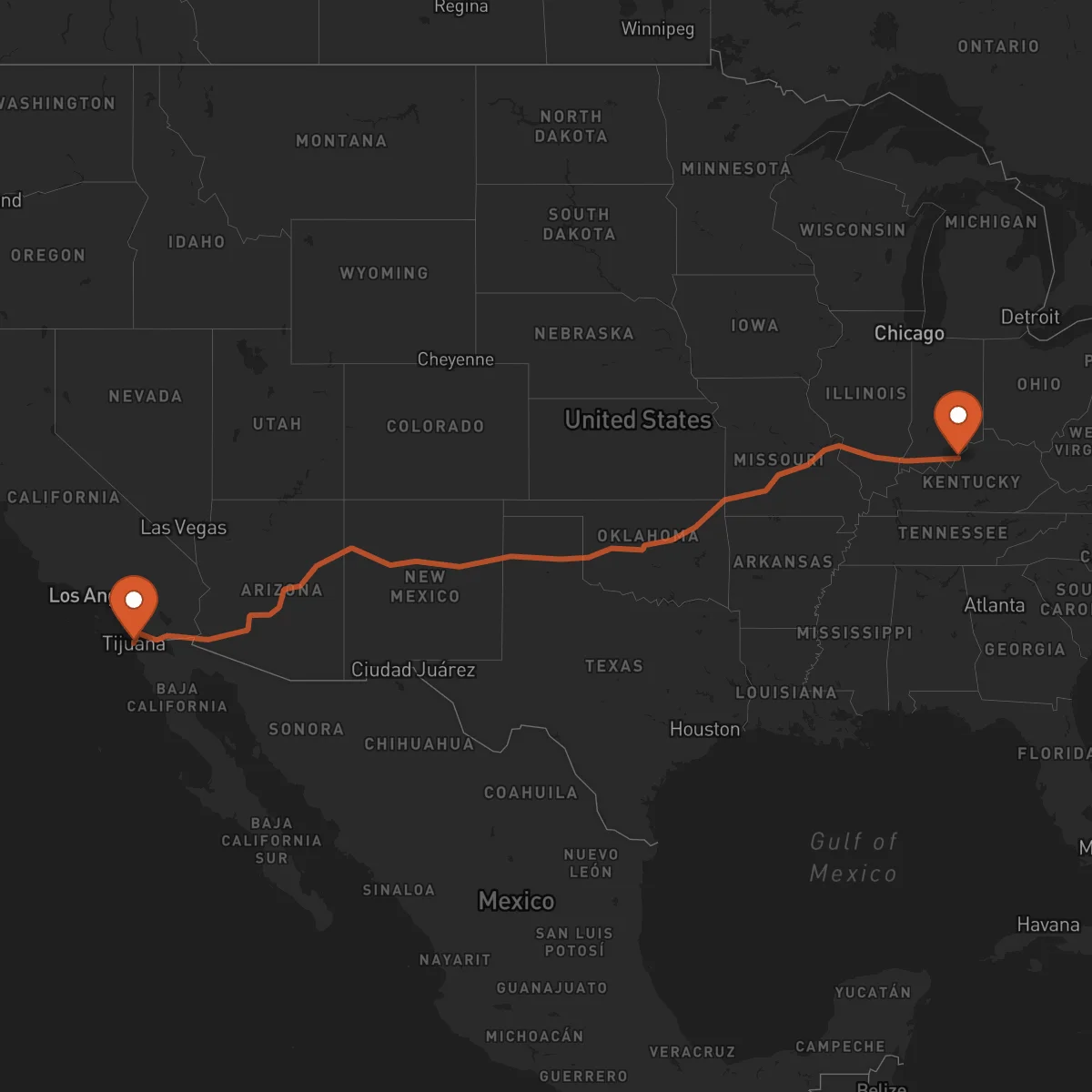
Louisville to Tijuana
Tijuana → LouisvilleFTL freight transportation service between Louisville and Tijuana. Reliable logistics solutions for your business.
Route Description
Everything you need to know about the corridor Louisville - Tijuana
The Louisville to Tijuana logistics corridor represents a vital cross-border freight route connecting the heart of the American Midwest with Mexico's leading manufacturing hub on the Pacific coast. This 2,889 km corridor traverses diverse landscapes and crosses multiple states, facilitating the movement of goods between two major industrial regions. The route strategically links Louisville's robust manufacturing and logistics ecosystem with Tijuana's position as a key player in Mexico's maquiladora industry and its proximity to major Pacific ports.
The economic significance of this corridor is underscored by the complementary industrial strengths of both regions. Louisville serves as a major distribution center with strong automotive, aerospace, and healthcare manufacturing sectors, while Tijuana has emerged as a leading destination for electronics assembly, medical device manufacturing, and automotive parts production. This synergy creates substantial freight demand moving in both directions, with components, raw materials, and finished goods flowing continuously between these economic powerhouses.
Transportation along this corridor primarily utilizes Interstate 65 south from Louisville to connect with major interstate highways leading to the West Coast, before transitioning to Interstate 8 or Interstate 10 toward the California-Baja California border. The main border crossing utilized is typically Otay Mesa for its efficiency with commercial freight, though other crossings may be used based on specific routing and customs requirements. Control Terrestre's expertise in cross-border operations ensures seamless navigation of customs procedures, regulatory compliance, and efficient cargo handling throughout this extensive journey, providing reliable FTL transportation solutions that keep your supply chain moving smoothly between these critical industrial centers.
Services for this Route
Available services for the corridor Louisville - Tijuana
 Origin
Louisville
Louisville, Kentucky stands as a strategic logistics hub in the American Midwest, leveraging its central geographic location and robust transportation infrastructure. The city serves as a critical nexus where major interstate highways converge, including I-65, I-64, and I-71, providing excellent connectivity to both coastal regions and inland markets. Louisville's position on the Ohio River further enhances its logistics capabilities, offering multimodal transportation options that complement its extensive road network. The city is home to one of the nation's busiest cargo airports and serves as a major distribution center for numerous national retailers and manufacturers.
The economic landscape of Louisville is diverse and robust, with particular strengths in advanced manufacturing, healthcare, and logistics. The region hosts major operations for companies in the automotive sector, including facilities for Ford and GE Appliances, while also being a center for aerospace manufacturing and bourbon production. Louisville's logistics sector benefits from these industrial strengths, creating substantial demand for efficient freight transportation services to both domestic and international destinations.
 Destination
Tijuana
Tijuana, Baja California represents one of Mexico's most dynamic industrial and commercial centers, strategically positioned along the U.S.-Mexico border just south of San Diego, California. The city's location provides immediate access to major Pacific ports and serves as a gateway to both U.S. and Mexican markets. Tijuana's transportation infrastructure includes direct connections to Mexico's federal highways, proximity to the Tijuana International Airport, and efficient border crossing facilities that facilitate the rapid movement of goods between the two countries. The region's industrial parks and manufacturing facilities are well-connected to both domestic and international transportation networks.
The economic profile of Tijuana is characterized by its strong manufacturing sector, particularly in electronics, medical devices, and automotive components. The city has become a leading destination for foreign investment in advanced manufacturing, with numerous multinational companies operating state-of-the-art facilities. Tijuana's maquiladora industry, combined with its growing technology sector and service economy, creates substantial freight transportation demand. The region's industrial diversity and proximity to major consumer markets make it an essential node in North American supply chains, requiring reliable logistics solutions to maintain the flow of materials and finished products.










