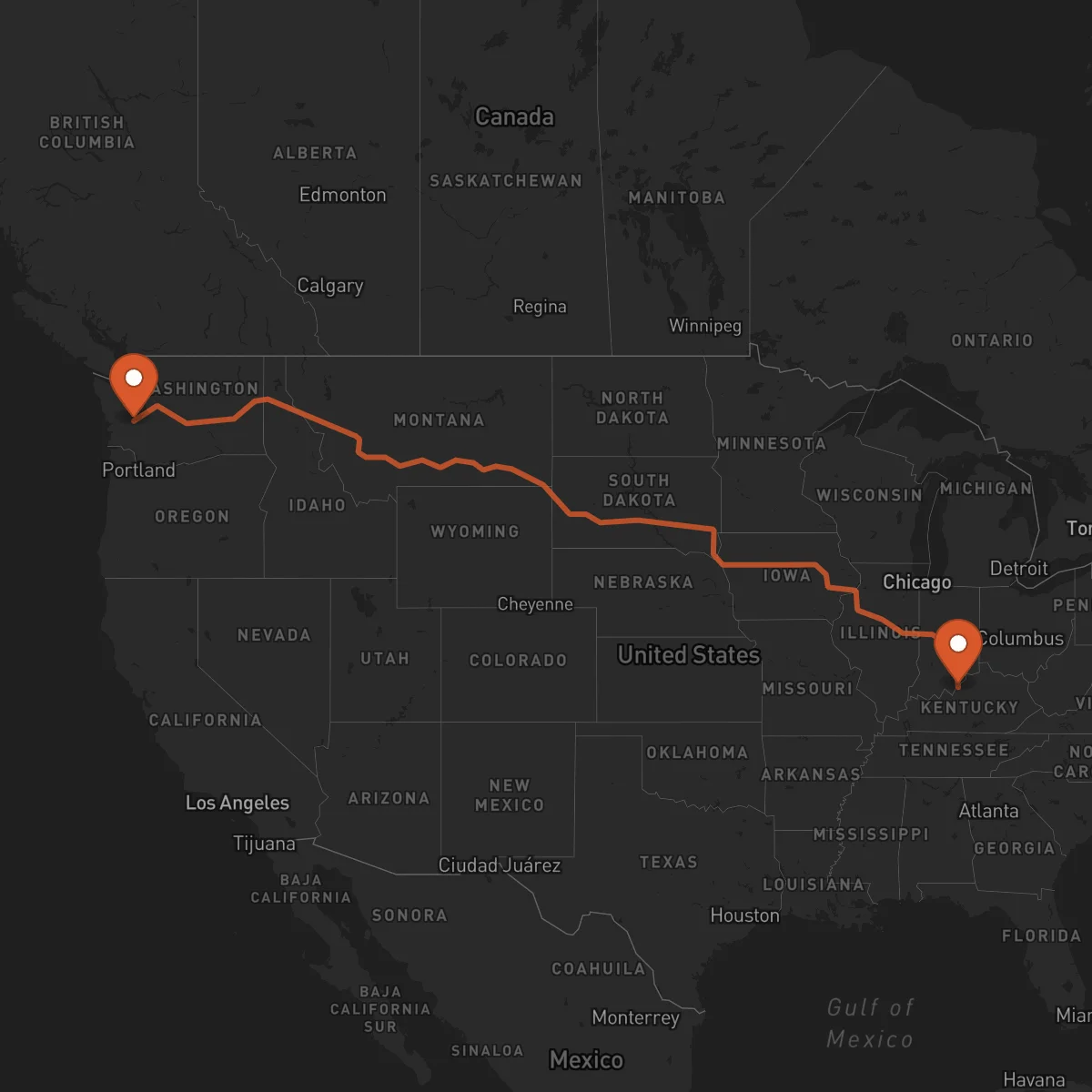
Louisville to Olympia
Olympia → LouisvilleFTL freight transportation service between Louisville and Olympia. Reliable logistics solutions for your business.
Route Description
Everything you need to know about the corridor Louisville - Olympia
The Louisville to Olympia corridor represents a crucial domestic freight route connecting the Midwest to the Pacific Northwest across 3,157 kilometers of diverse American terrain. This east-west transportation artery traverses multiple states and serves as a vital link between major economic regions, facilitating the movement of goods from Kentucky's manufacturing heartland to Washington's coastal ports and distribution centers.
The corridor's strategic importance stems from its connection between Louisville's logistics hub and Olympia's gateway to Asian trade routes. Major highways including I-64, I-70, I-80, and I-90 form the backbone of this route, offering multiple path options for freight carriers. The journey crosses the Mississippi River, Rocky Mountains, and Columbia River Basin, presenting both challenges and opportunities for specialized freight services.
This route primarily serves manufacturing, automotive, technology, and agricultural industries. Companies in Louisville's extensive logistics network regularly ship finished goods, automotive parts, and industrial equipment westward, while Olympia's region sees inbound shipments of electronics, consumer goods, and agricultural products. The corridor also supports e-commerce fulfillment operations, with major distribution centers located in both metropolitan areas.
Control Terrestre provides comprehensive FTL transportation solutions along this corridor, offering dedicated truckload services with real-time tracking capabilities. Our experienced carriers navigate this extensive route efficiently, ensuring your cargo moves safely through varying terrain and weather conditions. With our network of certified transportation providers, we maintain consistent service quality across all states, delivering your freight from origin to destination with the reliability your supply chain demands.
Services for this Route
Available services for the corridor Louisville - Olympia
 Origin
Louisville
Louisville, Kentucky stands as a premier logistics hub in the eastern United States, strategically positioned at the crossroads of major transportation networks. The city's location along the Ohio River and its proximity to the geographic center of the country make it an ideal distribution point for freight moving in all directions. Louisville International Airport's UPS Worldport facility, one of the largest automated package handling facilities globally, reinforces the region's logistics dominance.
The Louisville metropolitan area hosts diverse economic sectors including automotive manufacturing, healthcare, bourbon production, and logistics services. Major employers include Ford Motor Company, GE Appliances, and numerous logistics providers who have established major distribution centers in the region. The city's extensive highway network, including I-65, I-64, and I-71, provides immediate access to regional and national freight corridors.
 Destination
Olympia
Olympia, Washington serves as the gateway to the Pacific Northwest's extensive logistics network, offering strategic access to international trade routes and major West Coast markets. Located at the southern end of Puget Sound, Olympia provides direct connections to Seattle, Tacoma, and the Port of Olympia, creating a multimodal transportation hub that serves the entire region. The area's infrastructure includes major highways I-5 and US-101, facilitating efficient freight movement to and from the Pacific coast.
The Olympia region's economy centers around government services, technology, aerospace, and maritime industries. The presence of major employers like the state government, technology firms, and proximity to Boeing's manufacturing facilities creates consistent freight demand. The Port of Olympia handles diverse cargo including agricultural products, manufactured goods, and specialized equipment, while the region's growing e-commerce sector drives increased demand for reliable freight transportation services.










