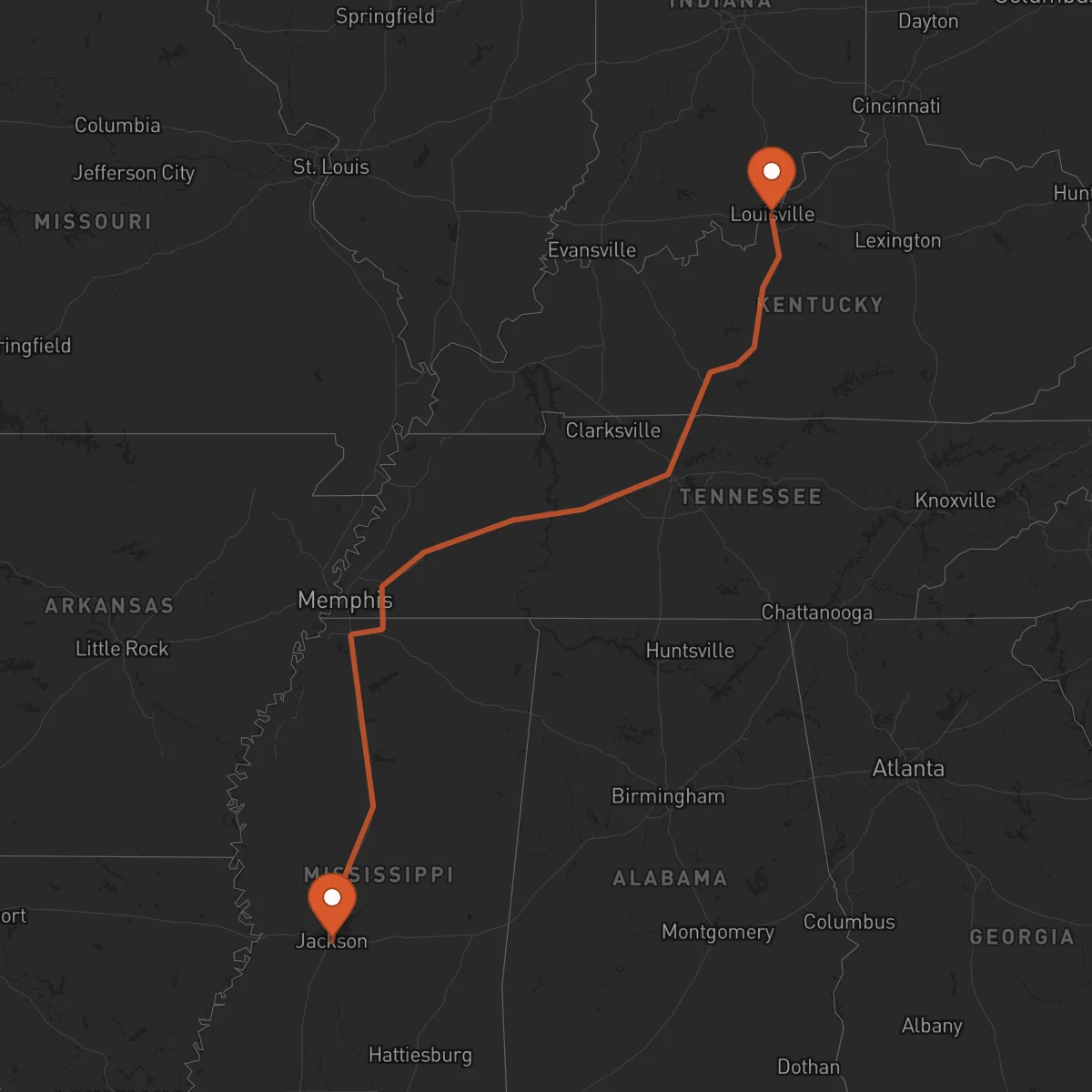
Louisville to Jackson
Jackson → LouisvilleFTL freight transportation service between Louisville and Jackson. Reliable logistics solutions for your business.
Route Description
Everything you need to know about the corridor Louisville - Jackson
The Louisville-Jackson corridor connects two key cities in the southeastern United States, spanning approximately 773 kilometers through Kentucky, Tennessee, and Mississippi. This route serves as a vital link between the Ohio Valley region and the Gulf Coast, facilitating the movement of goods between major industrial centers and ports. The corridor passes through important urban areas including Nashville and Birmingham, offering multiple routing options for efficient freight transportation.
The economic significance of this corridor is substantial, connecting Louisville's manufacturing and logistics hub with Jackson's growing industrial sector. Louisville serves as a major distribution center with UPS Worldport, while Jackson has developed as a center for automotive manufacturing, food processing, and advanced manufacturing. The corridor supports the flow of automotive parts, industrial equipment, consumer goods, and agricultural products between these regions.
Key transportation infrastructure includes Interstate 65 south from Louisville through Nashville, connecting to Interstate 20/59 through Birmingham, and finally Interstate 55 south to Jackson. This interstate network provides reliable, high-capacity freight movement with multiple lane options and modern rest areas. The route also offers connections to major rail lines and intermodal facilities along the way.
Control Terrestre facilitates seamless operations on this corridor through our network of certified carriers and strategic partnerships. We provide dedicated full truckload services with real-time tracking, ensuring your freight moves efficiently between Louisville and Jackson. Our experienced team understands the specific requirements of this route, including regional regulations and optimal scheduling to avoid congestion in major metropolitan areas.
Services for this Route
Available services for the corridor Louisville - Jackson
 Origin
Louisville
Louisville, Kentucky serves as a strategic logistics hub in the Midwest, positioned at the Falls of the Ohio River where major transportation routes converge. The city's location provides access to six major interstates (I-64, I-65, I-71, I-264, I-265, I-265) and is within a day's drive of two-thirds of the U.S. population. Louisville International Airport's UPS Worldport is one of the largest air freight hubs globally, while the Port of Louisville offers river transportation capabilities.
The local economy thrives on manufacturing, healthcare, and logistics sectors. Major employers include Ford Motor Company, GE Appliances, and Yum! Brands. The city's logistics infrastructure includes numerous warehousing facilities, cross-dock operations, and intermodal yards. Louisville's central location and robust infrastructure make it an ideal origin point for freight distribution throughout the southeastern United States.
 Destination
Jackson
Jackson, Mississippi serves as the state capital and a growing logistics center in the southeastern United States. Located at the intersection of major highways including I-55 and I-20, Jackson provides strategic access to the Gulf Coast ports and the southeastern market. The city's transportation infrastructure includes the Jackson-Medgar Wiley Evers International Airport and the Port of Jackson on the Pearl River.
The local economy features strong automotive manufacturing, with Nissan's assembly plant nearby in Canton. Other significant industries include food processing, advanced manufacturing, and healthcare. Jackson's central Mississippi location offers cost advantages for distribution while providing access to growing markets in the southeastern region. The city's industrial parks and available warehouse space support logistics operations, making it an increasingly important destination for freight movement from northern manufacturing centers.










