Los Angeles to Austin
Austin → Los AngelesFTL freight transportation service between Los Angeles and Austin. Reliable logistics solutions for your business.
Route Description
Everything you need to know about the corridor Los Angeles - Austin
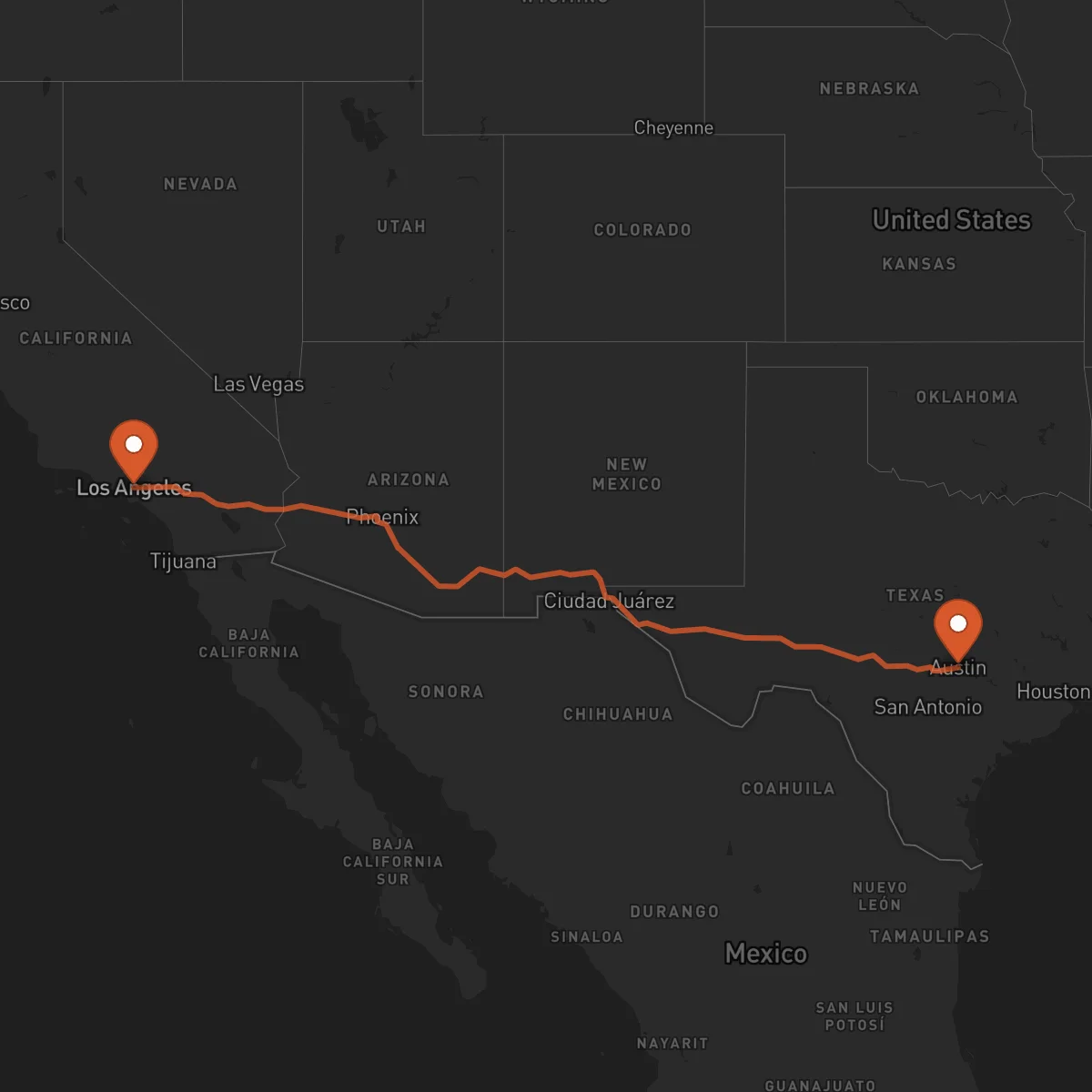
The Los Angeles to Austin corridor represents a vital logistics artery connecting the West Coast's largest port complex with the booming technology and business hub of Texas. This 1,971 km route traverses some of America's most dynamic economic regions, facilitating the movement of goods between California's manufacturing and import/export sectors and Texas's rapidly growing consumer markets and industrial base. The corridor serves as a critical link in the North American supply chain, enabling businesses to efficiently transport goods across diverse geographic and economic zones.
The route primarily follows Interstate 10, one of the nation's major east-west transportation corridors, passing through key cities including Phoenix, Tucson, and El Paso. This well-established highway network provides reliable infrastructure for freight transportation, with multiple lanes and modern facilities supporting the high volume of commercial traffic. The corridor benefits from California's extensive port facilities and Texas's central location within the continental United States, making it an optimal path for cross-country freight movement.
Major industries utilizing this corridor include technology, automotive, aerospace, electronics, and consumer goods. Los Angeles serves as a gateway for Asian imports, while Austin has emerged as a major technology and business center, creating substantial freight demand in both directions. The route also supports the energy sector, with Texas's oil and gas industry requiring specialized transportation services. Manufacturing facilities throughout both states rely on this corridor for just-in-time delivery of components and finished products.
Control Terrestre optimizes operations on this corridor through our network of certified transportation providers and specialized equipment. Our dedicated services ensure that full truckload shipments move efficiently between these major markets, with real-time tracking and experienced drivers familiar with the route's specific requirements. We provide tailored solutions for various cargo types, including temperature-controlled transportation for sensitive goods and specialized handling for oversized or hazardous materials, ensuring reliable delivery across this critical logistics corridor.
Services for this Route
Available services for the corridor Los Angeles - Austin
 Origin
Los Angeles
Los Angeles stands as one of North America's most significant logistics hubs, anchored by the Ports of Los Angeles and Long Beach, which together form the largest container port complex in the Western Hemisphere. The city's strategic Pacific location makes it the primary gateway for goods entering the United States from Asia, handling over 40% of the nation's containerized imports. Los Angeles's extensive transportation infrastructure includes multiple interstate highways, rail connections, and proximity to major airports, creating a comprehensive multimodal logistics network. The region's industrial base spans manufacturing, entertainment, technology, and international trade, generating substantial freight volume that requires efficient ground transportation solutions to domestic markets.
 Destination
Austin
Austin has rapidly evolved into a major logistics and economic center, driven by its status as a technology and business powerhouse often called 'Silicon Hills.' The city's strategic location in central Texas provides excellent connectivity to major markets across the southern and southwestern United States. Austin-Bergstrom International Airport and its proximity to major highways, including I-35 and I-10, support robust freight movement. The region's diverse economy encompasses technology, healthcare, education, and government sectors, with major employers like Dell, Apple, and IBM creating significant demand for reliable freight transportation. Austin's growing population and business environment continue to expand logistics requirements, making it an increasingly important destination for cross-country freight shipments.










