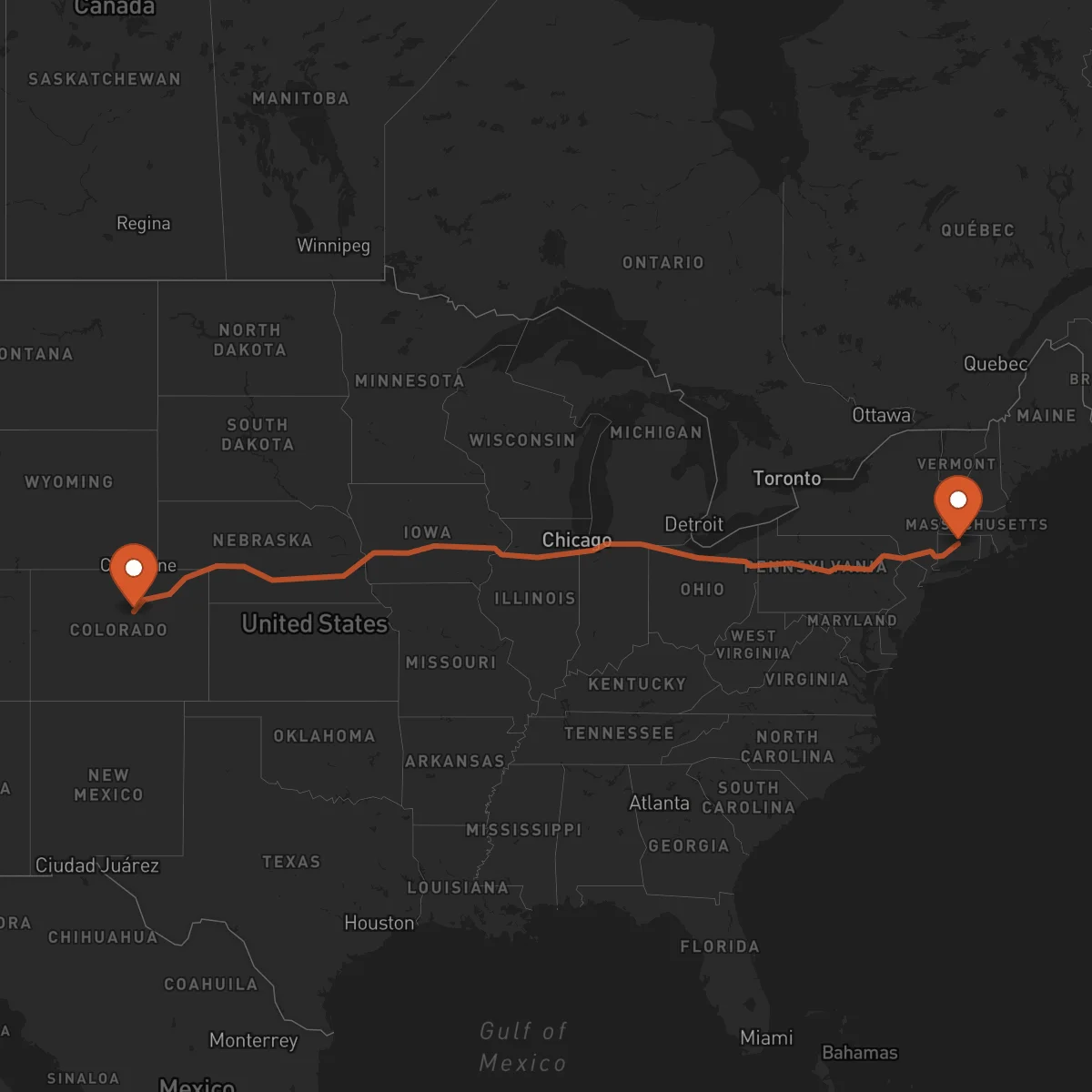
Hartford to Denver
Denver → HartfordFTL freight transportation service between Hartford and Denver. Reliable logistics solutions for your business.
Route Description
Everything you need to know about the corridor Hartford - Denver
The freight transportation corridor between Hartford, Connecticut, and Denver, Colorado, represents a vital link connecting the Northeast with the Rocky Mountain region of the United States. This 2,715-kilometer route traverses diverse landscapes and connects major industrial and commercial centers, facilitating the movement of goods across the country's heartland. The corridor is strategically positioned to serve both the densely populated Eastern Seaboard and the growing markets of the Mountain West.
The economic significance of this route is substantial, supporting industries ranging from advanced manufacturing and aerospace in Connecticut to energy, technology, and agriculture in Colorado. Major companies in both regions rely on efficient freight transportation to maintain their supply chains and distribution networks. The corridor enables the movement of specialized equipment, raw materials, and finished products between these economically distinct but complementary regions.
Key transportation infrastructure along this route includes major interstate highways such as I-84, I-80, and I-76, which provide reliable and efficient freight movement. These highways connect to major logistics hubs, intermodal facilities, and distribution centers that facilitate seamless cargo transfer. The route also benefits from proximity to major airports and rail terminals, offering multimodal transportation options when needed.
Control Terrestre provides comprehensive FTL (Full Truckload) transportation services along this corridor, ensuring reliable and timely delivery of your cargo. Our experienced carriers understand the unique challenges of this long-haul route and are equipped to handle diverse freight requirements. With our network of certified transportation providers, we offer dedicated services, specialized equipment options, and real-time tracking to optimize your supply chain between Hartford and Denver.
Services for this Route
Available services for the corridor Hartford - Denver
 Origin
Hartford
Hartford, Connecticut, serves as a strategic logistics hub in the Northeast, offering excellent connectivity to major metropolitan areas along the Eastern Seaboard. The city's location provides convenient access to major highways including I-91 and I-84, facilitating efficient distribution throughout the region. Hartford's Bradley International Airport and proximity to major ports in New York and New Jersey enhance its multimodal transportation capabilities, making it an ideal origin point for freight distribution.
The region's economy is characterized by diverse industries including insurance, advanced manufacturing, aerospace, and healthcare. Major employers in the area create consistent demand for freight transportation services. Hartford's industrial parks and warehouse facilities are equipped with modern logistics infrastructure, supporting both inbound and outbound freight operations. The area's skilled workforce and business-friendly environment contribute to its role as a key logistics center in the Northeast.
 Destination
Denver
Denver, Colorado, stands as a strategic logistics hub in the Mountain West region, offering unique advantages for freight transportation. The city's elevation and location at the intersection of major transportation routes make it a natural distribution center for the surrounding states. Denver International Airport, one of the largest cargo airports in the nation, combined with extensive highway networks including I-70 and I-25, provides excellent connectivity for freight movement.
The Denver metropolitan area is home to diverse industries including energy, technology, aerospace, and agriculture. The region's growing economy has led to increased demand for efficient freight transportation services. Denver's proximity to major rail yards and intermodal facilities enhances its logistics capabilities, while the surrounding industrial parks offer modern warehousing and distribution solutions. The city's central location in the Mountain Time Zone also makes it an ideal hub for coordinating freight movements across multiple time zones.










