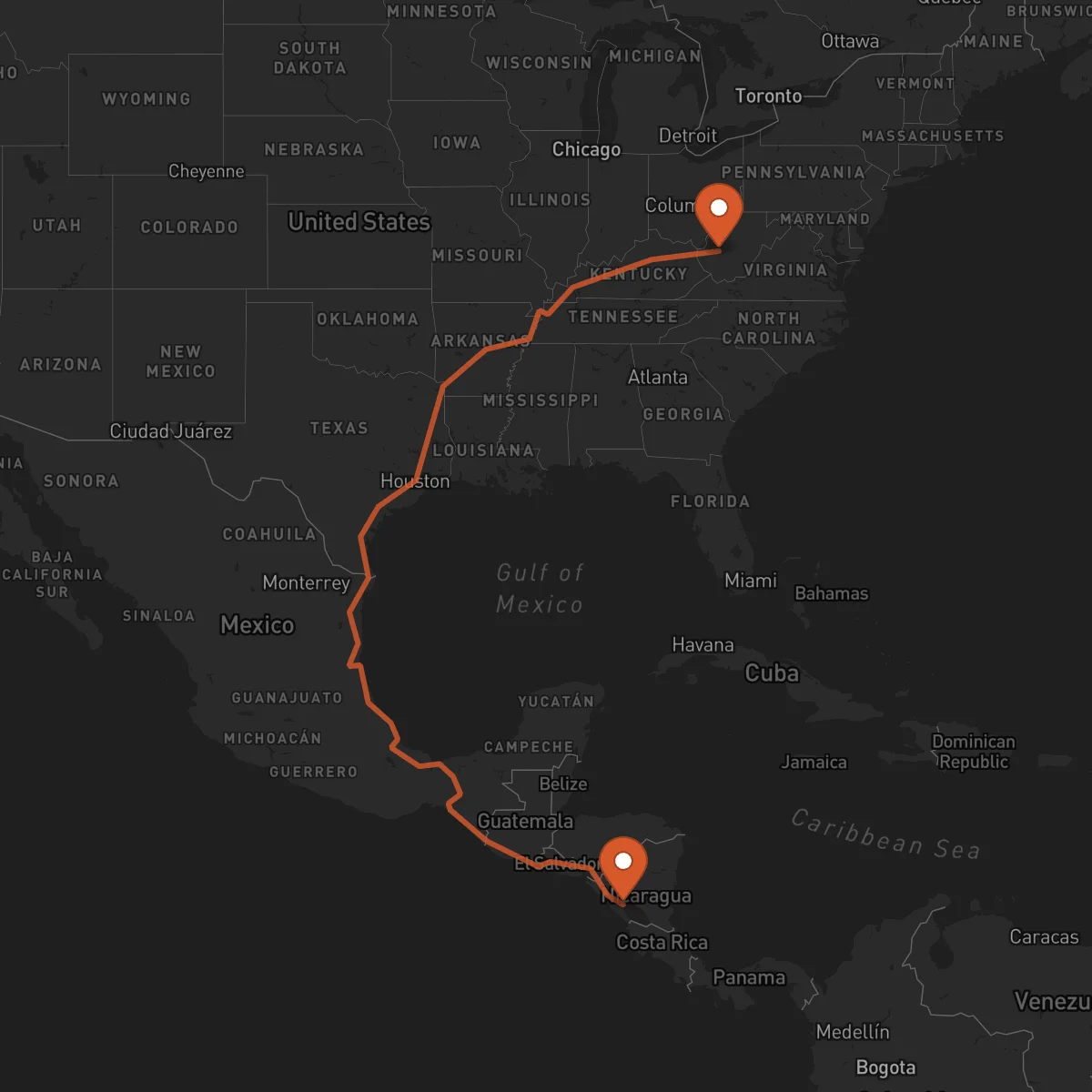
Granada to Charleston
Charleston → GranadaFTL freight transportation service between Granada and Charleston. Reliable logistics solutions for your business.
Route Description
Everything you need to know about the corridor Granada - Charleston
The logistics corridor connecting Granada, Nicaragua to Charleston, West Virginia represents a vital cross-border freight route spanning approximately 2,968 kilometers through diverse terrain and multiple jurisdictions. This corridor serves as a critical link between Central American production centers and key industrial markets in the eastern United States, facilitating the movement of goods across international boundaries with strategic precision.
The economic context of this corridor encompasses agricultural exports from Nicaragua's fertile regions, including coffee, sugar, and manufactured goods, which find their way to distribution networks in Appalachia and beyond. Industries utilizing this route benefit from access to both raw material sourcing and consumer markets, making it an essential artery for bilateral trade between the two regions.
Transportation infrastructure along this corridor relies heavily on interconnected highway systems, with major routes traversing through Central American road networks before connecting to U.S. interstate systems. Key border crossings and customs considerations require careful coordination to ensure compliance with international trade regulations and timely clearance of goods.
Control Terrestre facilitates operations on this corridor through our alliance of experienced transportation providers, offering full truckload (FTL) services dedicated to maintaining supply chain integrity. Our expertise in cross-border logistics ensures seamless coordination from origin to destination, supporting businesses seeking reliable freight solutions across this demanding route.
Services for this Route
Available services for the corridor Granada - Charleston
 Origin
Granada, situated in western Nicaragua along the shores of Lake Nicaragua, holds strategic importance as a logistics hub connecting agricultural and manufacturing sectors to international markets. The region's economy thrives on coffee production, tourism, and light manufacturing, generating consistent freight demand for ground transportation services. Available transportation infrastructure includes access to major highways linking to Pacific ports and inland distribution networks, positioning Granada as an efficient origin point for cross-border freight operations throughout Central America and beyond.
 Destination
Charleston
Charleston, West Virginia serves as a strategic logistics destination within the Appalachian region, connecting eastern seaboard markets with inland distribution networks. The city's economy encompasses chemical manufacturing, energy production, and healthcare sectors, creating diverse freight requirements for incoming goods. Transportation infrastructure includes access to major interstate highways and rail networks, facilitating efficient last-mile distribution throughout the Ohio Valley and beyond. Charleston's position makes it a valuable endpoint for cross-border freight originating from Central American production centers.










