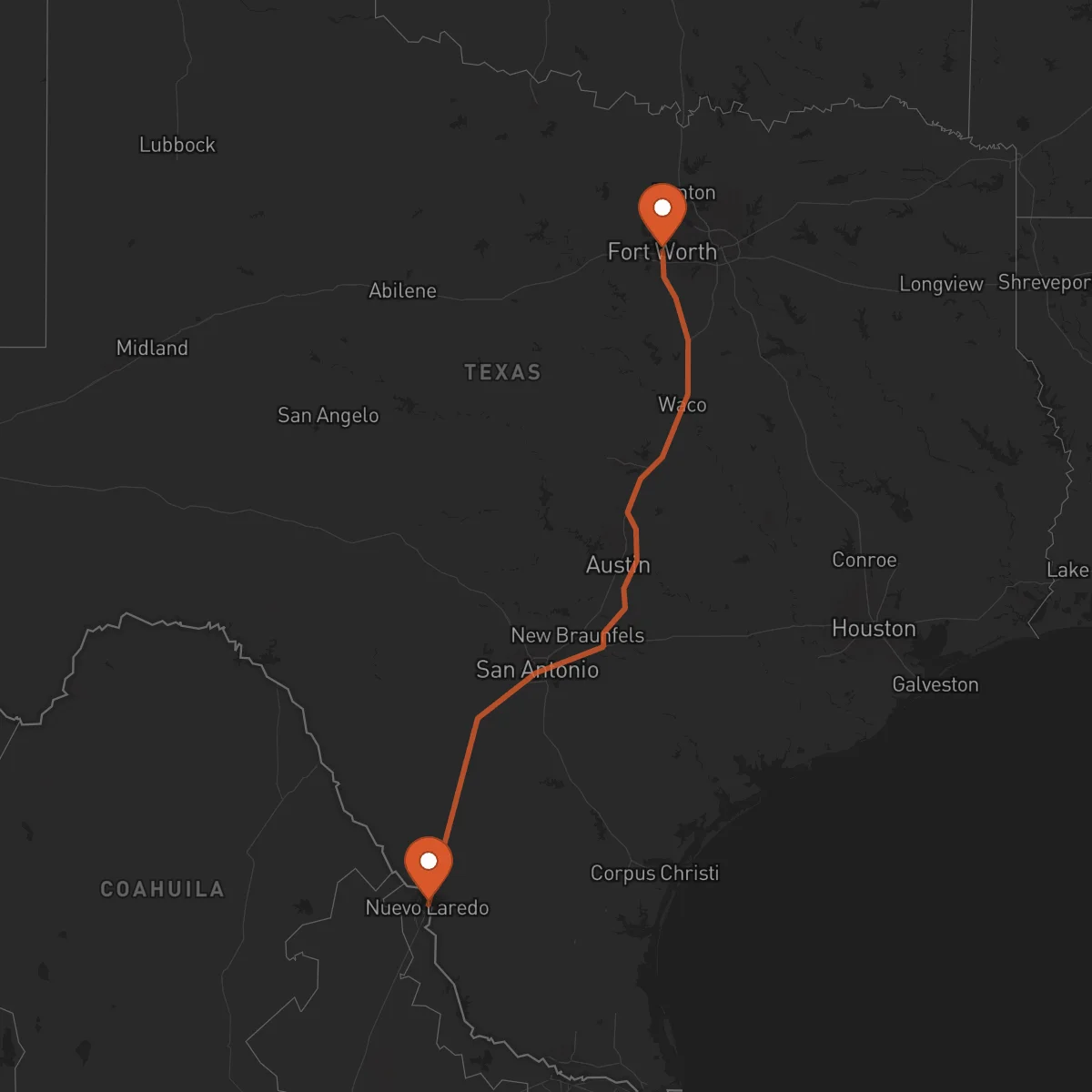
Fort Worth to Laredo
Laredo → Fort WorthFTL freight transportation service between Fort Worth and Laredo. Reliable logistics solutions for your business.
Route Description
Everything you need to know about the corridor Fort Worth - Laredo
The logistics corridor between Fort Worth and Laredo represents one of the most critical freight transportation routes in Texas, connecting the Dallas-Fort Worth metropolitan area with the busiest inland port on the U.S.-Mexico border. This 620-kilometer route traverses the heart of Texas, facilitating the movement of goods between the state's industrial north and its international trade gateway to the south.
The corridor's strategic importance stems from its role in connecting major economic hubs. Fort Worth serves as a key distribution center for the central United States, while Laredo handles over 40% of all U.S.-Mexico trade through its international bridges. This route supports the movement of manufactured goods, agricultural products, automotive components, and consumer merchandise between production centers and international markets.
Transportation infrastructure along this corridor is robust, primarily utilizing Interstate 35, which serves as the main artery for freight movement. This highway connects with major distribution centers, manufacturing facilities, and logistics parks throughout the region. The route also provides access to rail intermodal facilities and major airports, creating a comprehensive multimodal transportation network.
Control Terrestre facilitates seamless operations on this corridor through our specialized full truckload services. Our experienced carriers understand the unique requirements of this route, from navigating urban traffic in the DFW area to managing border crossing procedures near Laredo. We provide dedicated transportation solutions that ensure your freight moves efficiently and reliably between these strategic locations, supporting your supply chain needs with professional service and industry expertise.
Services for this Route
Available services for the corridor Fort Worth - Laredo
 Origin
Fort Worth
Fort Worth serves as a strategic logistics hub in North Texas, offering exceptional connectivity to major markets across the central United States. The city's location within the Dallas-Fort Worth metroplex provides access to one of the nation's largest consumer markets and a dense network of manufacturing and distribution facilities. Fort Worth's economy is anchored by aviation, aerospace, healthcare, and logistics sectors, with major employers including American Airlines and Lockheed Martin.
The transportation infrastructure in Fort Worth is comprehensive and well-developed. The city is served by multiple interstate highways, including I-35W, I-30, and I-20, providing direct access to regional and national freight corridors. AllianceTexas, one of the largest inland ports in the United States, offers extensive intermodal facilities, warehousing, and distribution capabilities. The Dallas/Fort Worth International Airport and Fort Worth Alliance Airport provide air cargo services, while the city's rail connections support efficient freight movement throughout the region.
 Destination
Laredo
Laredo's strategic location on the U.S.-Mexico border makes it the premier gateway for North American trade, handling billions of dollars in cross-border commerce annually. The city's economy is fundamentally driven by international trade, with over 12,000 trucks crossing the border daily through its six international bridges. Laredo serves as a critical distribution point for goods destined for both U.S. and Mexican markets, supporting industries including automotive, electronics, and consumer products.
The transportation infrastructure in Laredo is specifically designed to handle high-volume international freight movement. The city is served by Interstate 35, which connects directly to major Mexican highways, creating a seamless transportation corridor. Laredo's World Trade Bridge and other international crossings are equipped with advanced cargo processing facilities. The city also features extensive warehousing and distribution centers, intermodal rail yards operated by major Class I railroads, and proximity to the Laredo International Airport for air cargo operations. This infrastructure makes Laredo an essential node in the North American supply chain.










