Edmonton to McAllen
McAllen → EdmontonFTL freight transportation service between Edmonton and McAllen. Reliable logistics solutions for your business.
Route Description
Everything you need to know about the corridor Edmonton - McAllen
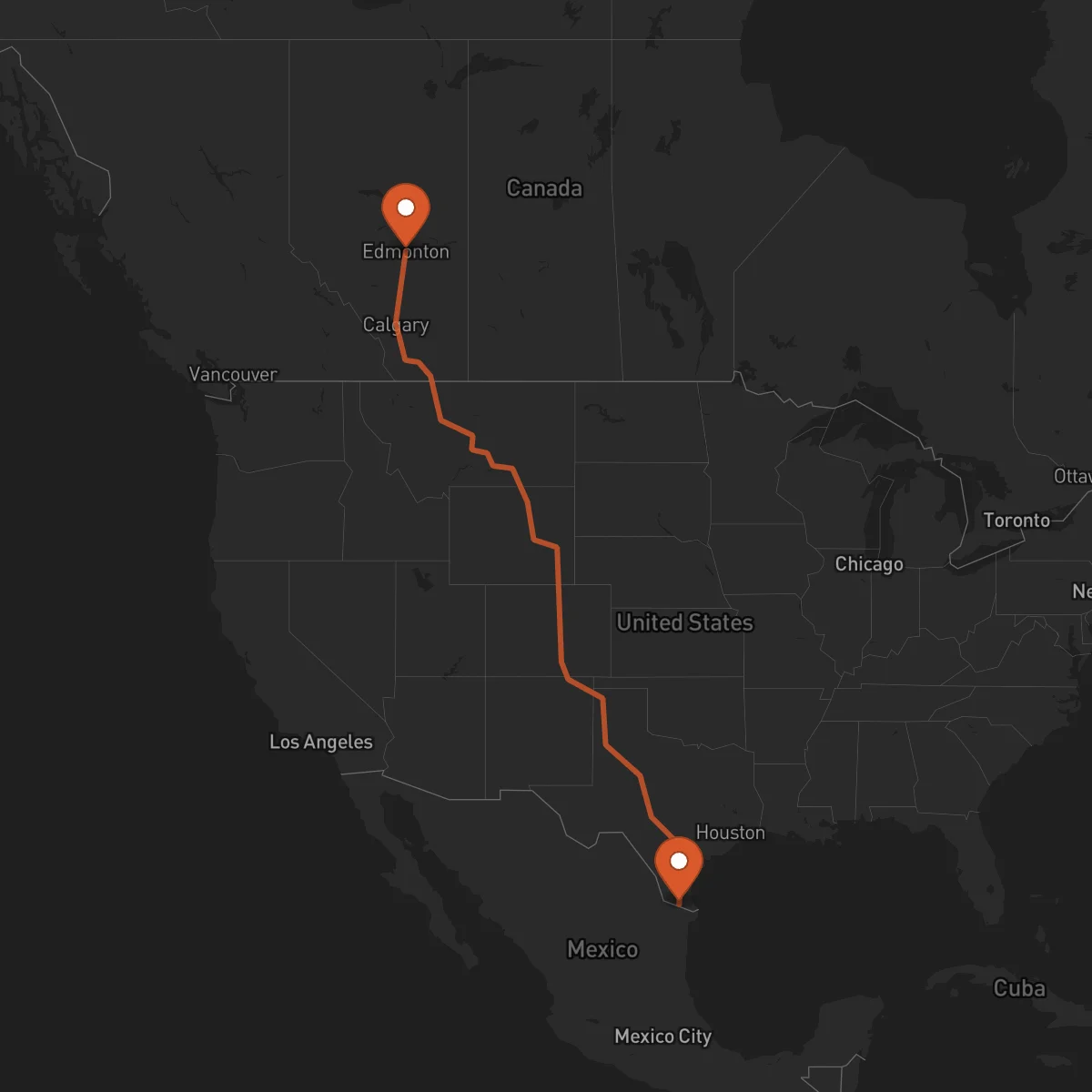
The Edmonton-McAllen corridor represents a vital cross-border freight transportation route connecting the industrial heartland of Alberta with the strategic logistics hub of South Texas. This 3,292 km corridor traverses the North American continent, facilitating the movement of goods between Canada and the United States through major transportation networks. The route serves as a critical link for companies operating in the energy, manufacturing, and agricultural sectors, connecting the resource-rich Canadian prairies with the distribution centers and manufacturing facilities of the Texas-Mexico border region.
The corridor follows established transportation infrastructure, primarily utilizing Interstate 35 South through the United States, connecting with Canadian highways in Alberta. Key border crossings include the Peace Bridge and other major commercial ports of entry, where Control Terrestre's certified carriers ensure smooth customs clearance and compliance with cross-border regulations. The route passes through major industrial centers including Calgary, Minneapolis, and San Antonio, offering multiple logistics nodes for potential consolidation or distribution.
Control Terrestre facilitates seamless operations on this corridor through our network of C-TPAT certified carriers and experienced logistics professionals. We provide dedicated full truckload services, ensuring that shipments move efficiently without delays associated with consolidated freight. Our expertise in cross-border documentation, customs procedures, and compliance requirements helps minimize transit times and reduce the risk of border delays, making us the ideal partner for companies requiring reliable transportation between Edmonton and McAllen.
Services for this Route
Available services for the corridor Edmonton - McAllen
 Origin
Edmonton, located in Alberta, Canada, serves as a strategic logistics hub for Western Canada, positioned at the crossroads of major transportation networks. The city functions as a gateway to the oil sands of Northern Alberta and the agricultural heartland of the prairies, making it a critical distribution point for energy products, industrial equipment, and agricultural commodities. Edmonton's robust infrastructure includes major highways such as the Yellowhead Highway (Trans-Canada Highway 16) and proximity to the Edmonton International Airport, facilitating efficient multimodal transportation solutions.
The region's economy is driven by the energy sector, manufacturing, and agriculture, with numerous industrial parks and warehousing facilities supporting logistics operations. Edmonton's location provides access to the Pacific Northwest through British Columbia and connects to the broader North American market via the Trans-Canada Highway system. The city's cold climate and seasonal variations require specialized transportation capabilities, particularly for temperature-sensitive cargo and winter operations.
 Destination
McAllen
McAllen, Texas, situated in the Rio Grande Valley near the Mexico border, represents a strategic logistics hub for South Texas and Northern Mexico. The city's location provides immediate access to major transportation corridors including Interstate 2 and Interstate 69C, connecting to the broader Interstate 35 network. McAllen's proximity to the Pharr International Bridge and other border crossings facilitates efficient cross-border operations with Mexico's industrial centers.
The region's economy is characterized by international trade, manufacturing, and retail distribution, with numerous maquiladoras and industrial parks in the surrounding area. McAllen serves as a critical distribution point for goods moving between the United States and Mexico, with extensive warehousing and logistics infrastructure supporting cross-border supply chains. The city's warm climate and year-round operational capability make it an attractive location for distribution centers and manufacturing facilities requiring consistent transportation schedules.










