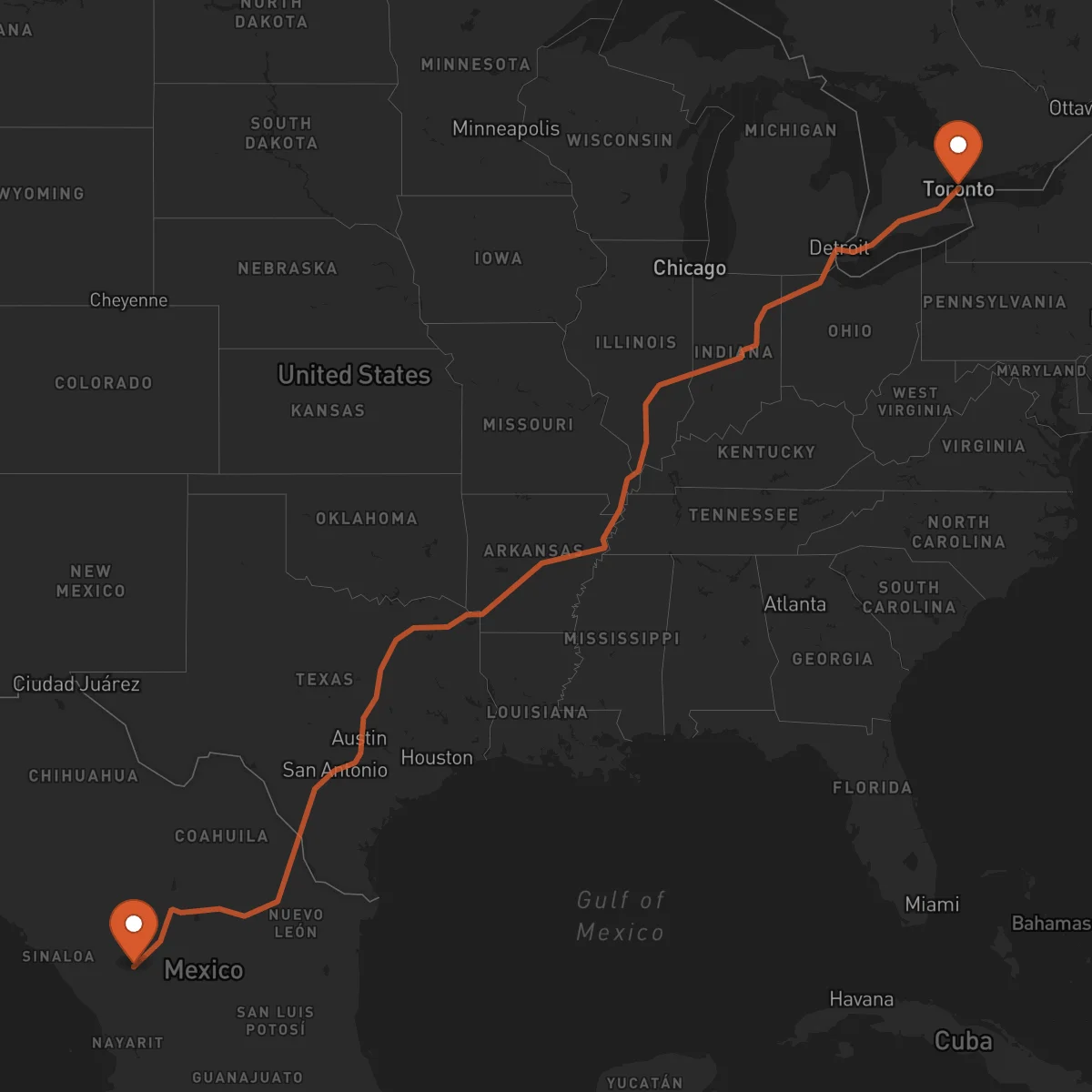
Durango to Toronto
Toronto → DurangoFTL freight transportation service between Durango and Toronto. Reliable logistics solutions for your business.
Route Description
Everything you need to know about the corridor Durango - Toronto
The logistics corridor connecting Durango, México to Toronto, Canadá represents a vital cross-border freight transportation route spanning approximately 3,172 kilometers. This corridor links the industrial heart of northern México with one of Canada's most important economic centers, facilitating the movement of goods between North American manufacturing and distribution hubs. The route traverses diverse terrain and crosses international borders, requiring specialized expertise in cross-border logistics operations.
The corridor's strategic importance stems from the complementary industrial strengths of both regions. Durango serves as a manufacturing and agricultural center, while Toronto functions as a major financial, technological, and distribution hub for Eastern Canada. This creates a continuous flow of freight in both directions, with manufacturing components, agricultural products, and consumer goods moving north, while finished products, technology equipment, and retail merchandise flow south.
Key transportation infrastructure along this corridor includes Mexico's Federal Highway 45D connecting Durango to the U.S. border, followed by major interstate highways through the United States, and finally Canada's 400-series highways leading to Toronto. The primary border crossing utilized is typically Laredo/Nuevo Laredo, one of North America's busiest commercial crossings. Control Terrestre's expertise in cross-border operations ensures seamless customs clearance and compliance with all regulatory requirements, minimizing delays and optimizing transit times for our clients' freight shipments.
Services for this Route
Available services for the corridor Durango - Toronto
 Origin
Durango, located in northern México, serves as a strategic logistics hub with excellent connectivity to major markets in both México and the United States. The city benefits from its position along Federal Highway 45, which provides direct access to border crossings and connects to México's extensive highway network. Durango's transportation infrastructure includes the Durango International Airport and a growing network of warehousing and distribution centers that support its industrial activities.
The region's economy is diversified, with strong manufacturing sectors including automotive parts, electronics, and mining equipment production. Durango also has significant agricultural output, particularly in livestock, dairy products, and various crops. These industries generate substantial freight volumes requiring reliable transportation solutions to both domestic and international markets. The city's industrial parks and manufacturing facilities make it an ideal origin point for full truckload shipments destined for North American distribution centers.
 Destination
Toronto, Ontario represents one of Canada's most dynamic logistics and economic centers, strategically positioned to serve the entire Eastern Canadian market and beyond. The Greater Toronto Area boasts an extensive transportation infrastructure including Pearson International Airport, multiple rail terminals, and a comprehensive highway network including the 400-series highways that provide efficient access to all parts of Ontario and neighboring provinces. The Port of Toronto on Lake Ontario also offers maritime shipping capabilities.
The city's economy is highly diversified, with major sectors including financial services, technology, manufacturing, retail, and healthcare. Toronto serves as a primary distribution hub for consumer goods, electronics, automotive parts, and industrial equipment throughout Eastern Canada. The region's numerous industrial parks, warehousing facilities, and just-in-time manufacturing operations create consistent demand for full truckload freight services. Toronto's proximity to the U.S. border also makes it a key node in North American supply chain networks, facilitating cross-border trade with major U.S. markets.










