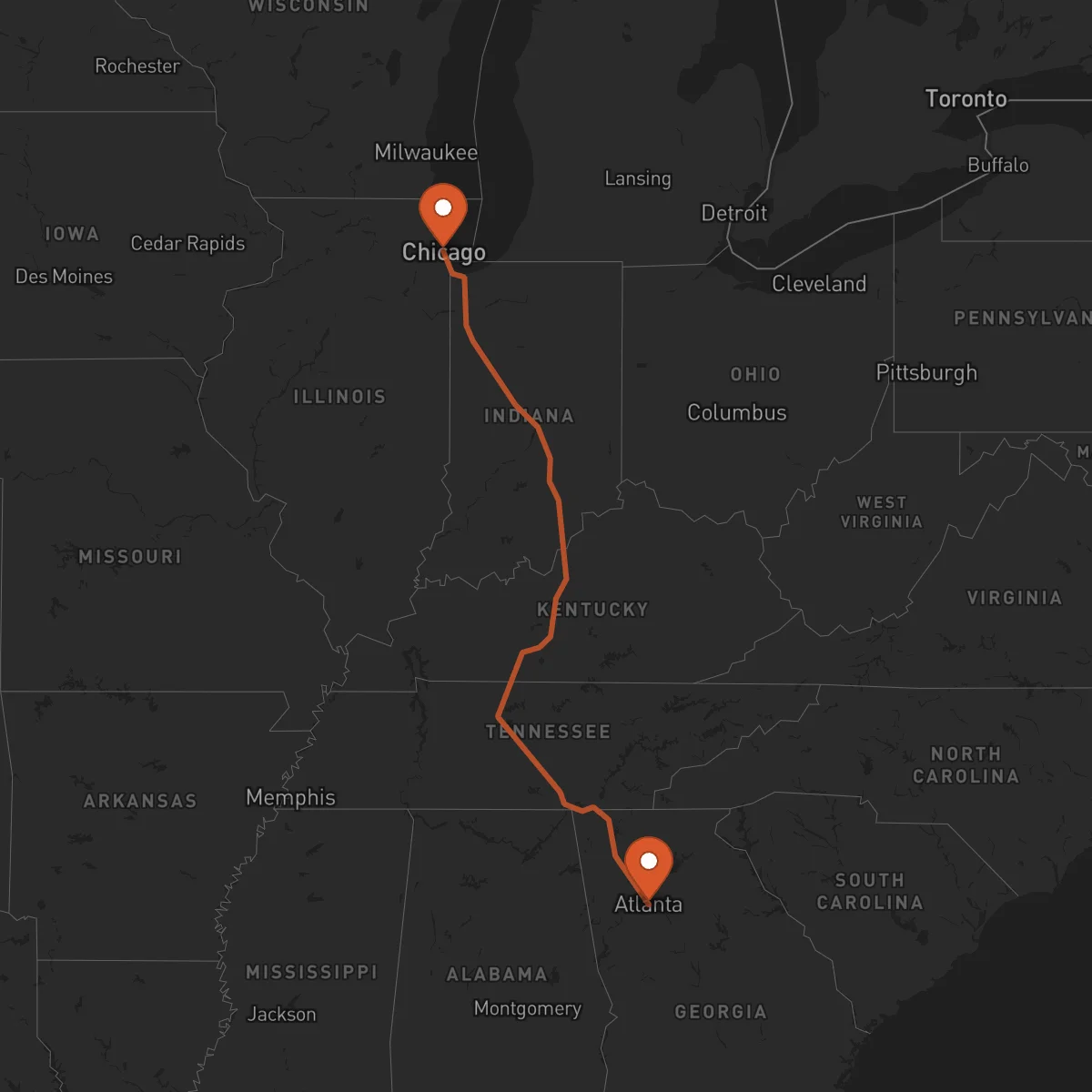
Chicago to Atlanta
Atlanta → ChicagoFTL freight transportation service between Chicago and Atlanta. Reliable logistics solutions for your business.
Route Description
Everything you need to know about the corridor Chicago - Atlanta
The Chicago to Atlanta corridor is a vital logistics route connecting two major economic hubs in the United States. Spanning approximately 590 miles, this corridor links the Midwest's industrial powerhouse with the Southeast's growing logistics center. The route traverses diverse terrain and crosses multiple states, making it a critical artery for freight movement between the North and South.
The corridor's significance stems from the complementary economic profiles of Chicago and Atlanta. Chicago, with its manufacturing heritage and transportation infrastructure, serves as a distribution point for goods destined for the Southeast. Atlanta, as a major logistics hub and gateway to the Southeast, receives these goods for distribution throughout the region. This north-south flow of commerce creates consistent demand for reliable freight transportation services.
Key industries utilizing this corridor include automotive manufacturing, consumer goods, electronics, and food products. The automotive sector, in particular, relies on this route for just-in-time delivery of components between assembly plants. Additionally, the e-commerce boom has increased the volume of parcel and pallet shipments moving along this corridor, as distribution centers in both cities serve as hubs for last-mile delivery.
Control Terrestre facilitates seamless operations on this corridor by leveraging our network of certified carriers and specialized equipment. Our full truckload (FTL) services ensure dedicated transportation for your cargo, minimizing handling and reducing transit times. With real-time tracking and experienced drivers familiar with this route, we provide the reliability and efficiency that businesses need to maintain their supply chain integrity.
Services for this Route
Available services for the corridor Chicago - Atlanta
 Origin
Chicago
Chicago, Illinois, stands as a premier logistics hub in North America, strategically positioned in the heart of the Midwest. The city's location at the crossroads of major interstate highways, including I-90 and I-65, provides unparalleled access to both coastal and inland markets. Chicago's extensive transportation infrastructure encompasses O'Hare International Airport, one of the busiest cargo airports globally, and the Port of Chicago, offering intermodal capabilities that extend to the Great Lakes and beyond.
The city's economy is diverse, with strong manufacturing, technology, and financial services sectors. Chicago is home to numerous Fortune 500 companies and serves as a distribution center for goods throughout the Midwest. The region's industrial base includes automotive manufacturing, food processing, and consumer goods production, all of which generate substantial freight volume. Chicago's central location and robust infrastructure make it an ideal origin point for freight destined for the Southeast and other regions of the country.
 Destination
Atlanta
Atlanta, Georgia, has emerged as a leading logistics and distribution center in the Southeast, earning its reputation as the 'Silicon Valley of Logistics.' The city's strategic location at the intersection of major interstate highways I-20, I-75, and I-85 provides direct access to markets throughout the Eastern United States. Hartsfield-Jackson Atlanta International Airport, the world's busiest airport by passenger traffic, also ranks among the top cargo airports, facilitating air freight operations.
Atlanta's economy is characterized by its logistics and supply chain management industry, technology sector, and growing film and entertainment industry. The city hosts numerous distribution centers for major retailers and e-commerce companies, taking advantage of Atlanta's central location in the Southeast. Atlanta's mild climate and business-friendly environment have attracted companies from various sectors, including automotive, aerospace, and advanced manufacturing, all of which contribute to the demand for efficient freight transportation services.










