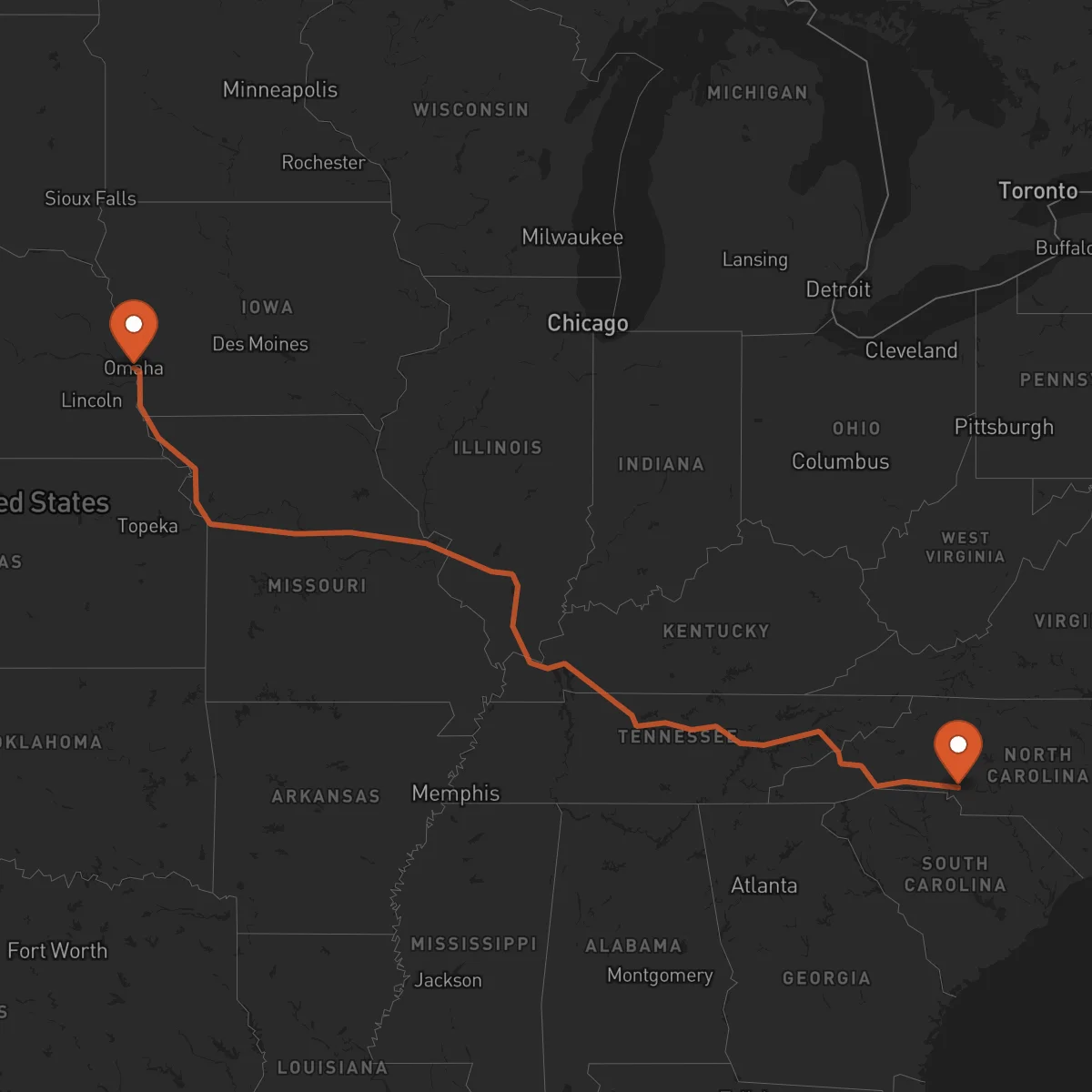
Charlotte to Omaha
Omaha → CharlotteFTL freight transportation service between Charlotte and Omaha. Reliable logistics solutions for your business.
Route Description
Everything you need to know about the corridor Charlotte - Omaha
The logistics corridor connecting Charlotte, North Carolina, to Omaha, Nebraska, represents a vital transportation link across the eastern United States. This 1,476 km route traverses multiple states, connecting the southeastern industrial base with the central Midwest's distribution networks. The corridor serves as a critical artery for freight movement between regions with complementary economic profiles, facilitating the flow of goods from manufacturing centers to major distribution hubs.
The route passes through diverse economic landscapes, linking Charlotte's financial and manufacturing powerhouse with Omaha's role as a major logistics and agricultural hub. This corridor intersects with numerous interstate highways and rail networks, creating multiple options for freight movement. The region's robust infrastructure supports the transportation of various cargo types, from automotive parts and electronics to agricultural products and consumer goods.
Control Terrestre provides specialized full truckload (FTL) transportation services along this corridor, leveraging our network of certified carriers and strategic partnerships. Our dedicated service ensures that your cargo moves efficiently between Charlotte and Omaha, with options for specialized equipment including refrigerated units for temperature-sensitive goods and flatbed trailers for oversized cargo. We understand the unique requirements of each shipment and provide tailored solutions that maintain cargo integrity throughout the journey.
Our expertise in this corridor allows us to navigate the complexities of interstate freight movement, ensuring compliance with all regulations and optimizing transit times. Whether you're shipping from Charlotte's industrial parks to Omaha's distribution centers or managing reverse logistics, Control Terrestre delivers reliable, secure transportation that keeps your supply chain moving smoothly.
Services for this Route
Available services for the corridor Charlotte - Omaha
 Origin
Charlotte
Charlotte, North Carolina, serves as a strategic logistics hub in the southeastern United States. The city's location at the intersection of major interstate highways (I-85, I-77, and I-485) provides excellent connectivity to regional and national markets. Charlotte's robust infrastructure includes the Charlotte Douglas International Airport, one of the busiest airports in the world for cargo operations, and the Port of Wilmington, offering intermodal transportation options. The region's economic strength lies in its diverse industrial base, including financial services, energy, advanced manufacturing, and technology sectors. Major corporations have established significant operations in the area, creating substantial freight movement requirements. The city's proximity to the Research Triangle and other major southeastern markets makes it an ideal origin point for freight distribution across the eastern United States.
 Destination
Omaha
Omaha, Nebraska, stands as a crucial logistics center in the American Midwest, strategically positioned for freight distribution across the central United States. The city's location at the crossroads of I-80 and I-29 provides direct access to major transportation routes connecting the East and West Coasts. Omaha's Eppley Airfield serves as a significant cargo hub, while the city's extensive rail network, operated by major carriers including Union Pacific, offers intermodal transportation capabilities. The region's economy is anchored by agriculture, food processing, insurance, and healthcare industries, creating diverse freight transportation needs. Omaha's central location makes it an ideal distribution point for companies serving the Midwest and Mountain West regions. The city's concentration of Fortune 500 companies and its role as a regional headquarters for numerous corporations generate substantial freight volume, particularly in food products, agricultural commodities, and manufactured goods.










