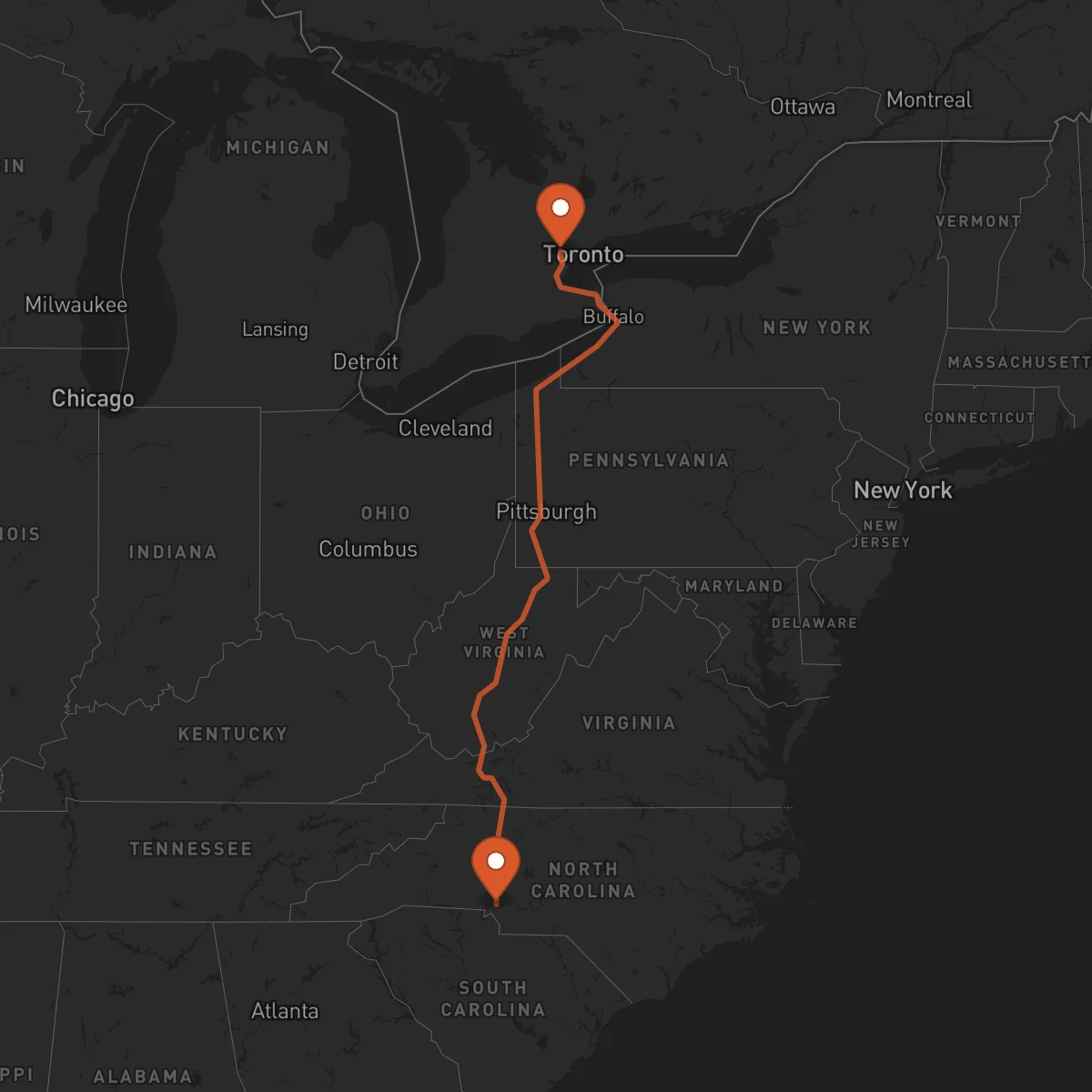
Charlotte to Brampton
Brampton → CharlotteFTL freight transportation service between Charlotte and Brampton. Reliable logistics solutions for your business.
Route Description
Everything you need to know about the corridor Charlotte - Brampton
The Charlotte to Brampton corridor represents a vital cross-border logistics connection between the southeastern United States and the Greater Toronto Area. This 945 km route links North Carolina's manufacturing hub with Ontario's industrial powerhouse, facilitating the seamless movement of goods between two major economic regions. The corridor traverses diverse terrain and crosses the international border at key points, requiring specialized knowledge of cross-border regulations and customs procedures.
The region's economic significance stems from its concentration of automotive, aerospace, and advanced manufacturing industries. Charlotte serves as a major distribution center for southeastern markets, while Brampton functions as a critical logistics hub for the Canadian market. This corridor supports the automotive supply chain, with numerous Tier 1 and Tier 2 suppliers operating along the route, as well as technology and consumer goods manufacturers requiring reliable transportation solutions.
Major transportation infrastructure includes Interstate 85, Interstate 40, and the Queen Elizabeth Way, providing multiple routing options for efficient freight movement. The corridor crosses at strategic border points such as the Peace Bridge or the Blue Water Bridge, depending on the specific routing. Control Terrestre's expertise in cross-border operations ensures smooth customs clearance, proper documentation handling, and compliance with both US and Canadian regulations, minimizing delays and optimizing transit times for our customers' freight shipments.
Services for this Route
Available services for the corridor Charlotte - Brampton
 Origin
Charlotte
Charlotte, North Carolina serves as a strategic logistics hub in the southeastern United States, offering exceptional connectivity through its central location. The city benefits from proximity to major ports in Charleston and Savannah, creating a comprehensive multimodal transportation network. Charlotte's robust infrastructure includes the Charlotte Douglas International Airport, extensive highway systems (I-85, I-77, I-485), and direct rail connections through Norfolk Southern and CSX Transportation.
The region's economy is anchored by strong financial services, energy, and manufacturing sectors. Major industries include automotive manufacturing, with facilities operated by companies like Daimler Trucks and Continental AG, as well as advanced manufacturing in aerospace and defense. The presence of numerous distribution centers and warehouses makes Charlotte an ideal origin point for freight shipments, with companies requiring reliable transportation to both domestic and international markets.
 Destination
Brampton, Ontario stands as one of Canada's most dynamic logistics and manufacturing centers, strategically positioned in the Greater Toronto Area. The city's location provides immediate access to major transportation corridors, including Highway 401 (the busiest highway in North America), Highway 407, and proximity to Toronto Pearson International Airport. Brampton's infrastructure supports extensive warehousing and distribution operations, with modern facilities designed to handle high-volume freight movements.
The economic landscape of Brampton is diverse, with particular strength in advanced manufacturing, automotive parts production, and technology sectors. The city hosts numerous multinational corporations and serves as a gateway to Canadian markets for US-based companies. Brampton's proximity to Toronto's financial district and its integration with the broader GTA economy make it a crucial destination for freight shipments, supporting both local consumption and further distribution throughout eastern Canada.










