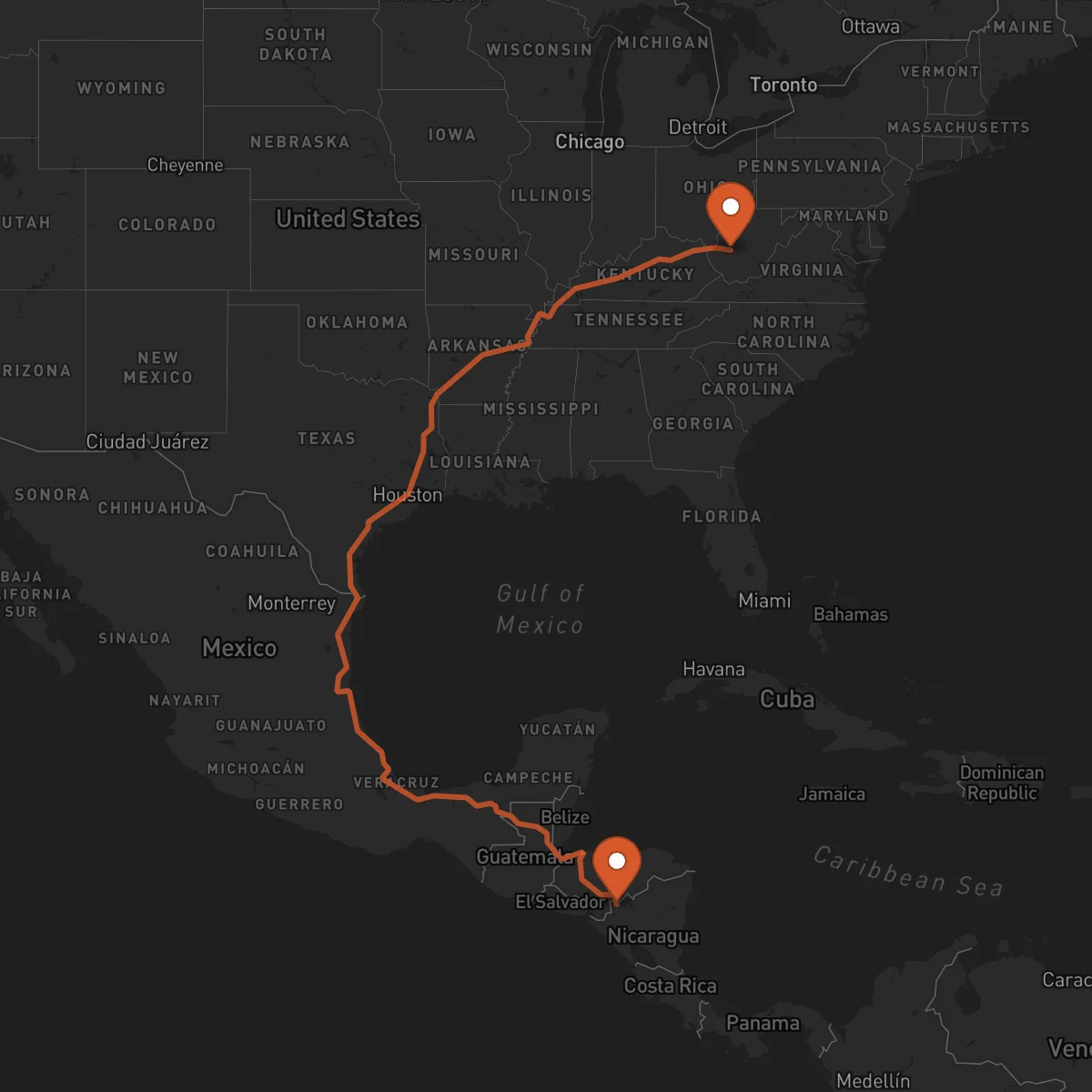
Charleston to Ocotal
Ocotal → CharlestonFTL freight transportation service between Charleston and Ocotal. Reliable logistics solutions for your business.
Route Description
Everything you need to know about the corridor Charleston - Ocotal
The Charleston, West Virginia to Ocotal, Nicaragua corridor is a strategically vital cross-border freight route connecting the industrial heartland of the United States with the agricultural and manufacturing regions of Northern Nicaragua. This approximately 2,790 km corridor serves as a critical economic link, facilitating the movement of goods across multiple international borders and diverse landscapes. The route traverses the Eastern U.S., crosses into Mexico via major border points, and continues through Central America, requiring sophisticated coordination for customs clearance and regulatory compliance.
Economically, the corridor supports the exchange of U.S. industrial and chemical products from the Appalachian region for Nicaraguan agricultural exports like coffee, beef, and textiles, along with manufactured goods. Key industries leveraging this route include chemicals, machinery, agricultural inputs, and consumer goods. The transportation infrastructure relies on a network of major U.S. Interstates (such as I-64, I-77, and I-40), Mexico's federal highways, and Central American road networks, demanding expertise in cross-border logistics.
Control Terrestre facilitates seamless operations on this complex corridor through our alliance of certified providers. Our team manages the entire journey, leveraging partners with C-TPAT, FAST, and BASC certifications to ensure secure and efficient cross-border transit. We coordinate all customs brokerage, border crossing procedures, and land transportation, providing a singular point of contact for our clients. This eliminates the fragmentation typically associated with multi-country shipments, offering a streamlined, door-to-door FTL solution that navigates the regulatory and logistical challenges of the U.S.-Mexico-Central America corridor with precision.
By focusing exclusively on full truckload solutions, we ensure dedicated capacity and specialized handling for cargoes ranging from standard dry van to refrigerated, flatbed, and tanker shipments. Our network's expertise in this specific corridor means we anticipate and mitigate common hurdles, from Mexican customs processes to Central American transit regulations, providing our clients with reliable, human-centric freight transportation from origin to destination.
Services for this Route
Available services for the corridor Charleston - Ocotal
 Origin
Charleston
Charleston, West Virginia, serves as a strategic logistics origin for this corridor, anchored by its position in the Appalachian industrial region. The city is a hub for chemical manufacturing, polymer production, machinery, and historically, coal and timber. This industrial base generates consistent outbound freight demand for raw materials, chemicals, and finished goods needing distribution to international markets. The available infrastructure is robust for overland freight, with direct access to major interstate highways I-64 and I-77, which provide efficient connections to key U.S. border crossings with Mexico. Charleston's inland location is complemented by its role as a consolidation point for regional industries, making it a practical launchpad for long-haul, cross-border truckload shipments heading south.
 Destination
Ocotal
Ocotal, located in Nicaragua's Nueva Segovia department, is a strategically important destination in Northern Nicaragua's agricultural and commercial corridor. It serves as a key economic center for the region's high-quality coffee production, a major export commodity, as well as for cattle, dairy, and textiles. The city's logistics significance is enhanced by its proximity to the Honduran border and its connection via Nicaragua's road network to major Pacific ports like Corinto for global shipping. For inbound freight, Ocotal requires reliable land transportation for imported goods, machinery, and consumer products that supply the local and regional economy. The route's final overland segment benefits from established road infrastructure, though it requires experienced navigation to ensure timely delivery to this inland destination.










