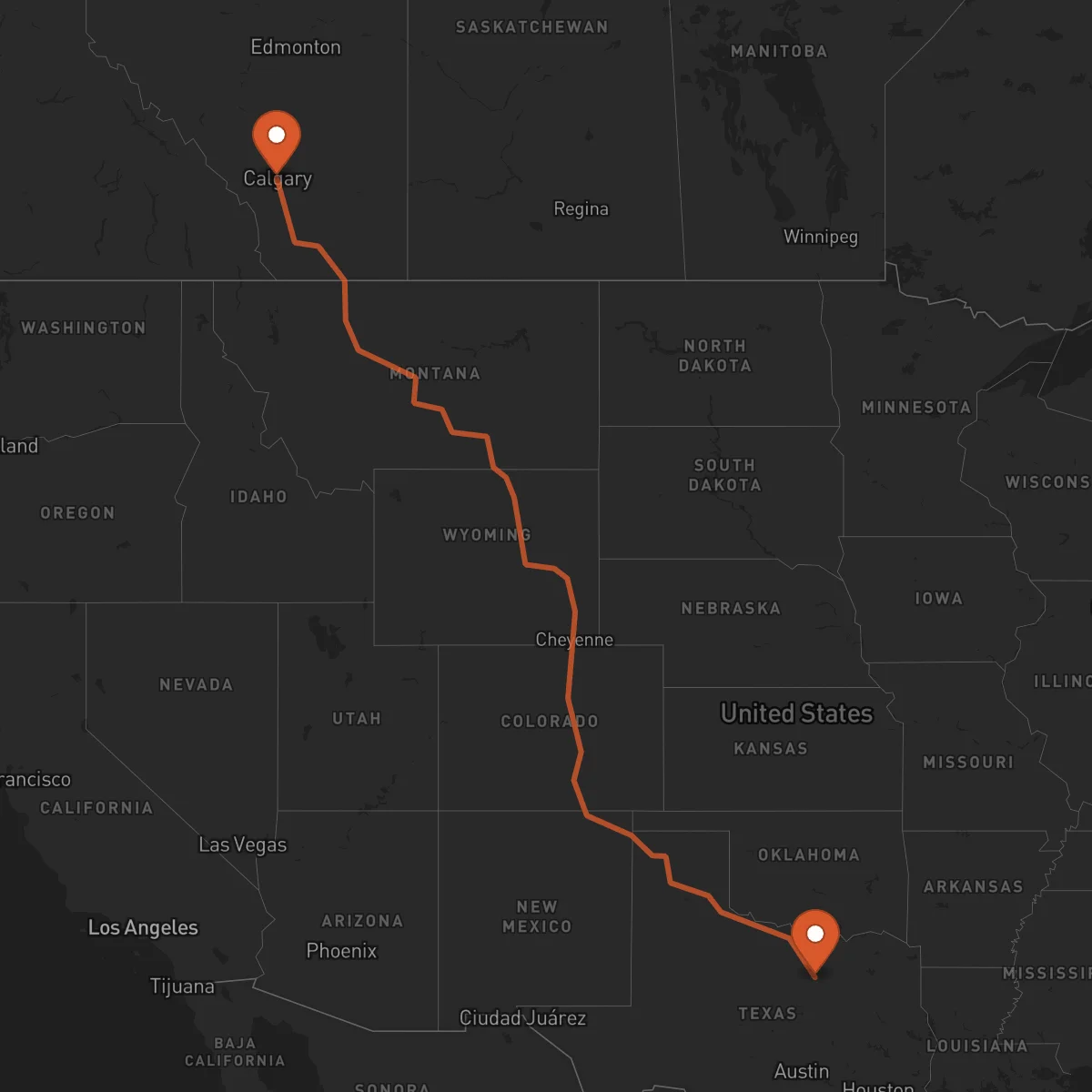
Calgary to Fort Worth
Fort Worth → CalgaryFTL freight transportation service between Calgary and Fort Worth. Reliable logistics solutions for your business.
Route Description
Everything you need to know about the corridor Calgary - Fort Worth
The Calgary to Fort Worth corridor represents a vital cross-border logistics connection linking Canada's energy capital with one of Texas's major industrial hubs. This 2,448 km route traverses the North American heartland, connecting Alberta's booming oil and gas sector with Texas's diverse manufacturing and energy industries. The corridor serves as a critical supply chain artery for energy equipment, industrial machinery, and specialized cargo moving between these two economic powerhouses.
The transportation infrastructure along this route is robust, primarily utilizing Interstate 15 South through Montana and Idaho, connecting to Interstate 90 East through Wyoming and South Dakota, then transitioning to Interstate 35 South through Oklahoma and into Texas. This multi-state journey crosses the international border at various points, with Sweetgrass, Montana/Calgary being a primary crossing for commercial freight. Control Terrestre's expertise in cross-border operations ensures seamless customs clearance and compliance with both US and Canadian regulations, minimizing delays and optimizing transit times.
This corridor is particularly crucial for the energy sector, with Calgary's oil and gas equipment manufacturers supplying the shale and conventional energy operations in the Fort Worth area. The route also facilitates the movement of agricultural products, industrial components, and specialized machinery. Control Terrestre's dedicated FTL services along this corridor provide reliable, temperature-controlled, and specialized transportation solutions, ensuring that time-sensitive and high-value cargo reaches its destination safely and efficiently.
Services for this Route
Available services for the corridor Calgary - Fort Worth
 Origin
Calgary stands as Canada's energy capital and a strategic logistics hub in Alberta. Located at the foothills of the Canadian Rockies, Calgary offers excellent connectivity through major highways including the Trans-Canada Highway (Highway 1) and the Queen Elizabeth II Highway (Highway 2), which connects to the US border. The city's economy is dominated by the energy sector, with oil and gas companies, energy services firms, and related industries forming the backbone of its industrial base. Calgary International Airport and the nearby Edmonton International Airport provide air cargo options, while the Port of Vancouver offers maritime connections for international shipments. The city's logistics infrastructure is well-developed, with numerous warehousing and distribution centers supporting the energy and industrial sectors.
 Destination
Fort Worth
Fort Worth serves as a major logistics and industrial center in North Texas, strategically positioned within the Dallas-Fort Worth metroplex. The city's location provides excellent access to major transportation networks, including Interstate 35, which connects to the NAFTA corridor, and multiple rail lines operated by major carriers. Fort Worth's economy is diverse, with strong presence in aviation (Lockheed Martin), manufacturing, and energy sectors. The city hosts Alliance Airport and Fort Worth Meacham International Airport, supporting air cargo operations. The Port of Houston's proximity provides additional maritime connectivity. Fort Worth's logistics infrastructure includes numerous industrial parks, warehousing facilities, and cross-docking operations, making it an ideal destination for freight distribution throughout Texas and the southern United States.










