Brampton to Tucson
Tucson → BramptonFTL freight transportation service between Brampton and Tucson. Reliable logistics solutions for your business.
Route Description
Everything you need to know about the corridor Brampton - Tucson
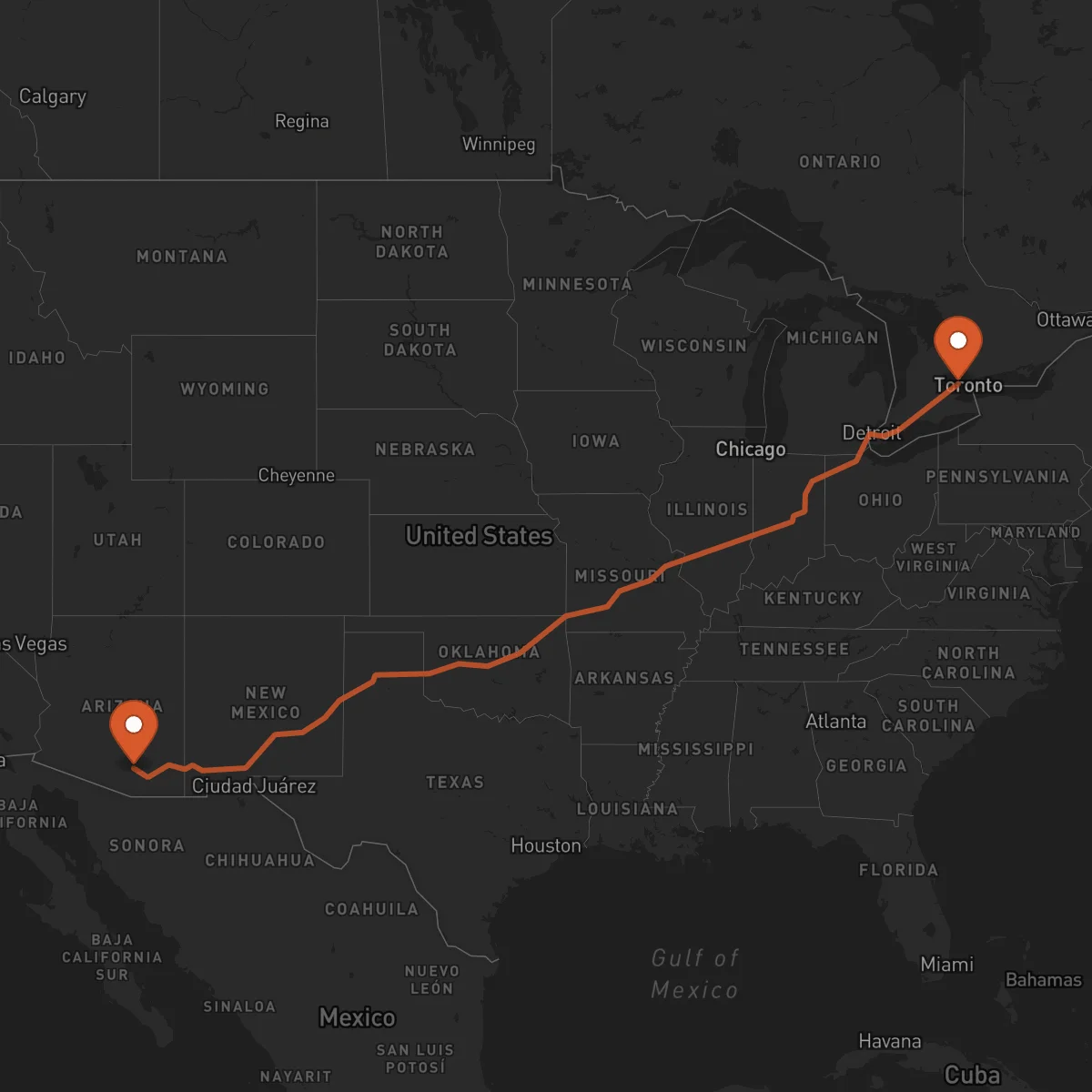
The logistics corridor between Brampton, Ontario, and Tucson, Arizona, represents a vital cross-border transportation route connecting Canada's manufacturing heartland with the southwestern United States. This 2,993 km corridor traverses diverse landscapes and economic regions, facilitating the movement of goods between two major North American markets. The route serves as a critical link in the supply chain for companies operating across the Canada-US border, supporting just-in-time manufacturing and distribution networks that span the continent.
The corridor passes through key economic centers including Detroit, Chicago, and Dallas, connecting major industrial hubs and distribution centers. Brampton's proximity to Toronto and its position within Canada's Golden Horseshoe manufacturing region makes it an ideal origin point for freight destined for southwestern US markets. Tucson's strategic location near the Mexico-US border and its growing logistics infrastructure position it as an important gateway for goods distribution throughout the southwestern United States and beyond.
This cross-border route primarily utilizes major interstate highways including I-69, I-65, I-40, and I-10, providing reliable transportation infrastructure for full truckload shipments. The corridor benefits from established border crossing facilities at key points, with customs clearance processes optimized for efficient freight movement. Control Terrestre's expertise in cross-border logistics ensures seamless coordination between Canadian and US transportation networks, handling all regulatory requirements and documentation to facilitate smooth freight movement along this important trade corridor.
Services for this Route
Available services for the corridor Brampton - Tucson
 Origin
Brampton, located in the Greater Toronto Area of Ontario, serves as a strategic logistics hub within Canada's most populous and economically active region. The city's proximity to Toronto Pearson International Airport and major highway networks, including Highway 401 and Highway 407, provides excellent connectivity for freight transportation. Brampton's industrial parks house numerous manufacturing facilities, particularly in automotive, food processing, and advanced manufacturing sectors, creating substantial freight movement requirements.
The city's location within Canada's Golden Horseshoe region offers access to a dense network of suppliers, customers, and distribution centers. Brampton's transportation infrastructure includes extensive warehousing facilities, intermodal yards, and specialized logistics centers that support efficient freight consolidation and distribution. The region's strong manufacturing base, particularly in automotive and aerospace industries, generates consistent demand for full truckload services to US markets.
 Destination
Tucson
Tucson, Arizona, occupies a strategic position in the southwestern United States, serving as a crucial logistics gateway for the region. Located approximately 100 miles from the Mexico-US border, Tucson provides access to major transportation corridors connecting to Phoenix, Los Angeles, and El Paso. The city's Sky Harbor International Airport and Union Pacific rail facilities complement its road transportation network, creating a multimodal logistics environment.
The Tucson metropolitan area has developed significant warehousing and distribution infrastructure to support its role as a regional logistics center. Major industries in the region include aerospace and defense, optics and photonics, and mining equipment manufacturing. Tucson's proximity to major ports of entry and its position along Interstate 10 make it an ideal destination for freight originating from Canadian manufacturing centers, facilitating the distribution of goods throughout the southwestern United States.










