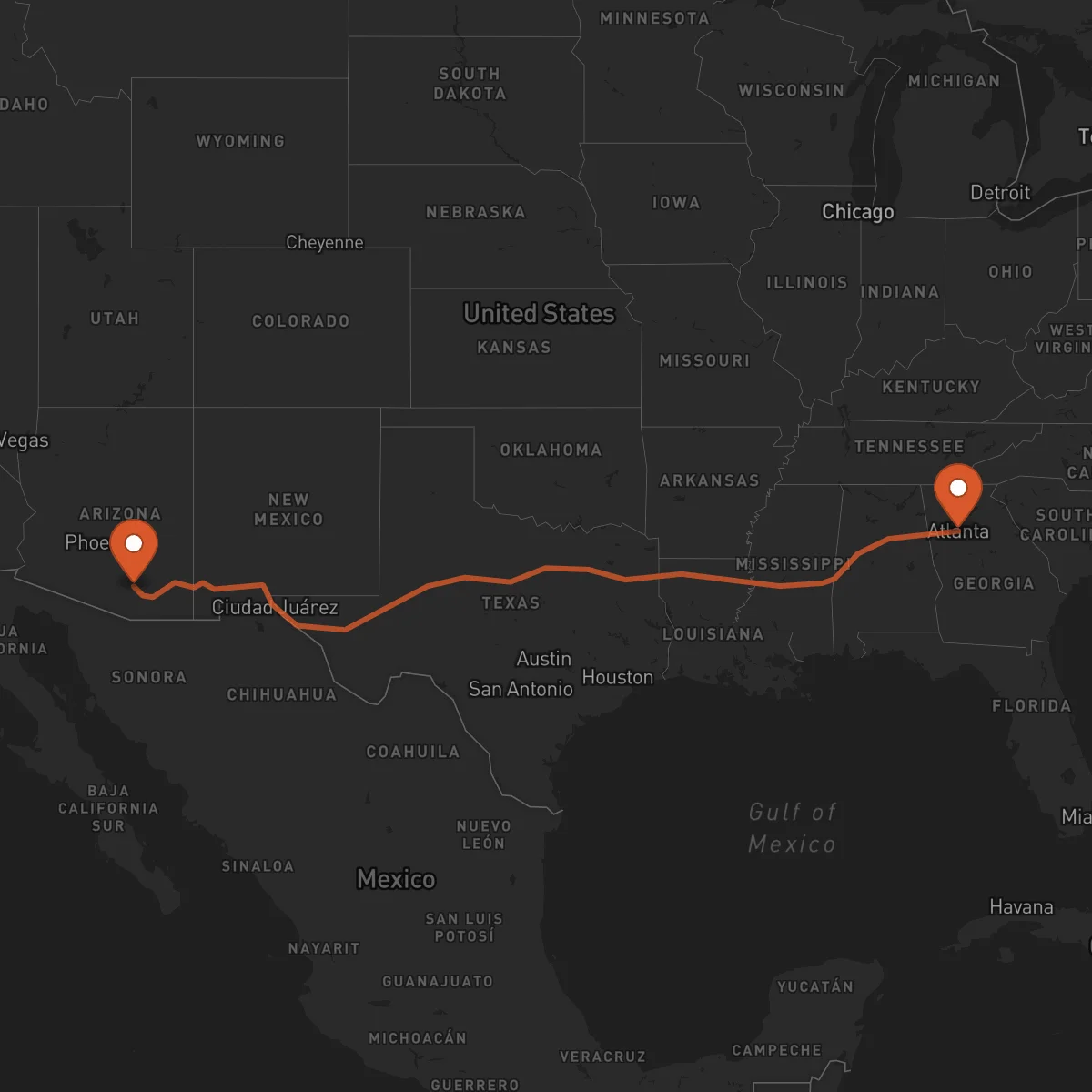
Atlanta to Tucson
Tucson → AtlantaFTL freight transportation service between Atlanta and Tucson. Reliable logistics solutions for your business.
Route Description
Everything you need to know about the corridor Atlanta - Tucson
The Atlanta to Tucson corridor is a vital logistics route connecting the southeastern United States with the southwestern region. Spanning approximately 2,478 kilometers, this corridor traverses diverse terrain and crosses multiple states, including Georgia, Alabama, Mississippi, Louisiana, Texas, New Mexico, and Arizona. The route serves as a crucial link between major economic hubs, facilitating the movement of goods across the country's heartland.
The corridor's strategic importance is underscored by its connection of Atlanta, a major southeastern logistics center, with Tucson, a key gateway to the Southwest and Mexico. This route enables efficient transportation of goods between the manufacturing powerhouses of the Southeast and the growing markets of the Southwest, including the technology and aerospace industries in Arizona.
Control Terrestre specializes in full truckload (FTL) transportation along this corridor, offering dedicated services that ensure timely and secure delivery of your cargo. Our extensive network of certified carriers and strategic partnerships allows us to provide reliable transportation solutions, whether you're moving industrial equipment from Atlanta's manufacturing districts or consumer goods destined for Tucson's distribution centers.
We leverage our expertise in cross-country logistics to optimize routes, manage transit times, and provide real-time tracking of your shipments. Our commitment to safety, efficiency, and customer satisfaction makes us the ideal partner for businesses looking to streamline their supply chain operations between Atlanta and Tucson.
Services for this Route
Available services for the corridor Atlanta - Tucson
 Origin
Atlanta
Atlanta, Georgia, is a major logistics hub in the southeastern United States, known for its strategic location and robust transportation infrastructure. The city boasts one of the busiest airports in the world, Hartsfield-Jackson Atlanta International Airport, and is a key rail center with multiple Class I railroad connections. Atlanta's extensive highway network includes I-20, I-75, and I-85, providing excellent road connectivity to major markets across the country.
The city is home to a diverse range of industries, including automotive manufacturing, aerospace, logistics, and technology. Major corporations such as Delta Air Lines, Coca-Cola, and Home Depot have their headquarters in Atlanta, contributing to a thriving business environment. The presence of the Port of Savannah, one of the largest container ports in the United States, further enhances Atlanta's importance in the logistics landscape.
 Destination
Tucson
Tucson, Arizona, serves as a crucial logistics gateway to the Southwest and Mexico, offering strategic advantages for businesses operating in the region. Located in the Sonoran Desert, Tucson benefits from its proximity to major transportation routes, including I-10, which connects the city to Los Angeles and Phoenix. The Tucson International Airport and the Union Pacific Railroad provide additional transportation options, facilitating efficient movement of goods.
The city's economy is diverse, with key industries including aerospace and defense, optics and photonics, and mining technology. Tucson is home to major employers such as Raytheon Missiles & Defense and the University of Arizona, which contribute to a skilled workforce and innovative business environment. The region's growing technology sector and its role as a distribution center for goods heading to Mexico make Tucson an increasingly important logistics hub in the Southwest.










