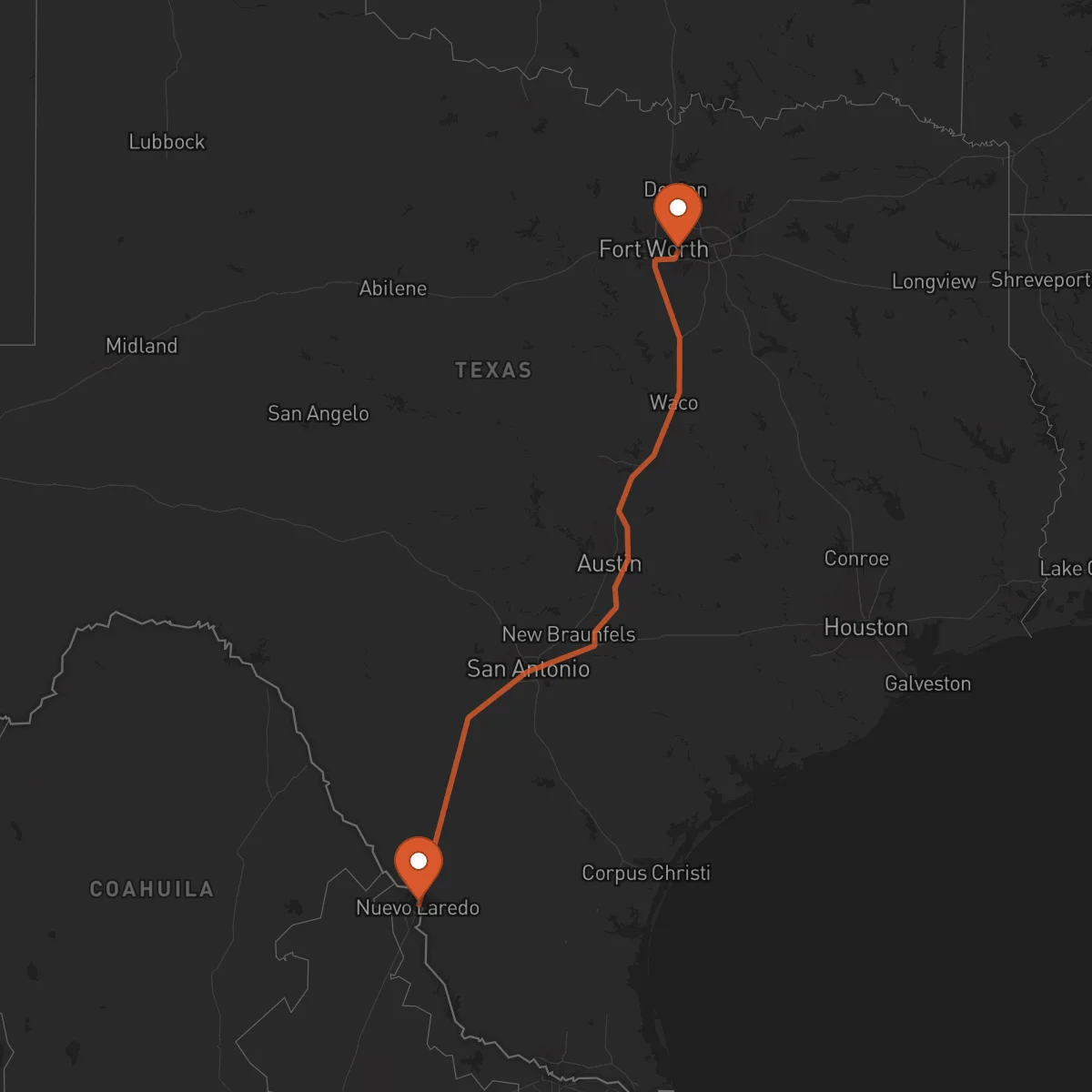
Arlington to Laredo
Laredo → ArlingtonFTL freight transportation service between Arlington and Laredo. Reliable logistics solutions for your business.
Route Description
Everything you need to know about the corridor Arlington - Laredo
The Arlington to Laredo corridor represents a vital domestic freight transportation route in Texas, spanning approximately 626 kilometers. This strategic connection links the Dallas-Fort Worth metropolitan area with the critical border crossing at Laredo, facilitating the movement of goods between major industrial centers and international trade hubs. The corridor serves as a key artery for Texas commerce, connecting manufacturing hubs in North Texas with distribution centers and export facilities in South Texas.
The economic significance of this route is underscored by the diverse industrial activities it supports. Arlington's proximity to the Dallas-Fort Worth metroplex provides access to major manufacturing, technology, and logistics operations, while Laredo's position as one of North America's busiest inland ports creates a natural flow of cross-border freight. The corridor benefits from Texas's robust infrastructure network and serves industries ranging from automotive and electronics to consumer goods and industrial equipment.
Transportation along this route primarily utilizes Interstate 20 and Interstate 35, two of Texas's most important freight corridors. These highways provide reliable, high-capacity connections that support the movement of full truckload (FTL) freight between the two cities. Control Terrestre leverages this infrastructure to provide efficient FTL transportation services, ensuring that cargo moves seamlessly between Arlington's industrial centers and Laredo's border facilities. Our network of certified carriers and strategic partnerships enables us to handle the diverse freight needs of businesses operating along this important Texas corridor.
Services for this Route
Available services for the corridor Arlington - Laredo
 Origin
Arlington
Arlington, Texas, serves as a strategic logistics hub within the Dallas-Fort Worth metropolitan area. Located in Tarrant County, Arlington benefits from its position in one of the nation's largest economic regions, with excellent access to major transportation networks including Interstate 20, Interstate 30, and State Highway 360. The city's central location in North Texas makes it an ideal origin point for freight distribution throughout the state and beyond.
The economic landscape of Arlington is diverse, anchored by major industries including aerospace and defense, automotive manufacturing, and technology. The presence of the General Motors Arlington Assembly plant and the growing entertainment and tourism sector, centered around AT&T Stadium and Six Flags Over Texas, creates consistent freight movement. Arlington's logistics infrastructure includes multiple warehousing and distribution facilities, providing excellent staging capabilities for freight operations.
 Destination
Laredo
Laredo, Texas, stands as one of the most critical logistics gateways in North America, strategically positioned on the U.S.-Mexico border. As the nation's largest inland port, Laredo handles billions of dollars in international trade annually, with its World Trade International Bridge and Laredo International Airport providing multiple freight transportation options. The city's location at the intersection of Interstate 35 and major Mexican highways creates an unparalleled logistics advantage for cross-border operations.
The economic foundation of Laredo is built on international trade, with the city serving as a vital link between U.S. and Mexican supply chains. Key industries include manufacturing, logistics and warehousing, and wholesale trade. The city's extensive industrial parks and distribution centers are specifically designed to handle the high volume of cross-border freight, while its proximity to major Mexican industrial centers ensures consistent freight flow in both directions.










