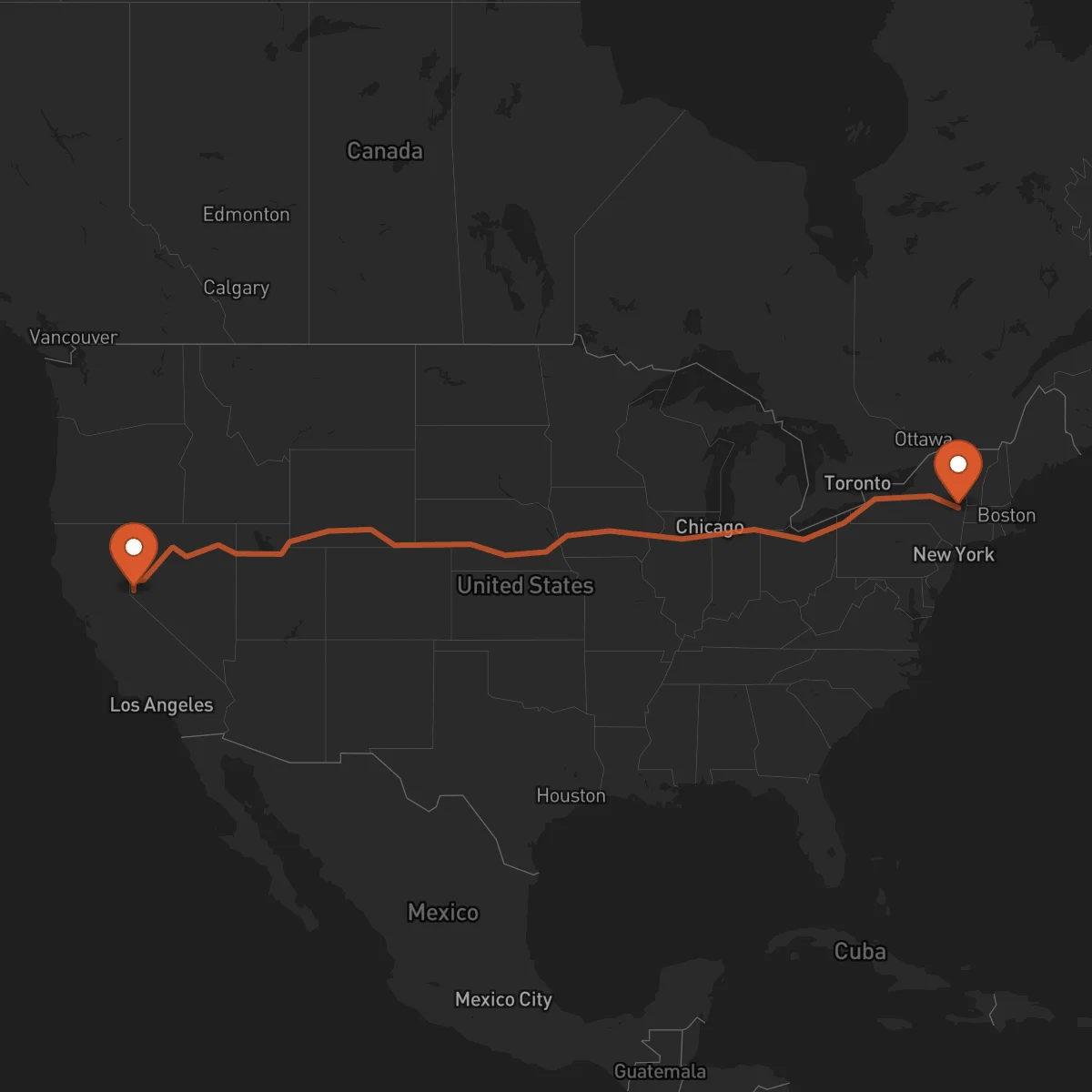
Albany to Carson City
Carson City → AlbanyFTL freight transportation service between Albany and Carson City. Reliable logistics solutions for your business.
Route Description
Everything you need to know about the corridor Albany - Carson City
The Albany-Carson City corridor represents one of the most significant domestic freight transportation routes in the United States, spanning approximately 3,838 kilometers across the country's diverse geography. This transcontinental connection links the historic capital of New York with the emerging commercial hub of Nevada, creating a vital supply chain artery for numerous industries. The route traverses multiple states, crossing through the industrial heartland, agricultural regions, and mountainous terrain, requiring specialized logistics expertise to ensure efficient cargo movement.
The economic importance of this corridor cannot be overstated. Albany serves as a major distribution center for the northeastern United States, with its proximity to major ports and manufacturing hubs. Meanwhile, Carson City has evolved into a strategic logistics point for the western United States, benefiting from Nevada's business-friendly environment and its position as a gateway to the Pacific markets. This east-west connection facilitates the movement of diverse cargo types, from manufacturing components and agricultural products to retail goods and industrial equipment.
Control Terrestre specializes in optimizing freight operations along this challenging corridor. Our extensive network of certified carriers and deep understanding of regional logistics requirements allow us to provide reliable full truckload services that meet the demanding needs of businesses operating between these two strategic locations. We leverage advanced route planning technology and real-time tracking capabilities to ensure cargo arrives safely and on schedule, regardless of weather conditions or seasonal traffic variations.
Services for this Route
Available services for the corridor Albany - Carson City
 Origin
Albany
Albany, New York, stands as a crucial logistics hub in the northeastern United States, strategically positioned at the intersection of major transportation networks. Located on the west bank of the Hudson River, Albany serves as a gateway to both domestic and international markets, with easy access to the Port of Albany and major interstate highways including I-90 and I-87. The city's central location within New York State makes it an ideal distribution point for companies serving the entire northeastern region, from Boston to Washington D.C.
The economic landscape of Albany is diverse and robust, with strong representation from government services, healthcare, education, and technology sectors. The region is also home to significant manufacturing operations, particularly in nanotechnology and semiconductor production. Albany's logistics infrastructure includes the Albany International Airport, extensive rail connections through CSX and Canadian Pacific railways, and a well-developed network of warehousing and distribution centers that support the region's role as a major supply chain node.
 Destination
Carson City
Carson City, Nevada, has emerged as a strategic logistics center in the western United States, benefiting from its unique geographical position and business-friendly environment. Situated in the western part of Nevada, just minutes from the California border, Carson City provides companies with access to major markets in California while avoiding some of the state's more stringent regulations. The city's proximity to Reno-Tahoe International Airport and major highways including US-50 and US-395 makes it an ideal location for distribution and logistics operations.
The economic profile of Carson City is characterized by a growing technology sector, government services, and tourism-related industries. Nevada's lack of corporate income tax and favorable business regulations have attracted numerous companies to establish distribution centers in the region. The city's logistics infrastructure continues to expand, with new warehousing facilities and improved transportation connections supporting its role as a key distribution point for goods moving throughout the western United States and beyond.










