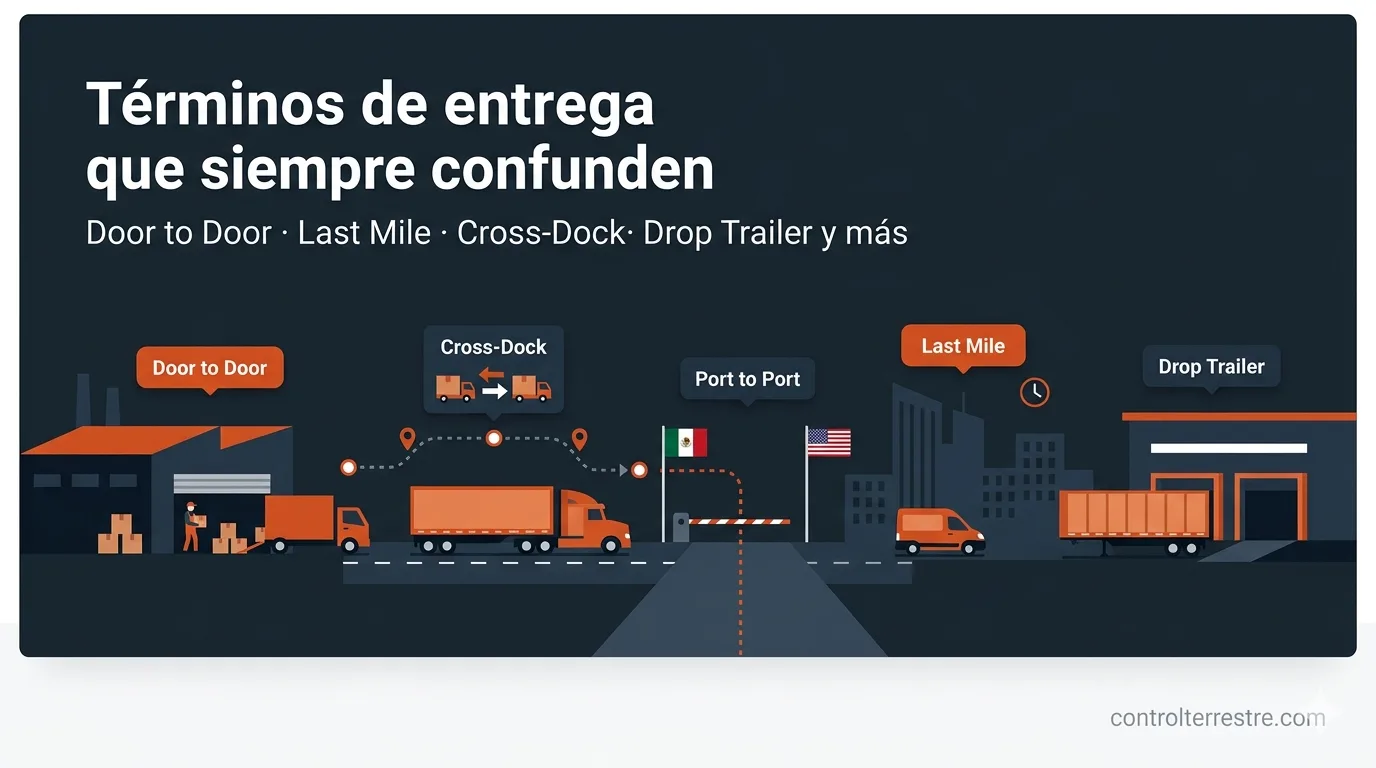
You don't need to be a customs broker or foreign trade specialist to move goods between Mexico and the United States. But you do need to speak the language. These are the 20 terms that come up in every international logistics operation — explained without jargon.
Why knowing the vocabulary matters
Every time you sign a transportation contract, review a freight quote, or talk to your customs broker, you are making decisions that affect the cost, risk, and speed of your operation. If you don't understand the terms, you are making those decisions blindly.
This glossary is not meant to be memorized — it's meant to be within reach when you need it.
The 20 essential terms
1. Incoterm
An international rule that defines who pays what and who assumes the risk at each stage of a foreign trade transaction. They are published by the International Chamber of Commerce and the current version is Incoterms 2020. The Incoterm you choose in your contract determines whether you or your buyer is the one who arranges the freight, pays for insurance, and is responsible if something goes wrong in transit.
2. FOB — Free On Board
One of the most widely used Incoterms in Mexico–U.S. trade. It means the seller is responsible for the goods until they are loaded onto the means of transport at the point of origin. From that point on, risk and cost transfer to the buyer. If you sell FOB, your responsibility ends when the cargo leaves your warehouse or port of shipment.
3. DDP — Delivered Duty Paid
The Incoterm with the greatest responsibility for the seller. It means you deliver the goods to the final destination, with all taxes and duties paid. If you sell DDP to a buyer in Chicago, you arrange and pay for everything — freight, insurance, Mexican customs, U.S. customs, and final delivery. Greater control, greater cost, greater risk.
4. Pedimento
The official document required by SAT to import or export goods in Mexico. It is the Mexican equivalent of a customs declaration. Without a correct and stamped pedimento, your cargo does not cross the border. Your customs broker prepares it, and it must accurately reflect the contents, value, and origin of the goods.
5. Carta Porte
A mandatory fiscal complement in Mexico since 2021 for the transportation of goods by road. It is attached to the CFDI and must contain detailed information about the origin, destination, goods transported, operator, and vehicle. An error in the Carta Porte can stop your shipment at any SAT checkpoint.
6. Bill of Lading (BL)
The American equivalent of the carta porte — the document certifying that the carrier received the goods and commits to delivering them at the destination. In international ground transportation, the term "Straight Bill of Lading" is used for direct shipments. It is the base document for any claim in case of damage or loss on the U.S. side.
7. Customs
The government agency that controls the entry and exit of goods in each country. In Mexico, it falls under SAT. In the United States, it is CBP — Customs and Border Protection. Both customs authorities must release the goods for the crossing to be completed.
8. Customs Broker
The authorized professional who handles the customs clearance of your goods. In Mexico, a patent granted by SAT is required. In the U.S., a CBP license is required. This is not optional in foreign trade operations — this is the person who translates your commercial transaction into the legal and fiscal language of customs.
9. Tariff Classification / HS Code
The numerical code that classifies your goods within the international harmonized trade system. It defines the duty your product pays when entering another country and which health, phytosanitary, or safety regulations apply. An incorrect tariff classification can result in miscalculated taxes or the detention of your cargo.
10. Certificate of Origin
A document certifying that your goods were produced in Mexico. It is essential to access the tariff benefits of the USMCA when exporting to the U.S. or Canada. Without a valid certificate of origin, your product may be subject to duties as if there were no trade agreement.
11. Dwell Time
The amount of time a transport unit remains stopped at a crossing point or customs facility without moving forward. It is one of the most underestimated costs in border logistics — every hour of dwell time generates detention fees, idling fuel costs, and the risk of missing delivery windows.
12. Freight Rate
The cost of transporting goods from one point to another. It can be quoted per kilometer, per trip, per ton, or per load unit. The freight rate does not always include all costs — additional charges such as detention, tolls, handling, or insurance can significantly increase the actual cost.
13. LTL — Less Than Truckload
A transportation mode where your goods share truck space with cargo from other customers. You only pay for the space you occupy. Ideal for volumes that do not fill an entire vehicle. It may involve transshipments and longer transit times than full truckload.
14. FTL — Full Truckload
A mode where you contract the exclusive use of an entire vehicle, regardless of whether you fill it to 100%. The truck goes directly from origin to destination with no intermediate stops. Higher fixed cost but lower risk of damage, shorter transit time, and greater traceability.
15. Cargo Manifest
A document listing all goods transported in a vehicle. In international crossing operations, the manifest must be presented to customs authorities before the crossing. Any discrepancy between the manifest and the physical cargo can result in an extended inspection.
16. C-TPAT / OEA
Customs security certification programs. C-TPAT is the U.S. program administered by CBP — Customs-Trade Partnership Against Terrorism. OEA is its Mexican equivalent administered by SAT. Certified companies and carriers have access to preferential lanes at the border that significantly reduce crossing times.
17. ETA — Estimated Time of Arrival
The estimated time or date a shipment will arrive at its destination. It is not a guarantee — it is a projection based on normal transit conditions. In operations with strict delivery windows, the ETA must be monitored in real time and updated in the event of any en-route incident.
18. Consolidation / Deconsolidation
Consolidation is the process of combining several small shipments into a single vehicle to optimize transportation costs. Deconsolidation is the reverse process — separating a consolidated load into its individual shipments upon arrival at the destination. It is the foundation of LTL service and cross-dock distribution centers.
19. Backhaul
The return trip of a truck after delivering its cargo. If the carrier has no return load, the cost of the empty trip is factored into the outbound rate. A well-managed backhaul reduces the actual freight cost for both parties.
20. Lead Time
The total time that elapses from when an order is placed to when the goods arrive at the final destination. It includes production or preparation time, transit time, customs processing time, and delivery time. It is one of the most critical indicators in your relationship with your client — and one of the factors that most affects the perception of your service when it falls short.
How to use this glossary
Save it as a reference for your next freight negotiations, contract reviews, or conversations with your customs broker. When someone uses a term you don't recognize, it's a signal that there is a decision behind that term that deserves your attention.
At Control Terrestre, we work with operational transparency — we explain every part of the process to our clients because we understand that a logistics operation works better when everyone speaks the same language. Request a quote or subscribe to our newsletter to receive practical content on international logistics every week.