In logistics, there are terms everyone uses but few explain. You hear them in quotes, in contracts, in conversations with your carrier — and assuming you understand them can cost you money or time. Here we break them down one by one, with real-world examples.
Why These Terms Matter More Than They Seem
Each of these terms describes a specific way of moving, transferring, or delivering goods. Choosing the wrong model — or not understanding which one you're contracting — can lead to additional costs, delays, or misunderstandings with your carrier or your customer.
This is not unnecessary technical jargon. These are operational decisions disguised as vocabulary.
The Terms Explained
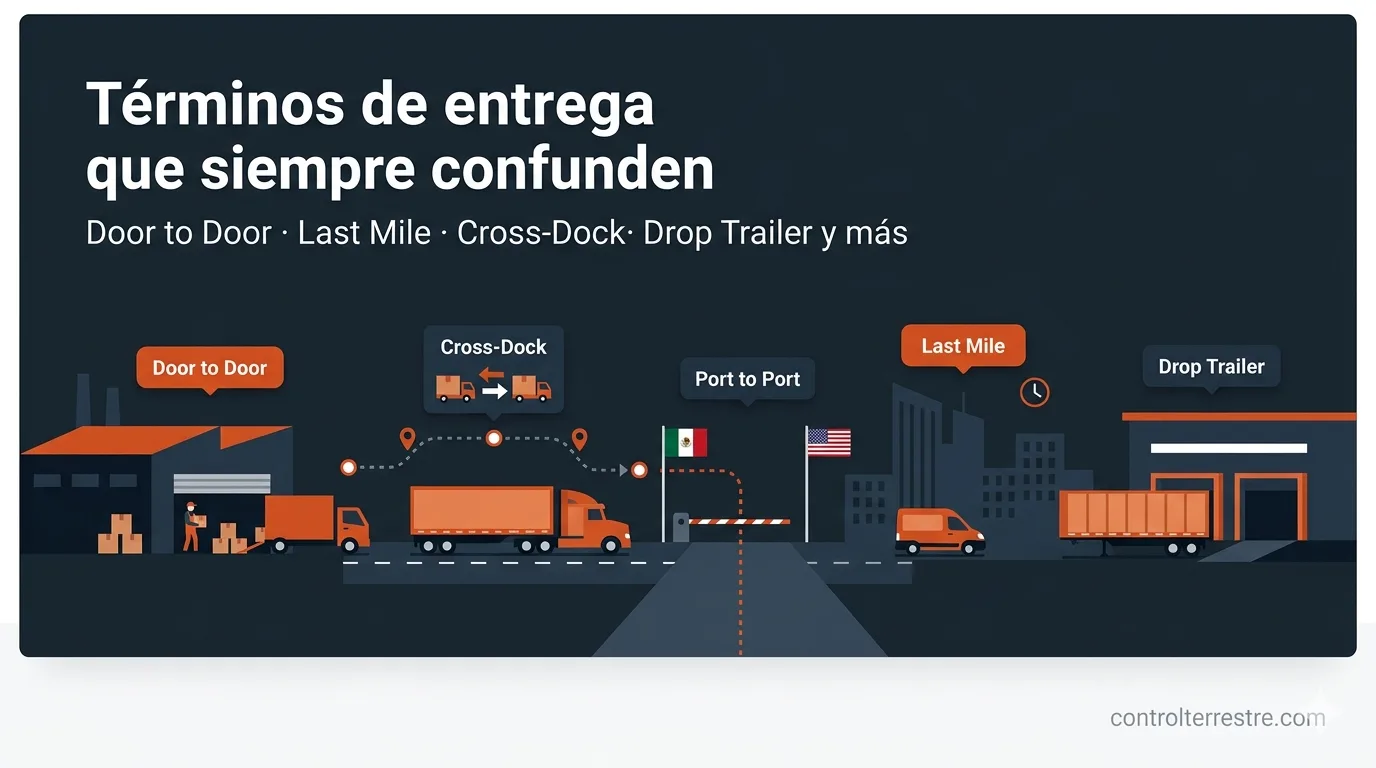
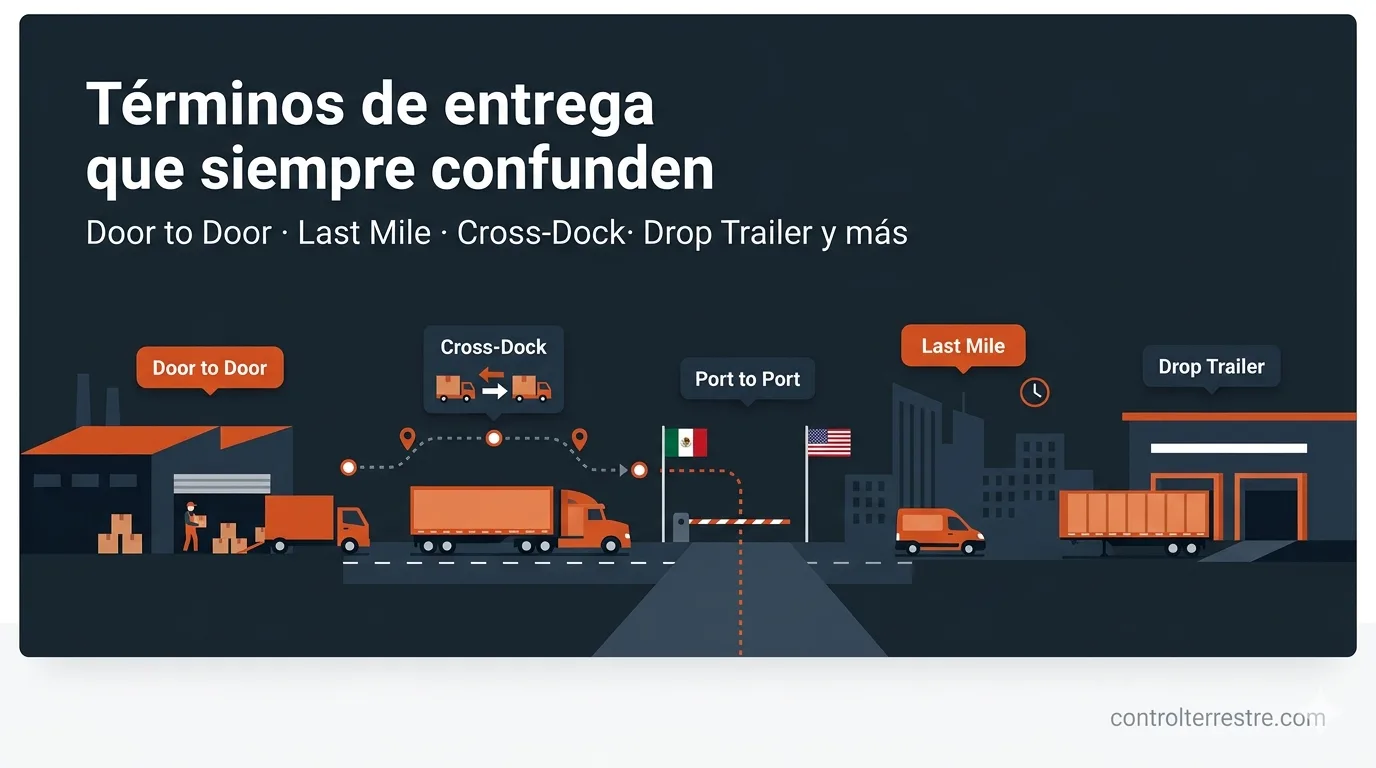
Door to Door
This is the most comprehensive service you can contract. The carrier picks up the goods at the door of your warehouse or facility and delivers them to the door of the final recipient — without you having to coordinate anything in between.
It includes pickup, transportation, and final delivery. In cross-border operations, it may also include customs clearance on both sides if agreed upon.
When it makes sense: when you want operational simplicity and a single point of contact responsible for the entire process. You pay more, but you reduce friction and coordination risk.
When it doesn't make sense: when you have your own logistics capacity at origin or destination and can handle any of the stages more efficiently on your own.
Port to Port
The carrier is only responsible for the leg between two transfer points — typically two terminals, warehouses, or border crossings. Pickup at origin and final delivery at destination are outside the scope of the service.
When it makes sense: when you have your own first- and last-mile logistics and only need to cover the main leg of the journey.
The most common confusion: many quotes that appear to be "complete" are actually port to port. If you don't explicitly ask whether pickup and final delivery are included, you may encounter additional costs you didn't expect.
Door to Port
A hybrid of the two above. The carrier picks up at your warehouse, but the final delivery is the responsibility of the recipient from the arrival point — terminal, transfer warehouse, or border crossing.
It's common in exports where the buyer has their own local logistics in the destination country but needs the seller to coordinate the origin side.
Last Mile
The final leg of a shipment's journey — from the last consolidation or transfer point to the final recipient. It is the shortest leg in distance and the most expensive in proportion, because it involves individual deliveries to multiple points with varying conditions: urban traffic, receiving hours, limited access for large units.
In B2B logistics, the last mile can be delivery to a plant dock or distribution center. In ecommerce, it's home delivery. In both cases, this is where the most incidents occur and where the impact on the end customer experience is greatest.
Cross-Dock
A cross-dock operation is when goods arrive at a transfer warehouse, are unloaded, reorganized or reclassified, and reloaded onto another unit — without going through storage. The goal is to reduce transit times and warehousing costs by transferring cargo directly from one vehicle to another.
It is very common in high-volume distribution operations and at border consolidation centers.
What causes confusion: cross-dock is not the same as warehousing. If your cargo goes through a cross-dock, it is not being stored — it is being transferred. The difference matters in costs and in transit times.
Drop Trailer
A modality in which the carrier drops off the trailer at the customer's facility without waiting for it to be unloaded. The customer unloads at their own pace, and the carrier returns later to pick up the empty trailer.
When it makes sense: for customers with high receiving volumes who cannot unload immediately — distribution centers, industrial plants, large retailers. It avoids wait times and detention charges for the carrier.
When it doesn't make sense: for small shipments or customers without space to store a trailer. And it requires the customer to have the equipment to move and unload the trailer independently.
Live Unload
The opposite of drop trailer. The carrier arrives, waits while the customer unloads the goods, and takes the empty trailer away on the same trip. It is the standard model for most deliveries.
The tension between live unload and drop trailer: if the customer takes a long time to unload during a live unload, detention charges are generated — wait time that the carrier bills. If the customer prefers drop trailer but the carrier doesn't have trailers available to drop off, it has to be negotiated. These terms define who absorbs the wait time.
Transshipment
The transfer of goods from one transport unit to another during transit. It can happen at a cross-dock warehouse, a transfer terminal, or a modal change point.
Every transshipment is a point of risk — higher probability of damage, loss, or delay. In fragile, high-value, or cold chain shipments, minimizing transshipments is an operational priority.
Hub and Spoke
A distribution model where all cargo converges toward a central point — the hub — from where it is redistributed to the final destinations — the spokes. It is the model used by major parcel carriers and many LTL operators.
The advantage is route efficiency and volume consolidation. The disadvantage is that it adds transit time because the cargo must pass through the hub before reaching its destination.
Milk Run
A pickup or delivery route that makes multiple stops in sequence, picking up or delivering small quantities at each point. The name comes from the tradition of milk delivery drivers who ran a fixed route with predefined stops.
It is efficient for suppliers that supply the same plant from multiple nearby origins — instead of each supplier sending their own truck, a single vehicle picks up at all points and consolidates the cargo before arriving at the plant.
The Question You Should Always Ask
Before signing any transportation quote, ask exactly what the service includes and what it doesn't. Pickup at origin? Delivery to the final destination or to a transfer point? Who coordinates customs? Are there intermediate transshipments?
A service that appears complete may be port to port with unmentioned additional costs. A service that seems expensive may include everything you need with no surprises.
The difference between understanding these terms and not understanding them is the difference between quoting with certainty and signing without knowing exactly what you bought.
At Control Terrestre, we explain every detail of the operation before the first truck leaves — because clarity in the terms is part of the service. Request a quote or subscribe to our newsletter to receive practical content on international logistics every week.