There's a lot of noise around artificial intelligence in logistics. Some say it will revolutionize everything in five years. Others are already using it without calling it that. And a significant part is still more promise than reality. This article separates the three.
Why logistics is one of the sectors where AI has the most real impact
Logistics is, at its core, a massive optimization problem. Routes, times, costs, capacity, demand, weather, traffic, regulations — everything interacts simultaneously and changes constantly. It's exactly the type of problem artificial intelligence systems are designed for.
It's no coincidence that companies like Amazon, UPS, and DHL have been investing in AI applied to their supply chains for years. What's changing now is that those tools — previously accessible only to corporations with enormous budgets — are reaching mid-size and small operations through more accessible software platforms.
What already exists and is working today
Real-time route optimization
This is the most mature application of AI in ground transportation and the most widespread. Systems like Google Maps Platform, Here Technologies, or specialized logistics platforms like Onfleet or Route4Me use machine learning algorithms to calculate optimal routes considering real-time traffic, weight restrictions, delivery windows, and fuel consumption.
For last-mile operations — urban deliveries with multiple stops — the difference between an AI-optimized route and a manually planned one can be 20% to 30% in time and fuel. That's not hype. That's applied math.
Demand forecasting and capacity planning
AI-based forecasting systems analyze shipment history, seasonality, external events, and customer behavior patterns to predict how much transportation capacity a company will need in the coming weeks or months.
For companies with variable volumes — seasonal manufacturing, retail, agriculture — this allows negotiating capacity with carriers in advance instead of scrambling to find units when the market is already saturated.
Anomaly detection and predictive alerts
Modern fleet monitoring systems no longer just track location — they analyze driving patterns, fuel consumption, engine temperature, and on-route behavior to detect anomalies before they become breakdowns.
A truck that starts showing abnormal fuel consumption patterns may be developing a mechanical issue. An AI system can detect that anomaly days before the driver notices it — and schedule preventive maintenance before the unit fails on the road.
Automatic classification of customs documents
In cross-border operations, document review and classification is one of the most costly bottlenecks. Natural language processing systems can now read, classify, and validate documents such as bills of lading, customs declarations, and commercial invoices — detecting errors or inconsistencies before they reach the border crossing checkpoint.
This doesn't replace the customs broker. But it does reduce review time and the risk of human error in high-volume documentation.
What's coming and is already in development
Autonomous trucks for specific segments
Fully autonomous trucks on open highways are not yet a widespread commercial reality — but Level 2 and Level 3 assisted driving systems are already operating in some U.S. fleets. Companies like Waymo Via and Aurora are developing autonomous driving technology specifically for freight transportation on highways.
The model that seems most viable in the short term is not the door-to-door driverless truck, but the "transfer hub" model: the autonomous truck handles the highway segment between two transfer points, and a human driver handles the first and last mile in urban environments.
Digital twins of the supply chain
A digital twin is a real-time virtual replica of a physical operation. In logistics, it means having a computational model of your entire chain — inventory, transportation, warehouses, suppliers — that updates in real time and allows you to simulate scenarios before making decisions.
What happens if the Nuevo Laredo crossing closes for 48 hours? How long does it take for the impact to ripple to your customers? What alternative route minimizes cost? A digital twin can answer those questions in seconds.
Today this is technology for large corporations. In five years it will be available to mid-size operations through SaaS platforms.
Automated freight rate negotiation
Platforms like Freightos and Flexport are already using AI to automate part of the freight quoting and negotiation process. The next step — systems that negotiate rates autonomously based on real-time market conditions — is already in development at several logistics innovation labs.
What's still hype
"AI that predicts exactly when your shipment will arrive"
Predictive ETA systems have improved significantly — but absolute accuracy in ground transportation remains an unsolved problem. There are too many unpredictable variables: weather, accidents, road closures, customs wait times, mechanical condition of the unit. AI systems can give you a probability and a range — not a certainty.
When someone sells you a system that "predicts exactly" when your shipment will arrive, the word you should focus on is "predicts" — not "guarantees."
"Blockchain + AI for transparent logistics"
Blockchain in logistics has been touted for years as the definitive solution for traceability and document transparency. The reality is that adoption has been slow, real use cases are limited, and most "blockchain in logistics" projects announced between 2018 and 2022 never reached commercial scale.
It's not that the technology doesn't work — it's that the problem it solves requires all chain actors to adopt the same system at the same time, and that's a human coordination problem, not a technological one.
The fully autonomous warehouse with no human intervention
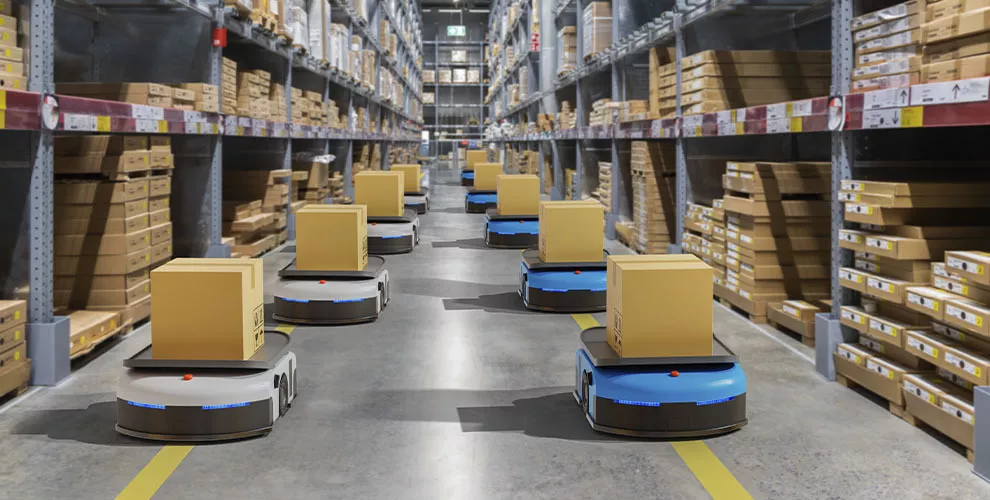
Warehouses with robots and automated systems exist and work well — at Amazon, at Alibaba, at some large logistics operators. But the image of a 100% autonomous warehouse with no human workers remains more aspirational than real for the vast majority of operations. Unstructured environments, irregular products, and operational exceptions still require human judgment.
What this means for your operation today
If you run a transportation operation or are a company that moves freight frequently, these are the practical questions worth asking yourself:
Does your carrier use route optimization? Not "we have GPS" — active route optimization considering traffic, appointments, and fuel consumption. If not, you're paying for inefficiencies that already have a technological solution available.
Do you have historical shipment data? Dates, routes, transit times, incidents, cost per trip. Without historical data, no AI works — and many companies that want to "implement AI" discover they first need to implement basic record-keeping.
Are you using forecasting to plan your transportation capacity? If you still plan based on intuition and last year's experience, there are accessible tools today that can significantly improve that planning.
AI in logistics is not the future. A significant part is already the present. The difference between companies that leverage it and those that don't is less about budget and more about the willingness to change how operational decisions are made.
At Control Terrestre, we closely follow the technological evolution of the sector — because the logistics that works today is not the same as what will work in five years, and preparing for that change is part of what we do. Request a quote or subscribe to our newsletter to receive practical content on logistics and technology every week.