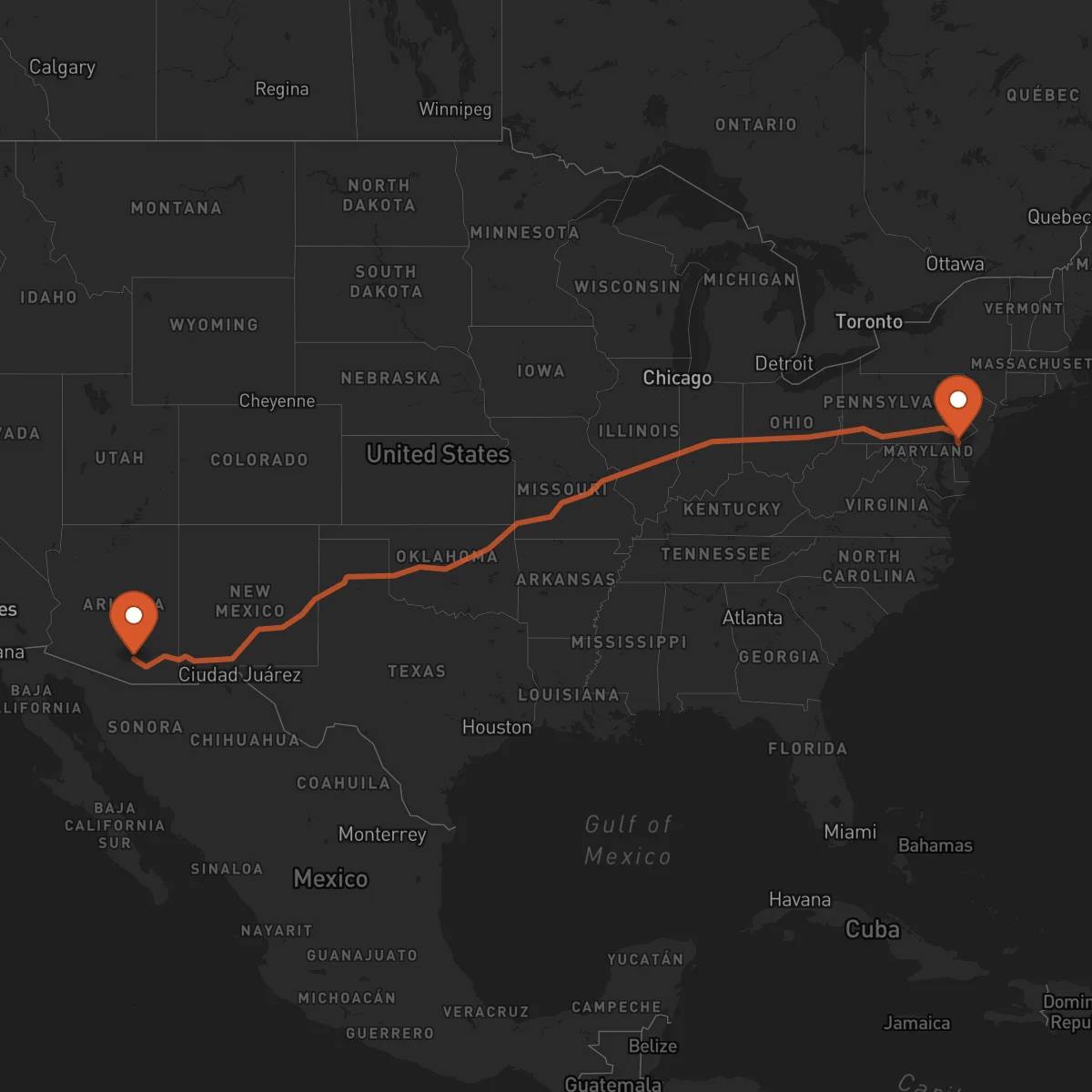
Wilmington to Tucson
Tucson → WilmingtonFTL freight transportation service between Wilmington and Tucson. Reliable logistics solutions for your business.
Route Description
Everything you need to know about the corridor Wilmington - Tucson
The logistics corridor connecting Wilmington, Delaware to Tucson, Arizona represents a vital artery for freight transportation across the United States, spanning approximately 3,271 kilometers. This east-west route traverses diverse terrain and crosses multiple states, serving as a critical link between the Mid-Atlantic manufacturing and port regions and the growing Southwest markets. The corridor's strategic importance lies in its ability to connect major industrial centers with distribution hubs, facilitating the movement of goods that fuel America's economy.
Wilmington's proximity to major ports and its established industrial base creates a steady flow of outbound freight, while Tucson's position as a gateway to the Southwest and Mexico makes it a crucial destination for imports and domestic distribution. The route primarily follows Interstate 40 and Interstate 10, two of America's most important freight corridors, providing reliable access through key logistics hubs including Nashville, Oklahoma City, and Phoenix. This infrastructure supports the efficient movement of full truckload shipments across the country.
Control Terrestre specializes in optimizing this corridor through our network of certified transportation providers and advanced logistics solutions. Our dedicated FTL services ensure that shipments move efficiently from origin to destination without unnecessary stops or handling. We understand the unique challenges of this long-haul route and provide the expertise needed to navigate it successfully, offering real-time tracking and dedicated customer support throughout the journey.
Services for this Route
Available services for the corridor Wilmington - Tucson
 Origin
Wilmington
Wilmington, Delaware serves as a strategic origin point for freight transportation, leveraging its prime location along the Eastern seaboard. The city's proximity to the Port of Wilmington and major East Coast ports creates exceptional access to international shipping lanes, while its position within the Northeast megalopolis provides immediate access to one of the nation's most concentrated consumer markets. Wilmington's robust transportation infrastructure includes direct access to I-95, connecting shippers to major metropolitan areas like Philadelphia, New York, and Washington D.C. within hours.
The region's economic landscape is dominated by financial services, with numerous credit card banks and corporate headquarters, alongside significant chemical and pharmaceutical industries. DuPont's historic presence has fostered a strong chemical manufacturing sector, while the healthcare and life sciences industries continue to expand. This diverse industrial base generates consistent freight volumes across multiple sectors, from raw materials to finished goods, making Wilmington an ideal origin for full truckload shipments requiring reliable, time-sensitive transportation solutions.
 Destination
Tucson
Tucson, Arizona stands as a strategic logistics hub in the Southwest, offering unique advantages for freight distribution and cross-border operations. Located just 96 kilometers from the U.S.-Mexico border, Tucson serves as a critical gateway for international trade, with the Nogales port of entry providing access to major Mexican manufacturing centers. The city's position along Interstate 10 creates a direct connection to Phoenix, Los Angeles, and the broader Pacific Coast, while its proximity to major rail intermodal facilities enhances multimodal shipping capabilities.
The Tucson metropolitan area has developed into a significant logistics and distribution center, driven by its strategic location and business-friendly environment. Key industries include aerospace and defense, with major employers like Raytheon Missiles & Defense and Davis-Monthan Air Force Base, alongside growing technology and healthcare sectors. The region's strong agricultural output, particularly in produce and livestock, creates substantial freight movement requirements. Tucson's modern warehousing facilities and expanding transportation infrastructure make it an ideal destination for full truckload freight, supporting both domestic distribution and international supply chain operations.










