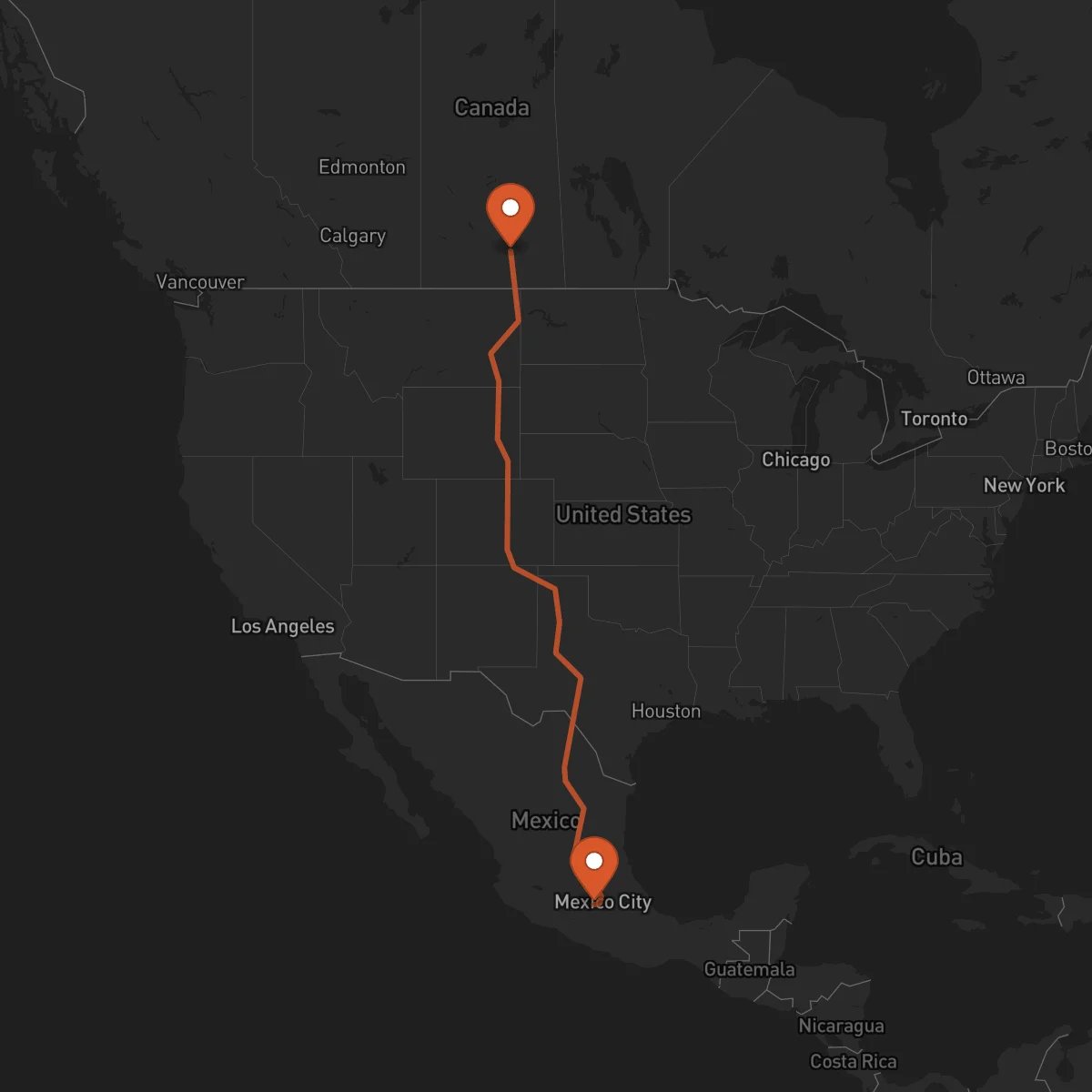
Toluca to Regina
Regina → TolucaFTL freight transportation service between Toluca and Regina. Reliable logistics solutions for your business.
Route Description
Everything you need to know about the corridor Toluca - Regina
The Toluca to Regina corridor represents a vital cross-border freight route connecting Mexico's industrial heartland with Canada's agricultural and energy powerhouse. This 3,493 km route traverses diverse economic regions, facilitating the movement of specialized cargo between North America's manufacturing and resource extraction sectors. The corridor leverages Mexico's strategic position as a manufacturing hub and Canada's role as a key supplier of agricultural products and energy resources.
The transportation infrastructure along this route includes Mexico's Federal Highway 15D connecting Toluca to the U.S. border, major interstate highways through the United States, and Canadian Highway 1 through Saskatchewan. Key border crossings include Laredo/Nuevo Laredo and Detroit/Windsor, depending on the specific routing. Control Terrestre's expertise in cross-border operations ensures seamless customs clearance and compliance with all regulatory requirements across three countries, providing dedicated FTL services that maintain cargo integrity throughout the journey.
Services for this Route
Available services for the corridor Toluca - Regina
 Origin
Toluca
Toluca serves as a strategic logistics hub in central Mexico, located just 64 km west of Mexico City. The city benefits from its proximity to major industrial centers and its well-developed transportation infrastructure, including the Toluca-Lerma Industrial Park and direct highway connections to the Mexican capital. Toluca's economy is driven by aerospace manufacturing, automotive components, food processing, and advanced manufacturing facilities. The Felipe Ángeles International Airport and extensive highway networks provide multimodal connectivity, making it an ideal origin point for cross-border freight operations.
 Destination
Regina
Regina, the capital of Saskatchewan, is strategically positioned in Canada's prairie region as a major distribution center for agricultural products, energy resources, and manufactured goods. The city's economy is anchored by agriculture, mining, and energy sectors, with significant activity in potash mining, oil and gas production, and grain processing. Regina's transportation infrastructure includes the Regina International Airport, extensive rail connections through Canadian National Railway, and major highways including the Trans-Canada Highway. The city's central location in Western Canada makes it a crucial node for distributing goods throughout the prairie provinces and beyond.










