Tegucigalpa to Cheyenne
Cheyenne → TegucigalpaFTL freight transportation service between Tegucigalpa and Cheyenne. Reliable logistics solutions for your business.
Route Description
Everything you need to know about the corridor Tegucigalpa - Cheyenne
The Tegucigalpa to Cheyenne corridor represents a vital North American trade link, connecting Central America's manufacturing heartland with the strategic interior of the United States. This cross-border route is essential for businesses requiring reliable, full truckload (FTL) movement of goods between Honduras and the Rocky Mountain region, facilitating economic integration across the continent. The corridor supports a dynamic flow of products, leveraging major highway networks to bridge diverse markets.
Economically, this route serves a robust industrial ecosystem. Honduras, particularly the Francisco Morazán department, is a hub for textile and apparel maquilas, agricultural exports (coffee, melons, shrimp), and increasingly, light manufacturing. Cheyenne, Wyoming, serves as a critical distribution and logistics gateway for the broader Mountain West, supporting agriculture (livestock, grains), energy sectors (mining, renewables), construction materials, and consumer goods distribution to a vast, landlocked region.
Primary industries utilizing this corridor include agricultural producers shipping perishable and bulk goods, manufacturers moving components and finished products, and distributors serving retail and industrial clients across Wyoming, Colorado, Nebraska, and the Dakotas. The transportation of specialized cargo, including refrigerated goods and oversized equipment, is also significant given the varied industrial base at both ends.
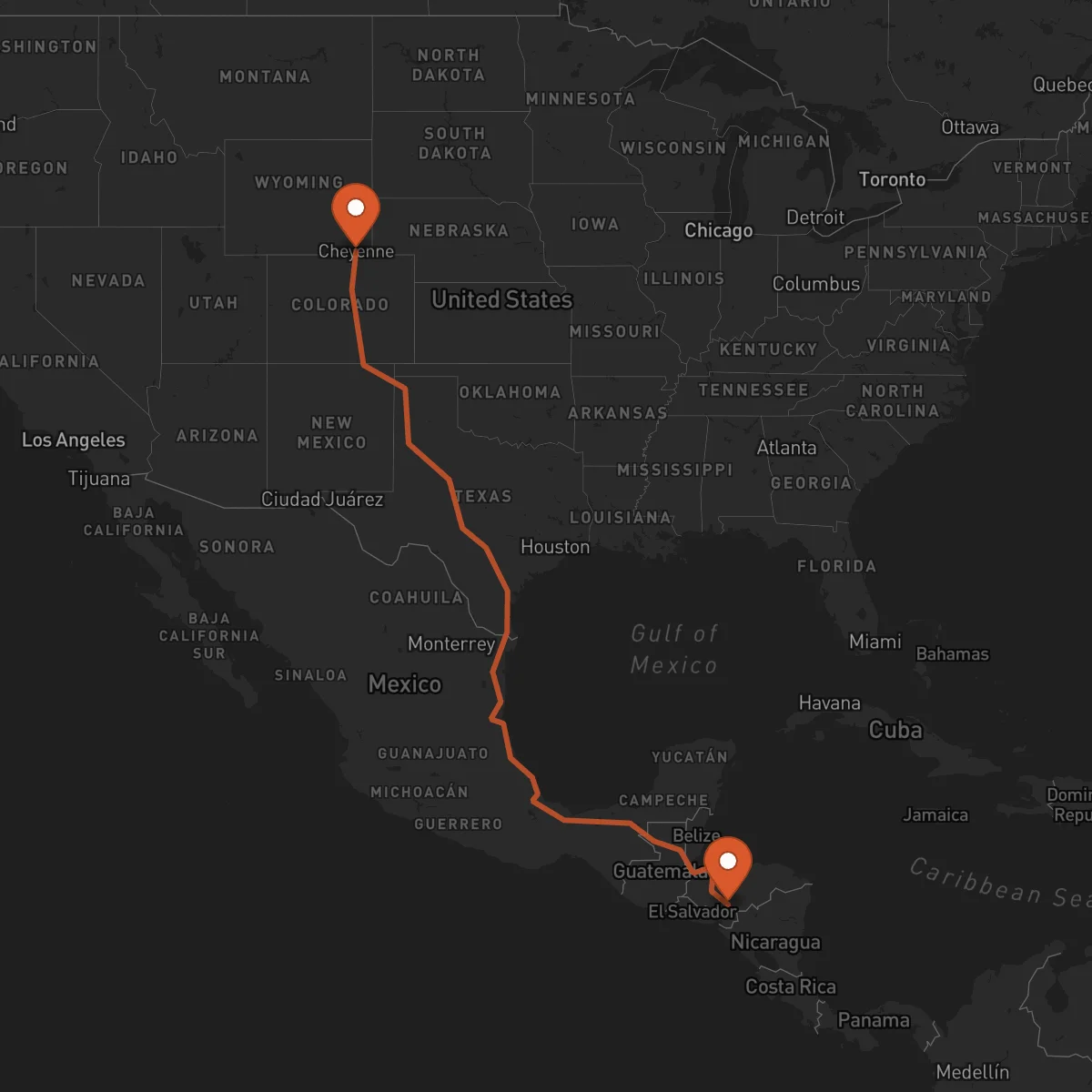
The route predominantly follows the CA-5 highway from Tegucigalpa to the Guatemalan border, continuing through Guatemala and Mexico via a network of federal highways (such as Mexico's Highway 190 and 85D) to key border crossings like Nuevo Laredo/El Paso. From the U.S. border, I-25 serves as the primary artery north through Texas, New Mexico, and into Wyoming, connecting directly to Cheyenne. Infrastructure quality varies by country, with well-maintained toll roads in Mexico complementing U.S. interstate highways.
Critical border crossings, such as those at Laredo/El Paso, are major points of commercial traffic. Efficient navigation requires expertise in customs documentation, compliance with programs like C-TPAT and FAST for expedited clearance, and an understanding of Mexican and U.S. regulations. Control Terrestre facilitates seamless operations on this corridor through our strategic alliance of certified providers. Our network includes carriers with C-TPAT, FAST, and BASC certifications, ensuring compliant and secure cross-border handling. We manage the full FTL journey—from origin pickup in Tegucigalpa through customs brokerage coordination to final delivery in Cheyenne—providing our clients with a single, human point of contact for this complex international route.
Services for this Route
Available services for the corridor Tegucigalpa - Cheyenne
 Origin
Tegucigalpa
Tegucigalpa, the capital of Honduras, is a pivotal logistics origin for Central American trade, strategically located in the Francisco Morazán valley. Its primary economic strength lies in being a major center for the maquila (assembly plant) industry, particularly textiles and apparel, alongside significant light manufacturing, food processing, and agricultural export operations. The city serves as a critical collection and distribution point for the country's interior, connecting agricultural regions to port facilities on the Caribbean and Pacific coasts.
Transportation infrastructure is anchored by the CA-5 highway, the main north-south artery of Honduras, which provides direct access to the Puerto Cortés seaport on the Caribbean coast and to border crossings with Guatemala and Nicaragua. While Toncontín International Airport handles air cargo, the vast majority of international freight, especially FTL shipments to the U.S., moves via this highway network to the border crossings. The city's industrial parks and distribution centers are well-positioned along this corridor, facilitating efficient truck loading and dispatch for long-haul international routes.
 Destination
Cheyenne
Cheyenne, Wyoming, is a strategically significant logistics destination at the crossroads of the American West. As the state capital and a key rail hub, it functions as a primary distribution center for Wyoming, northern Colorado, and the broader High Plains region. The local economy is deeply tied to agriculture (beef, grains), energy extraction (mining, oil, gas), and increasingly, technology and data centers. This creates consistent demand for inbound freight—moving construction materials, machinery, consumer goods, and specialized equipment—and outbound shipments of raw materials and finished products.
Infrastructure is defined by the intersection of Interstate 25 (the north-south corridor from New Mexico to Montana) and Interstate 80 (the transcontinental east-west route). This junction makes Cheyenne an ideal consolidation and deconsolidation point. The city is also served by a major Union Pacific rail yard, offering intermodal options. For FTL trucking, I-25 provides the direct link from the southern border, while I-80 enables efficient east-west distribution. The Cheyenne regional airport supports time-sensitive air cargo, complementing the dominant ground transportation network.


Ready to ship your cargo?
Get a personalized quote for your freight.
Quote Now Tegucigalpa - Cheyenne








