Santa Fe to Toronto
Toronto → Santa FeFTL freight transportation service between Santa Fe and Toronto. Reliable logistics solutions for your business.
Route Description
Everything you need to know about the corridor Santa Fe - Toronto
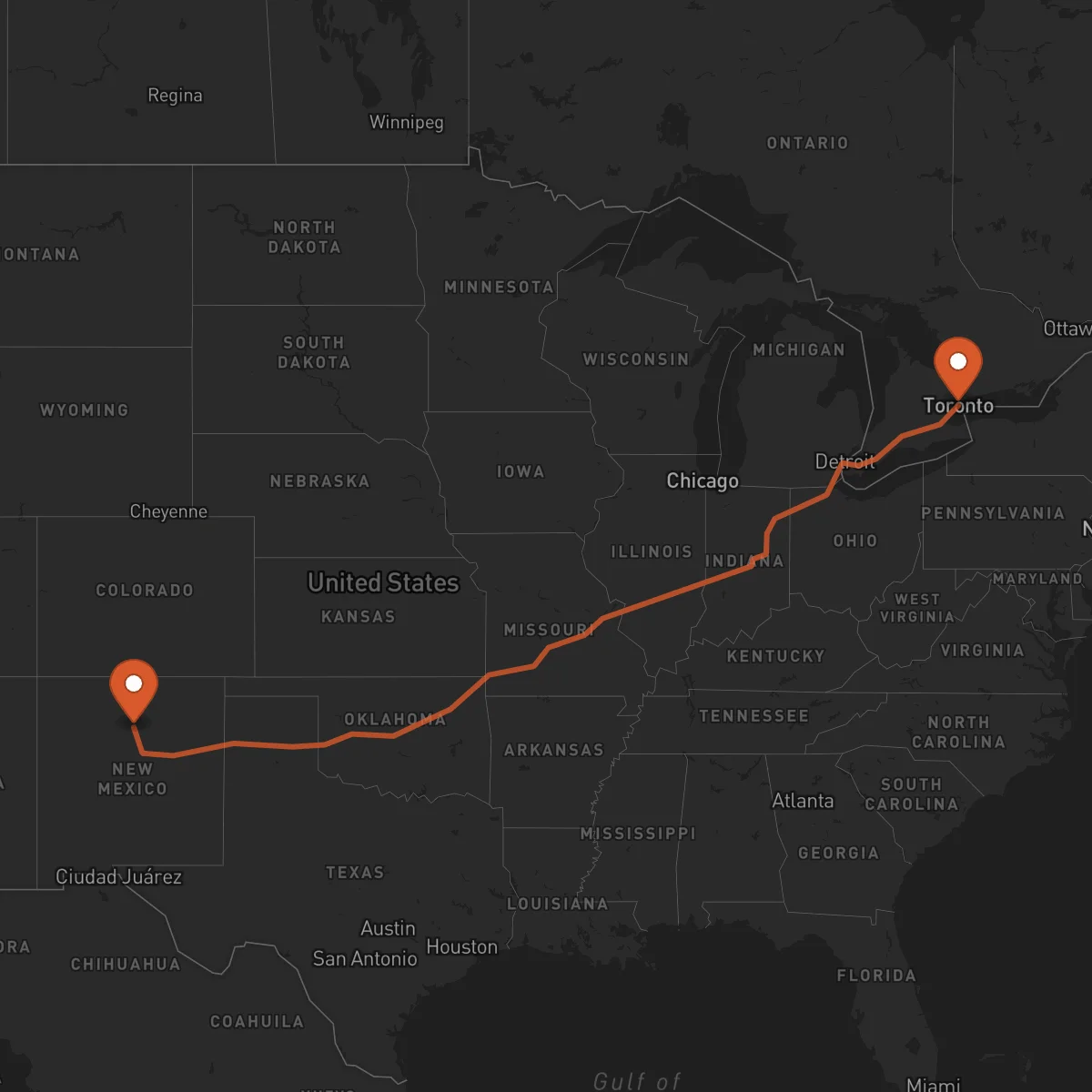
The Santa Fe to Toronto corridor represents a vital logistics connection between the southwestern United States and Canada's largest economic center. This cross-border route spans approximately 2,426 kilometers, traversing diverse terrain and connecting two major industrial regions. The corridor facilitates the movement of goods between New Mexico's growing manufacturing and technology sectors and Toronto's extensive distribution networks, serving as a critical link in North American supply chains.
The route primarily utilizes major transportation arteries including I-25 North from Santa Fe, transitioning to I-29 and I-94 through the Midwest before connecting to Ontario's highway system. Key border crossings such as the Blue Water Bridge near Port Huron provide efficient customs clearance for freight moving between the two countries. This infrastructure supports the corridor's role in handling diverse cargo types, from industrial equipment and automotive parts to consumer goods and agricultural products.
Control Terrestre's expertise in cross-border operations ensures seamless freight movement along this corridor. Our C-TPAT-certified carriers and experienced logistics team navigate customs requirements, coordinate documentation, and provide real-time tracking throughout the journey. We understand the unique challenges of this route, including seasonal weather variations and regulatory compliance, allowing us to deliver reliable full truckload (FTL) transportation services that keep your supply chain moving efficiently between Santa Fe and Toronto.
Services for this Route
Available services for the corridor Santa Fe - Toronto
 Origin
Santa Fe
Santa Fe, New Mexico serves as a strategic logistics hub with its unique position in the southwestern United States. The city benefits from proximity to major transportation routes including I-25, which connects to the broader interstate network, and its location near key industrial centers in New Mexico and neighboring states. Santa Fe's logistics infrastructure includes access to rail connections and regional airports, supporting diverse freight movement options for businesses in the area.
The region's economy features strong representation in technology, aerospace, renewable energy, and advanced manufacturing sectors. These industries generate consistent demand for reliable freight transportation services, particularly for specialized cargo and time-sensitive shipments. Santa Fe's growing business community, combined with its role as a distribution point for the broader Southwest region, makes it an important origin point for cross-border freight movements to Canada and beyond.
 Destination
Toronto, Ontario stands as Canada's premier logistics and economic center, offering unparalleled access to North American markets. The city's strategic location on Lake Ontario provides multimodal transportation options, including one of North America's busiest airports, extensive rail networks, and major highway connections. Toronto's logistics infrastructure encompasses modern warehousing facilities, advanced distribution centers, and efficient last-mile delivery networks that support its role as a major freight destination.
The Toronto metropolitan area hosts a diverse industrial base, with particular strength in automotive manufacturing, technology, financial services, and consumer goods production. These sectors create substantial demand for inbound freight transportation, especially from U.S. suppliers and manufacturing centers. The city's position as Canada's financial capital and its proximity to the U.S. border make it a critical node in cross-border supply chains, requiring sophisticated logistics solutions to manage the high volume of commercial freight moving through the region.










