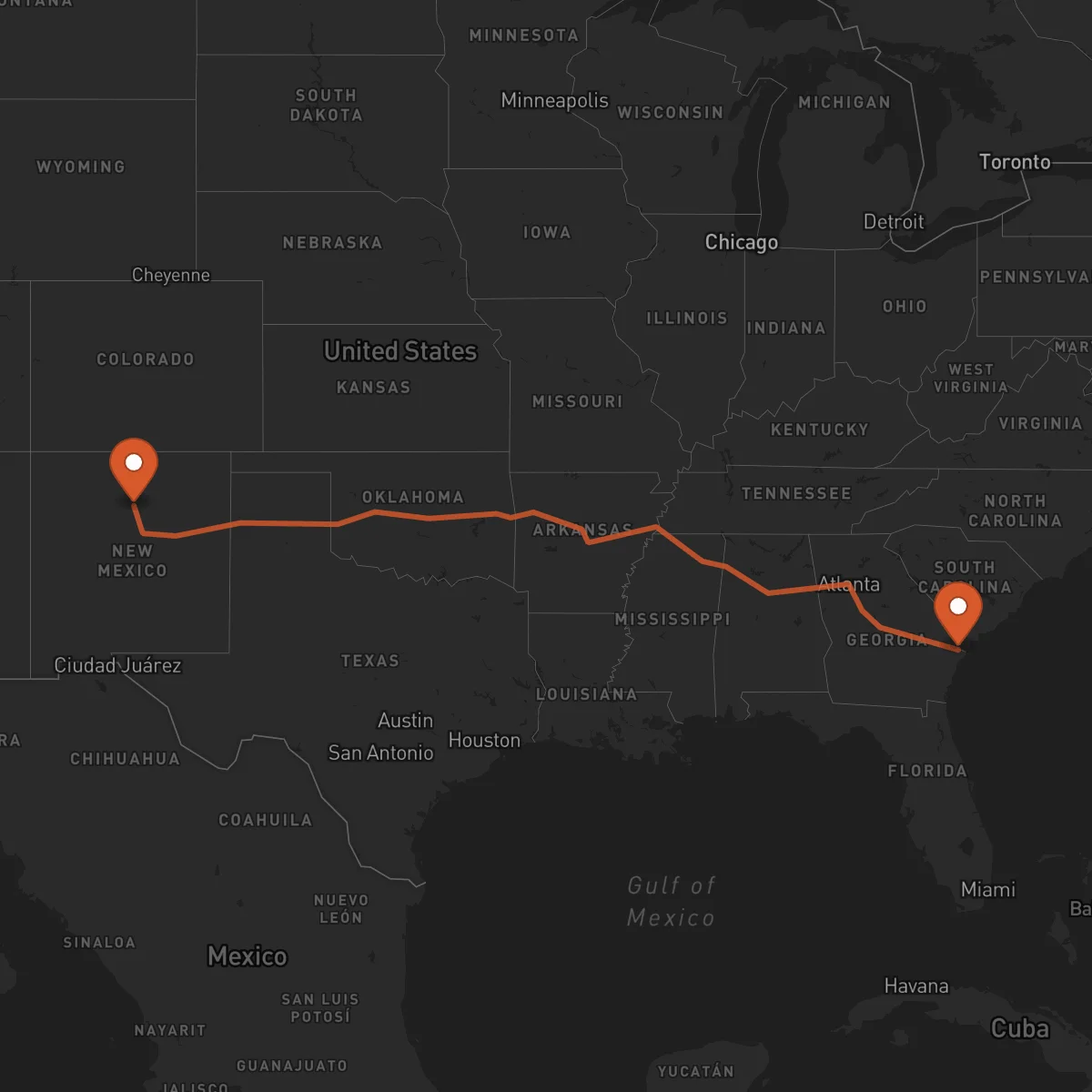
Santa Fe to Savannah
Savannah → Santa FeFTL freight transportation service between Santa Fe and Savannah. Reliable logistics solutions for your business.
Route Description
Everything you need to know about the corridor Santa Fe - Savannah
The logistics corridor between Santa Fe, New Mexico, and Savannah, Georgia, spans approximately 2,322 kilometers, connecting the southwestern United States with the southeastern Atlantic coast. This transcontinental route traverses diverse landscapes and crosses multiple state lines, making it a vital link for freight movement between these two strategic regions. The corridor facilitates the flow of goods from the Rocky Mountain region to one of the busiest ports on the East Coast, supporting both domestic distribution and international trade.
The economic significance of this corridor is substantial, as it connects Santa Fe's growing technology and cultural sectors with Savannah's thriving port economy and manufacturing industries. Santa Fe serves as a hub for high-tech industries, renewable energy, and tourism, while Savannah benefits from its status as a major seaport, logistics center, and manufacturing powerhouse. The corridor supports industries including aerospace, automotive, electronics, and agricultural products, enabling businesses to efficiently move goods across the country.
Transportation infrastructure along this route includes major interstate highways such as I-25, I-40, I-85, and I-95, providing reliable and efficient freight movement. Control Terrestre specializes in full truckload (FTL) transportation along this corridor, offering dedicated services with certified carriers who understand the complexities of cross-country logistics. Our strategic partnerships with C-TPAT-certified carriers ensure secure, timely, and compliant freight transportation from Santa Fe to Savannah, supporting your supply chain needs with professional expertise and reliable equipment.
Services for this Route
Available services for the corridor Santa Fe - Savannah
 Origin
Santa Fe
Santa Fe, New Mexico, serves as a strategic logistics hub in the southwestern United States, positioned at the intersection of major transportation routes connecting the Rocky Mountain region with the rest of the country. The city's elevation and location provide unique advantages for freight distribution, particularly for goods moving between the Mountain West and other regions. Santa Fe's growing technology sector, including aerospace and renewable energy industries, generates consistent freight demand, while its proximity to major highways like I-25 facilitates efficient outbound logistics.
The region's economic diversity includes tourism, government services, and emerging tech industries, all contributing to steady freight volumes. Santa Fe's transportation infrastructure includes access to I-25 for north-south movement and connections to I-40 for east-west distribution. The city's logistics ecosystem benefits from its relatively uncongested roadways compared to larger metropolitan areas, allowing for more predictable transit times and reliable freight operations.
 Destination
Savannah
Savannah, Georgia, stands as one of the most important logistics hubs on the East Coast, anchored by the Port of Savannah, which ranks among the busiest container ports in the United States. The city's strategic Atlantic location provides direct access to international shipping lanes and serves as a gateway for imports and exports to and from Europe, Asia, and Latin America. Savannah's extensive intermodal facilities, including rail connections and trucking infrastructure, create a seamless logistics network that supports both domestic and international freight movement.
The region's economy thrives on manufacturing, particularly in automotive, aerospace, and food processing industries, generating substantial freight demand. Savannah's transportation infrastructure includes major highways such as I-16 and I-95, providing excellent connectivity to the southeastern United States and beyond. The city's logistics advantages include the Georgia Ports Authority's extensive facilities, Class I rail service, and a concentration of warehousing and distribution centers that support efficient freight handling and storage.










